9 minutes ago
Muhamet Alidaj sentenced to 15 years in Izbica war crimes

Periskopi(2 years ago)
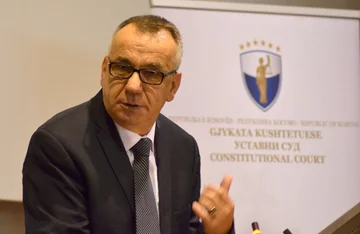
(2 years ago)The Constitutional Court in Pristina has found Muhamet Alidaj guilty and sentenced him to 15 years in prison for war crimes during 1999 in Izbica. According to the indictment, Alidemaj had joined members of Serbian police and military forces in killing Albanian civilians in the Izbica massacre that had occurred in March [...]
According to the indictment, Alidemaj had participated along with members of Serbian police and military forces in the murder of Albanian civilians in the Izbica massacre that had occurred in March 1999, where 130 Albanians had been killed and massacred, reports the “Justice Trust”.
The trial against Alidemaj was proclaimed Friday by Judge Vesel Ismaili, who said that in the prison sentence, the same time spent in detention will be calculated.
Also, accused Alidemaj continues the detention measure to the full extent of the act, but no more than the pronounced sentence.
On the other hand, he was pronounced a rejection of the other work - the damage to the corpses, since in the final address at the July 9, 2024 session, prosecutor Ilir Morina withdrew from the second point of the indictment device because he had failed to prove that the accused Alidaj had participated in the exhumation of the victims.
Otherwise, according to the indictment compiled on March 29, 2022, Muhamet Alidaj during March 24, 1999, during the armed conflict in Kosovo, as a member of Serbian police and military forces, along with other members of Serbian police and military forces, violently divide women and children and violently force them to head towards Albania.
While the indictment says that the remaining men are executed with automatic weapons, killing 130 people, of whom 114 victims were identified, while 12 civilians survived execution. After two months, they reportedly exhumed their bodies and drove them out with a few trucks in the unknown direction.
While, after the war ended the victims' bodies were found in mass cemetery in Batajnica, Serbia, in the village of Suhodol in Mitrovica, and in the village of Novovan in Vushtrri.
With this, it was charged that, in co-ordination, the criminal work was carried out by “the crime crime process against the civil population”, sanctioned by Article 142 concerning Article 22 of Yugoslavia's Criminal Law, as a law in force at the time of the conduct of the criminal work, currently sanctioned according to the criminal act “the violations of the war in serious violation of Article 3 for the Geneva <x3) conventions, by Article 146, concerning the 31st Code of the Republic of Kosovo.