2 minutes ago
From Kamenica to U.S.A., girls investigating early cancer detection
Periskopi(2 years ago)
(2 years ago)A lemon changed the life of Esma Fera from the village of Karacheva and Downtown Kamenica. Curiosity on molecules, DNA, genetics, had prompted him to do an experiment in this tree at home, with the tools that the biology professor had given him. The success of this experiment, which Esma did most [...]
A lemon changed the life of Esma Fera from the village of Karacheva and Downtown Kamenica.
Curiosity on molecules, DNA, genetics, had prompted him to do an experiment in this tree at home, with the tools that the biology professor had given him.
The success of this experiment, which Esma did in 2019, as an 11th-grader, convinced her passion for molecules and genetics, she had to continue in a state developed as the United States.
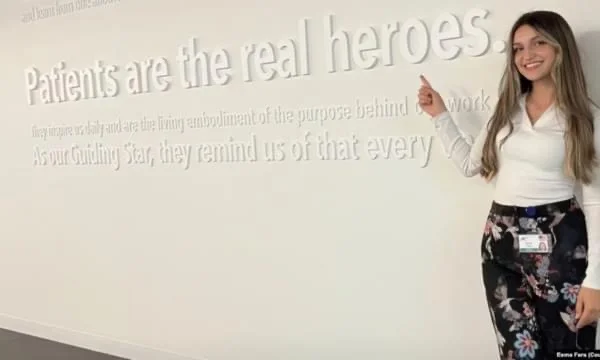
Today, Esma is in the fourth year of molecular biology studies at New Haven University in Connecticut State, and is a researcher for early ovaries cancer detection at prestigious American University, Yale, writes Radio Free Europe
The experiment involved the isolation of DNA in lemon fruit.
“ (After the experiment) it has been an indescribable feeling because what we learned in the classroom finally began to make sense in real life. This has made me realize that if I continue to study something related to biology in Kosovo, it would be very difficult to have this kind of access to science”, she says.
According to her, the school offered her no opportunity to follow her passions.
Even though I was in 11th grade I started reading university literature books about genetics. I read about different experiments in genetics, but we haven't been able to do it since the lab. So, I've looked at YouTube”, Esma says.
The dream is followed in the United States for four years now, thanks to various scholarships, aid from her family, donations and work.
She acknowledges the biggest challenge for her has been “belonging to a completely new academic system”.
I've been impressed by the education system and the professor-in-a-kind student connection. Here, professors are the best mentors if the student wants to have a very successful career, and they're mentoring it not only during professional and academic development, but even after they do it”, says Esma Fera.
It was thanks to the Mentor-student connection that Esma had joined her professor, and under a program at Yale University, she had become part of the team that researched the early detection of ovarian cancer.
The “Puna we do in Yale is detecting specific genes that have a very important role in detecting this cancer, and we've already discovered a gene and we're doing different experiments to collect data and we hope to publish the article”, she says.
Esma's day begins early when it is predating for speeches. After the lectures, Esma holds hours in the role of assistant to molecular biology. He spends the rest in the lab, as he dedicates the evening to tasks, studies, and projects.
The educational system here causes students to be engaged all the time, and when you have other commitments like work and scientific research, time management should be at a high level”, she says.
Researching cancer is not easy, she says, but the cause is greater than the challenge.
The science we do is definitely something very interesting, it's not something we do every day, but every day it explores different things. It's obviously very challenging, but knowing what the contribution is, it's phenomenal”, she says.
Thousands of miles from the family, Esma says that she often misses her parents.
It was something I didn't expect, which would be so hard. But now, in the fourth year, I know how to balance myself. When you're busy with many studies, even with a lot of work, you don't think, but you still have something to do. But when the weekend or spring break comes, then it's a little more difficult, because you see that everyone goes to family”, Esma relates.
She is convinced that her success is not only her own, but is also the result of the work and support of parents, who she says were the greatest “support”:
I believe that they are pleased that our joint efforts are being rewarded. Especially, they feel thrilled that I have the opportunity to make an important contribution to the global level in science field”.
The knowledge she has received from studies in New Haven, practice at the pharmaceutical company AstraZeneca and the research in Yale, Esma one day plans to bring it to Kosovo.
I plan to get a work experience, then develop doctorate studies in America, but the idea is always to go back to Kosovo. Co-operation is lacking in Kosovo between the hospital, university and students, and I think it should be connected. Whoever links it, I don't know yet, but I'll be very happy to be part of it”, she says.
For young people who want to do scientific research, she orders that they should not give up even if results sometimes do not turn out the way we expect.
In science not always get the results we expect, not forget to investigate is to create new knowledge, because what you explore is not yet known to the public. Therefore, it is not easy to learn, science has challenges. You can do a research project and not get results, but you can't stop. You need to know how much you're making in the world with what you're doing, and that's not something you need to forget”, she points out. / REL/