4 minutes ago
Havenier: Government needs to make some difficult decisions. What we're looking for is good for Kosovo.
Periskopi(2 years ago)
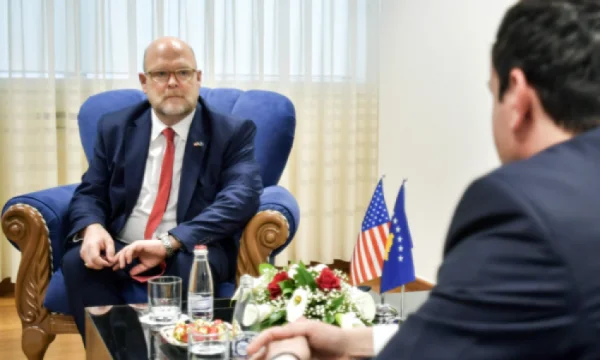
(2 years ago)US Ambassador to Pristina Jeffrey Havenier has stated last night that Kosovo can progress only with the help of the United States, taking into account its concerns. Hovenier said it is comfortable with what the US is looking for from Kosovo, since it is in the country's best interests. Havenier said it's no secret that [...]
US Ambassador to Pristina Jeffrey Havenier has stated last night that Kosovo can progress only with the help of the United States, taking into account its concerns. Hovenier said it is comfortable with what the US is looking for from Kosovo, since it is in the country's best interests.
Hovenier said it is no secret that they have faced challenges with some of the government's political decisions, Kurti, adding that the government must make difficult decisions.
“I feel very comfortable with what the United States is asking from Kosovo, as what we are asking from Kosovo is in Kosovo's best interests. The government must make some difficult decisions. We seek to do a better job by showing sensitivity to the concerns of minority communities. We're looking to work more efficiently with countries and organisms that will help it achieve those goals. What we're looking for is less unilateral action and more co-operation”, has declared Havenier in an interview for the Voice of America.
The American ambassador said he does not think there will ever be a moment when the United States government and Americans will not support people and Kosovo, but that does not mean that the government can do whatever it wants.
I don't think there will ever be a moment when the United States government and Americans will not support the people and the Kosovo project. It's part of our DNA. It is said that Kosovo is the most pro-American country in the world, but I think the United States is the most pro-Kosovo country in the world as well. But that does not mean that a certain government can do what it wants. It does not mean that a certain government can make political decisions that we believe to undermine what we are trying to achieve together, which is integration into European and Euro-Atlantic structures, approach to EU membership, NATO membership, membership in the Council of Europe”, has declared Havener.
Total interview:
The relationship between the United States and Kosovo is at the lowest point ever. The United States has questioned whether the Kosovo government is their partner and you have said that Kosovo authorities have ignored the advice and requirements of the United States, damaging the quality of relations between the two countries? How is the situation currently presented?
Jeff Havenier: Thank you for the question because it gives me the opportunity to explain how the situation is, because I think there are sometimes misunderstandings and I want to be as clear as possible. The United States is just as devoted to Kosovo, to the people of Kosovo and the state of Kosovo as we have always been. Next week we will mark together the 25th anniversary of NATO forces' entry. The United States played a very important role together with our partners and allies to end Milosevic's ethnic cleansing campaign in support of the people of Kosovo, while determining its path and we are very proud to have supported it in this direction.
It's no secret, it's no mystery, that we've faced challenges with some of the political decisions of the Kurti government. I've talked a lot about this. But we also have some other important areas of cooperation. We worked hard in terms of energy. The Kosovo government has adopted the new energy strategy, which is very ambitious, aimed at achieving (capacity) 30 percent of green energy by 2030. We are pleased to have supported drafting that strategy, we are satisfied with the MCC agreement through which the United States provides $202m and the Kosovo government will provide over $30m for the programme. We had good co-operation in the area of rule of law.
Disagreements deal with the issue of what is the best way to fulfill the vision of a multiethnic state, how best to protect minority communities in Kosovo, and how to give them the best answer to their concerns. When we supported Kosovo's independence, which we are proud of, we did it on the basis of a common idea for a sovereign, democratic and multiethnic state, and over the years we have worked with Kosovo authorities to advance this vision and will continue to do so.
We have been waiting for the Kosovo government to work closely with us to address the concerns of Serbian citizens (living in Kosovo) because they have the right to enjoy living conditions, dignity and security like all other Kosovo citizens and how to do so in a form that respects them and advance the common vision for a sovereign, multiethnic and democratic state. That's what we're trying to work together at, and we're looking for greater government cooperation.
Let's talk about the latest developments. You have just reacted against the government's move to finalise the deproportion of the lands in Serb majority municipalities in the northern part of Kosovo. This comes after criticism of the government for the decision to ban the use of the dinar, as well as refusal to take concrete steps to establish association. What are the foundations of your concerns?
Jeff Havenier: Differences do not concern the legal side of actions, but the way the law is being implemented. I want to illustrate it with two examples. On the issue of expropriation, no one disputes that the government has the authority to conduct land expropriation. But in all democratic societies, expropriation of land taking over land because of government needs for that land, despite the opposition of owners, is something that becomes like a last resort, something that is done in extreme circumstances. When that happens in the northern part of Kosovo, where tensions are already high and where citizens have doubts whether the government is really acting in their interest, community sensibilities should be taken into account in particular. It takes maximum communication efforts and a full commitment to the community in a form that leaves no room for misunderstandings, with attention for every detail. In the United States, the judicial system faces numerous issues from people who dispute government actions to expropriate lands. It's sensitive, people love their property. In the case in question, as our joint statement, not only of the United States, says but of all states of Quintus, the European Union as institution and mission of O The SEU in Kosovo, none of us dispute the legality of the government's move to expropriate land, but we have reservations about how this action is taking place. We have had some discussions with the Government of Kosovo about interpretation of the law and the fact that we do not think all legal criteria have been met.
We have expressed our concerns about how the government is engaged with communities affected by this decision and have expressed our disappointment that our counsel has not been taken into account.
The same is true of the Central Bank's decision. We do not object to ʹ I have said several times publicly that the Kosovo Central Bank has legal competencies, right and responsibility to impose rules for financial institutions and financial issues throughout the sovereign territory of the Republic of Kosovo, which includes the northern part of Kosovo. But the way this decision has been applied disturbed us. It was rushed, unannounced. When change was made in circulation with the euro in Kosovo, people had a whole year to prepare. In this case, there are communities in Kosovo whose lives we believe are provided by pensions or social scheme benefits and the way it was done, from our perspective, was without considering this issue enough so that the exposed community, endangered people, still have the financial support on which they rely. So we did not contest legitimacy, we do not challenge Kosovo's right to say that the currency that we use according to the law in Kosovo is euro, that is the decision of the sovereign authorities of Kosovo. We wanted the government to work with us on how to do this. We offered our expertise and support to do so in a form that provided helpful information to those affected by this decision, to consider the negative consequences of the decision, to avoid them, and to be done in a way that could support them.
We want to be the most powerful supporter of the Kosovo government of Kosovo residents. We want to see Kosovo advance into European and Euro-Atlantic structures. We want to see Kosovo in NATO and the European Union, in the Council of Europe. But to help Kosovo achieve these goals, we want the government to intervene actions that respond to the concerns we have raised, which advance these goals, which are in line with the pledges Kosovo has made in the dialogue. These are the ones we expect and part of what we believe is recently missing.
How can this relationship be overcome?
Jeff Havenier: I don't think there will ever be a moment when the United States government and Americans will not support the people and the Kosovo project. It's part of our DNA. It is said that Kosovo is the most pro-American country in the world, but I think the United States is the most pro-Kosovo country in the world as well. But that does not mean that a certain government can do what it wants. It does not mean that a certain government can make political decisions that we believe to undermine what we are trying to achieve together, which is integration into European and Euro-Atlantic structures, approach towards EU membership, NATO membership, membership in the Council of Europe.
Meanwhile, Kosovo's prime minister says he is implementing rule of law and recently said the international community is putting unjustified pressure on him. What's your answer?
Jeff Havenier: I feel very comfortable with what the United States is looking for from Kosovo, as what we are looking for from Kosovo is in Kosovo's best interests.
The government must make some difficult decisions. We seek to do a better job by showing sensitivity to the concerns of minority communities. We're looking to work more efficiently with countries and organisms that will help it achieve those goals. What we are looking for is less unilateral acts and more co-operation.
One of the requirements to the Government of Kosovo is to take concrete steps to establish association. Kosovo's leaders from all over the political spectrum seem to be uncomfortable with the creation of association while fearing a repeat of the Bosnian scenario, referring to the risk of deregulation it is experiencing. Why do you think such an approach would work in Kosovo?
Jeff Havenier: Pass is not the same approach. I want to be very clear about this. There is no link between the Republika Srpska and its competencies and structures and what we are proposing with the Association of Serb majority municipalities. It is a false parallel, and we have made this clear in many ways.
We are very clear that we do not want an association that has the authority, structures or competencies of Republika Srpska at all. We have made it clear that the association must be in accordance with the current Constitution. We have made it clear that there will be no competence or executive authority. We have made it clear that it should not influence the order of the functioning of the Kosovo state. We have made it clear that it should create the possibility for these Serb majority municipalities to co-ordinate with each other for exercising the competencies and municipal responsibilities they meet under the current Kosovo Constitution in some areas, such as health, education and other. And I say again, I'm very comfortable with this demand that is being made not only by the United States but by the European Union, all of the countries of Quintus, of all the states and institutions on which Kosovo is based and where it needs to rely to achieve its vision of European integration. We're hoping to see progress.
But how do you see the fact that Serbia has not fulfilled its obligations coming out of this agreement?
Jeff Havenier: My job is Kosovo, not Serbia. My focus is on Kosovo meeting its obligations regardless of what Serbia does or does not do. Kosovo can progress only with us, and with us it means that it should be sensitive to our concerns. If Kosovo fulfils its obligations, it will advance. If you hesitate to fulfill your obligations, it will be blocked. Kosovo's path towards the future is through implementation of these obligations. The requirements we are making for Kosovo to meet obligations from the basic agreement are in favour of Kosovo, helping the state to be more efficient and responsible for concerns of a part of its citizens.
Does it not concern you that the entire political spectrum in Kosovo has reservations for the creation of association?
Jeff Havenier: I understand in view of history that there are concerns about the possibility of a quasi-state or a pre-state or a political entity, but that's why we've worked so hard to have a draft and structure that avoids it. I say with confidence that if this draft status that the European Union presented with the support of the United States, Germany, France and Italy went to the Constitutional Court, it would determine that it conforms to the Constitution of Kosovo. This is an issue the Court must decide about not us, and of course we will all respect the Court's decision whoever it is. But I hope that this will solve this concern, since it is clear that (the association) does not change the Constitution, since it is clear that it does not create another political entity with authority and executive competence, there is no reason for concern.
There has been criticism that the United States is following a policy of making concessions to Serbia, which continues to maintain strong relations with Russia and China. For this reason some analysts have indicated that Kosovo is facing unfair pressure from the West. How do you respond to such criticism?
Jeff Havenier: I think I answered. No matter what is happening with Serbia, what we are asking from Kosovo are issues Kosovo has already pledged to realise and benefit Kosovo. We are not doing this because of concerns for Serbia. We are doing it because we want to see Kosovo advance. Kosovo's path towards membership in the European Union is through full implementation of obligations stemming from dialogue. Kosovo's road to approaching NATO, which we will be effective lawyers to NATO member states that have not recognised Kosovo, is through full implementation of all its obligations derived from dialogue, including the basic agreement. As my European colleagues have made clear, the United States does not have a vote in the Council of Europe, but Kosovo's path to membership in the Council of Europe is through the implementation of some of those obligations. I don't see this as anything more than well intentioned efforts to support Kosovo to achieve what we all intend to accomplish and which is integration into Europe. I'm proud of that and I don't apologize. I think it's the right thing.
And one last point I want to highlight, I want to underline another way in which we have supported the people of Kosovo. We have done this through the development of the Kosovo Security Force. Our vision is very clear. An interactive force with NATO, multiethnic, with territorial defence missions, with civil oversight with democratic legitimacy. The United States has made many investments, millions of dollars in training, its equipment, among other things, as another sign of our support because we see Kosovo in the future as NATO allies, as partners with whom we have carried out missions abroad. We have already served together with Kosovo on peacekeeping mission in the Middle East. We want to see more such commitments, which means membership in these European structures, which then relates to the need for full implementation of obligations from the basic agreement. And even though Serbia is not my job, we have the same requirements towards Serbia. We also expect Serbia to fulfil all obligations from the basic agreement and that come out of the dialogue. I can't talk about the consequences, it's Ambassador Hill's job, but we're clear about our expectations on all sides. Apply all your obligations that come out of the dialogue. By doing so, you provide the best future for your peoples and countries.