5 minutes ago
A year of violence in Zvecan: Until the judiciary is silent, what is known so far?
Periskopi(2 years ago)
(2 years ago)A year after the violence in Zvecan and the attack on NATO mission members in Kosovo, KFOR, justice is still pending collection of all facts. Kosovo Special Prosecutor and the Constitutional Court in Pristina did not answer Radio Free Europe's question of how far the prosecution of authors has achieved [...]
Kosovo Special Prosecutor and the Constitutional Court in Pristina did not answer Radio Free Europe's question of how far the prosecution of alleged authors has achieved.
What is now known is that about ten people were arrested, most of whom were released for freedom. Four were charged, but two were acquitted of assaulting KFOR. And two citizens of Serbia were expelled from Kosovo after their six-month prison sentence was replaced by fines.
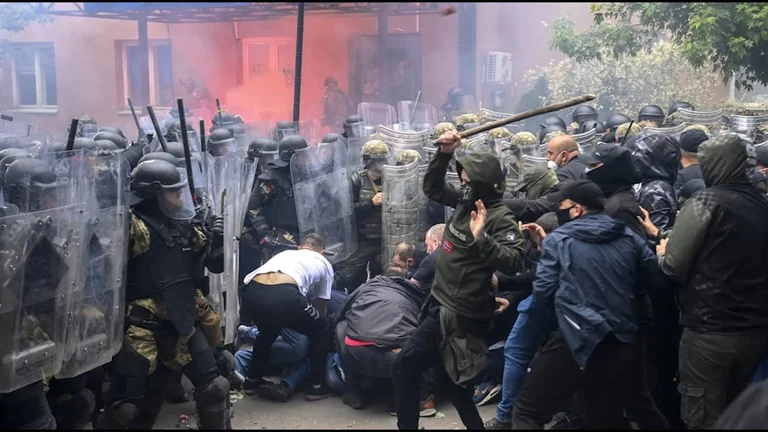
Violence occurred on May 29th last year, during the protest of several Serbian citizens who opposed the entry of Albanian mayors into majority Serb municipalities in northern Kosovo.
On the anniversary of this event, in which 93 KFOR soldiers who were deployed before the Zvecan municipality were seriously and easily injured, NATO says all facts must be collected and the authors held accountable.
The statement gave Radio Free Europe also says that “KFOR is not competent to enforce the law” and that “Pristina and Belgrade have been asked to conduct necessary legal investigations, prove the facts and bring those responsible to justice”.
Similar messages were delivered earlier by KFOR Commander Ozkan Ulutasch, stressing that the attack on NATO soldiers last year, “was unprotested and totally unacceptable”.
Ulutash said KFOR has increased its capacity by about 1,000 soldiers and that it has tripled the number of patrols in northern Kosovo municipalities and around the border with Serbia.
REL asked the High Public Prosecutor in Belgrade whether he is investigating the attack on KFOR soldiers in northern Kosovo and whether procedures have been initiated against individuals who have participated in it and are on Serbia's territory. But until the publication of this article, there was no answer.
What happened May 29th?
The clashes between KFOR soldiers and Serbs in Zvecan preceded increasing tensions on May 26th, when groups of local Serbs gathered in front of municipal objects in northern Kosovo to oppose the entry of new Albanian mayors into them.
Albanian leaders took power after the Serb majority in the four municipalities in northern Kosovo -- northern Mitrovica, Zvecan, Zubin Potok and Leposaviq -- boycotted local elections at the invitation of the Serbian List, the largest Serb party in Kosovo, which has the backing of official Belgrade.
On May 29th, it was representatives of the Serbian List who negotiated for several hours with KFOR, which called for the withdrawal of demonstrators who had surrounded a convoy of Kosovo Special Police members.
The negotiations ended without success and then the clashes broke out, which resulted in more than 100 people injured on both sides.
Among Serb demonstrators were those wearing masks on their faces, who later clashed with KFOR soldiers, using shock-bambas, Molotov cocktails and other hardies.
What did Kosovo do?
Kosovo's special prosecutor announced 5 February of this year that he has filed charges against two Serbs from Kosovo, with initials R.P. and D.O., for criminal work “participation in the crowd that committed criminal or hooliganism”.
It is Rados Petrovijcin and Dusan Obrenovqi, who were arrested on May 29th last year in Zvecan, during Serb protesters' clashes with KFOR.
Lawyer Asdren Hoxha says they were released, following the agreement with the prosecution to plead guilty to “for participation in a crowd that committed criminal or hooliganism”.
Otherwise, they were sentenced to six months in prison for measures that in Petrovic's case became fines, while Obrenovics was counted six-month detention.
Hoxha adds that, earlier, three criminal acts were dismissed with which they were charged: “coupled with the aim of unconstitutional action and assaulting the constitutional order of the Republic of Kosovo, endangering persons under international protection and assaulting officials”.
In July 2023, the indictment also rose against two citizens of Serbia with the initials S.J. and I.S., under suspicion of “participating in violent protests” and “possession without permission”.
The Kosovo prosecution said at the time that S.J. and I.S. “prepared actions to cause general danger” and that they were in contact with “violent Serbian sponsors” who clashed with KFOR soldiers in front of the municipal building in Zvecan, May 29th last year.
In August 2023, they were sentenced to six months in prison with the possibility of replacing the penalty action. For both of them, money was deposited and then expelled from Kosovo, with a three-year ban on entry.
Kosovo's Minister of Internal Affairs, Xhelal Svecla, identified Milun Milenkovici yaune, who was arrested on June 13th, 2023, as one of the leaders of “violent sponsors” and organiser of the attack on KFOR.
Milenkovic is still in custody, but no charges have been filed against him yet for the attack on KFOR.
He and three other members of the Serb community went on trial at the beginning of the year, on the basis of the indictment for “terrorism <x0vepth”, respectively, for attacking the Central Election Commission's object in Northern Mitrovica in December 2022.
While local Serbs in northern Mitrovica held protests due to Milenkovic's arrest, Minister Svecla said he is “one of the leaders of the civil protection formation and the leader of criminal groups, which for years have terrorised citizens, have attacked Kosovo Police members and the institutions of the Republic of Kosovo”.
Besides Milenkovic, Kosovo authorities blamed other members of organisations “Civil Protection” and “North Brigade” for the attack on KFOR.
After riots in Zvecan, Kosovo declared them Terrorist organizations.
Kosovo officials, on several occasions, have claimed that official Belgrade finances these organisations and that they are close even to Serbia's president, Aleksandar Vuciq.
Serbia, however, has denied these accusations and Vucic has held Kosovo Prime Minister Albin Kurti responsible, saying that “has largely been concurrent with the conflict between Serbs and NATO”.
“International Union pressure Serbia to co-operate with Kosovo”
Ehat Miftaraj, from the Kosovo Institute for Justice, believes the Kosovo Prosecution, in line with the situation in the north, has taken appropriate and effective action for prosecuting the attackers of KFOR members, as well as journalists reporting the crisis.
However, he adds, there is lack of co-operation with Serbia for the arrest and extradition of those who have committed criminal acts on Kosovo territory and are not available to the responsible institutions.
Unfortunately, Serbia has become a security haven for criminals who committed crimes in Kosovo, providing them with full institutional impunity”, Miftaraj tells Radio Free Europe.
He adds that Kosovo institutions should boost co-operation and co-ordination with KFOR and international partners when it comes to actions in northern Kosovo, and thus build confidence among the majority Serb population there.
In addition, KFOR and the international community must exert greater pressure on Serbia to extradite to Kosovo all those who have participated in the aggression against Kosovo, so that such actions do not repeat”, Miftaraj says.
The crisis in northern Kosovo culminated on 24 September last year, when an armed group of Serbs attacked Kosovo police in the village of Banjska, near Zvecan, killing police officer Africa Bulnjak.
Three Serb attackers were also killed in the subsequent shootout.
Kosovo blamed Serbia for this attack, but Belgrade denied responsibility.
Former Serbian List Vice President Milan Radoic took him. It is believed that he and other members of that armed group are in Serbia.
The international community has demanded several times that those involved in that attack be brought to justice.
The Supreme Court in Belgrade heard Radociqi in early October last year, but rejected the High Public Prosecutor's proposal to appoint detention.
He was barred from leaving the territory of the Republic of Serbia and, therefore, entering Kosovo.
The indictment against Radojici in the case of the attack on Banjska has not even been filed in Kosovo, though one was warned that it would be raised by the end of March of this year. /Radio Free Europe