4 minutes ago
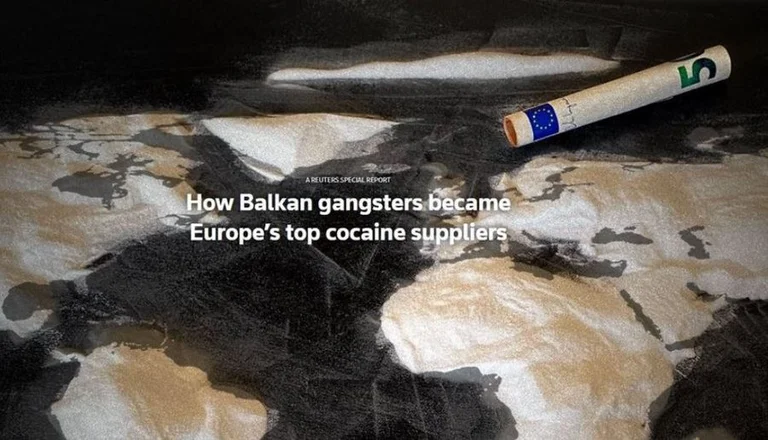
How did Balkan gangsters become Europe's leading cocaine suppliers?
Periskopi(2 years ago)
(2 years ago)...Balkan criminals “are more than happy to work with Israelis, Dutchs, Swedes, Dominicans, Chinese triads”, says a former DEA official. “They'll work, in fact, with everyone.” However, they have left the United States, he said, convinced by the domination of Mexican cartels and the fierce American police shares. Climbing [...]
...Balkan criminals “are more than happy to work with Israelis, Dutchs, Swedes, Dominicans, Chinese triads”, says a former DEA official. “They'll work, in fact, with everyone.” However, they have left the United States, he said, convinced by the domination of Mexican cartels and the fierce American police shares.
The rise of Balkan gangs to the high levels of global cocaine trade has prompted police to try to keep up the pace. Cocaine seizures in Western and Central Europe reached a record 315 tonnes in 2021, according to the latest data from the United Nations Office on Drugs and Crime (UNODC), exceeding 250 tonnes seized in the United States. Cocaine purity in Europe has grown steadily over the past decade, UNODC said, an indicator of its abundant amounts.
While Europe has been troubled by war, drug-related killings now rival terrorism as the main threat to the security of the European Union, according to the bloc's commissioner for internal affairs, Ylva Johansson.
Swedish Prime Minister Wolf Krittersson hired his country's military last year to help eliminate the violence of narcotics-related gangs that have involved bomb attacks and child murders. In March, Greek authorities destroyed a Balkan gang allegedly responsible for more than 60 murders across Europe in the last decade. That same month, the streets of Brussels were shaken by numerous weapons that allegedly included the Albanian mafia.
In Latin America, the presence of the Balkans is now stronger than ever, according to an investigator from the Balkan force of the European police agency Europol. The official said there are more than 50 key trafficking cells from the Western Balkans working throughout Latin America, with hundreds of gangsters scattered across the region.
Brazilian federal police detective Alexander Custodio, who last year led a major operation against Balkan smugglers, said it was “impressed” by their dominance in the transatlantic cocaine trade.
“currently in Latin America they are the main mafia in maritime traffic,” he said.
Links to Latin America
Authorities say the superiority of Balkan criminals in the global cocaine trade is the product of their two-decade-long investment in people and connections on both sides of the Atlantic.
After the breakup of Yugoslavia in 1991 and the decade of ethnic conflict that followed, Balkan criminals organised sophisticated smuggling operations from chaos. When peace was established in the region in the early 2000s, some fled to Latin America in search of new opportunities.
There they built alliances with powerful criminal groups, including Colombia Revolutionary Armed Forces and the First Command of Brazil Capital, to help them locate and transport cheap cocaine, anti-narcotics officials said.
The control of transatlantic smuggling routes was helped by maritime knowledge gained over the centuries. Thousands of men from the region work on cargo ships, some of whom have proved vulnerable to corruption or obligation, according to authorities against narcotics, police reports and court documents. Balkan traffickers bribe or threaten Balkan sailors to manipulate transport containers, hide cocaine in their belongings or ship it from smaller boats while at sea.
Even on the continent, criminals within Europe's Balkan diaspora community have offered distribution and retail infrastructure for street sales, giving Balkan Charter a presence along the entire supply chain, authorities said.
Kostovski, a Serb prisoner, was part of the first wave of these gangsters to bet his future in Latin America, according to Brazilian police. He entered their radar in 2006, following information by German police officers, according to Brazil's 3025-page Operation Niva report prepared by the federal police. By that time, Kostovski had a long list of criminal acts “involving armed robbery, unintentional murder and escape from prison in Sweden and the Netherlands, according to a 1989 ruling by the European Court of Human Rights.
After landing in Latin America, Kostovski smuggled cigarettes from Paraguay before passing “into other illegal activities, such as drug and arms trafficking and money laundering”, according to an unpublished report of American intelligence, which Reuters is capable of.
In 2006, it was located in the coastal town of Vilha Velha, near the port of Vittoria. There he lived in an apartment on the beach with his Brazilian wife and their son, according to reports of Operation Niva. Kostovski's decision to deploy to Brazil was not random, law enforcement officials said, given the wide coastline and proximity to cocaine-producing countries.
“There was a joint strategic effort early to send representatives of various Balkan cartel groups to South America to establish, establish roots, to marry locals,” said former official DEA. Many of them eventually became real mediator” of cocaine.
Kostovski often traveled, using passports with false names that made his movements difficult to track, according to American and Brazilian intelligence documents. Former agent of DEA said police around the world realised late how big the Balkan players have become, in part because these traffickers are noted for avoiding through false documents.
Sea Eminence
A rapid increase in their activity made it clear that they were a force to be taken seriously.
In June 2019, American authorities seized about 18 tonnes of cocaine metrics worth over $1 billion hidden in a cargo ship called MSC Gayane. The ship to Rotterdam was anchored in Philadelphia after a trip to Latin America. The seizure, one of the largest cocaine shipments in US history, revealed how deep Balkan cartels had been introduced into the ocean shipping industry, and especially the Mediterranean Transport Company, which owned ships. Known as the MSC, the Geneva-based firm is the largest transportation company in the world. It has employed hundreds of Balkan sailors and operates a crew training centre in Montenegro.
Eight members of MSC Gayane's crew, including five Montenegrins and a Serb native, were eventually convicted of smuggling cocaine into a bold night operation involving transporting drugs to ships from fast boats. Lawyers of condemned Balkan sailors either refused to respond or refused to comment. Goran Gogic, former Montenegrin heavyweight boxer whom prosecutors claim to be at the helm of logistics after the shipment, is currently in prison in New York pending trial. His lawyer, Joseph Corozzo, said Gogic insisted on innocence.
MSC told Reuters that cocaine smuggling was “an issue extending throughout the industry that requires an equally broad response”. The company said it strengthened security measures after the 2019 incident with tens of millions of annual investments, including technology. All its contractors have been fully verified, the MSC added.
Former Brazilian police documents show Balkan gangsters targeted MSC ships in South America for more than a decade ago.
In September 2010, federal police working in the investigation of Operation Niva seized 29kg of cocaine hidden in bags of food loaded by two Montenegrin seamen while trying to board their cargo ship, MSC Sandra, who was anchored at the Paranagá Port in southeastern Brazil.
Sailors Dragan Jovanovic and Vladimir Bulajic were sentenced to nine and a half years in the state of São Paulo. Such was the case of Boris Perkovic, Brazil-based Montenegrin, for whom prosecutors said he supplied drugs. Perkovic ) for whom police said he was working with Kostovsky's crew in Vilha Velha éha was released in 2018 and died two years later, according to data from Brazil's federal and state courts. Jovanovic and Bulajic are now at large. The company's ships were also at the centre of Kostovski's trafficking scheme, according to Operation Niva's report.
From its base in the state of Espírito Santo, Kostovski and his crew drafted a plan to return to one of the region's top exporters. The State is the capital of Brazil's decorative stone industry and transports marble and granite tablets worldwide on waterways. Kostovski and his team planned to empty blocks, hide cocaine inside them and then send them to Eastern Europe, said the report on Operation Niva.
In July 2010, Kostovski's right-hand arm, a Macedonian named Branislav Panevski, reportedly rented a warehouse near the port of Vittoria to do the job. As the date for the export of stones approached, Panevski told a Brazilian supplier that only one transport company would do. “We only need the MSC,” he said, under a transcript given to the wiretapped phone call in prison.
The MSC refused to comment on the police transcript.
Eventually, the gang scheme was set up. In early November 2010, Brazil's federal police raided Panevski's warehouse, where they found some 159kg of cocaine hidden in one of the stones. Panevski and Kostovski were both arrested and sentenced to 20 years for international drug trafficking. Sandra Kostovski, who helped finance her husband's operation by smuggling money to Brazil on flights from Europe, was sentenced to 14 years. She is now free, but did not respond to Reuters's request for comment.
Panevski was imprisoned in the western state of Mato Grosso do Sul. In 2019 he escaped during a short break and through a false passport passed through Bolivia, where he was finally caught and returned to Brazil to pay off the remaining sentence. He has been released since then, according to a federal police officer investigating Kostovski's Brazilian network, but Reuters was unable to contact him.
Kostovski too escaped from prison in 2018, using a false passport to return to Europe, according to the federal police officer.
About that time, European police began investigating two encrypted communication services -- EncroChat and Sky ECC -- that they believed were widely used by gangsters. Within a few years, French, Dutch, and Belgian police officers had bugged the canals. Throughout tens of millions of conversations, they discovered a noisy crime world ecosystem where suspects were openly talking about drug smuggling, arms trafficking, and assassination plots. EncroChat and Sky ECC have stopped working. But the consequences of surveillance continue to this day, with more than 6,500 arrests since 2020, according to Europol.
The legitimacy of police surveillance has been rejected by convicted gangsters and their lawyers in appeals courts across Europe. In the United States, the prosecution of Gogic, the alleged organiser of MSC Gayane remittances, is partly based on the bugged talks of Sky ECC, according to his lawyer, who said he would reject their use as evidence.
The American Department of Justice refused to comment on the matter. European authorities have defended their methods as legitimate and say many crimes were prevented by these wiretapping. Europol said last year that these communications revealed the key “criminal networks ... (from) the Balkan region in global cocaine trade”.
At the end of 2021, when Belgrade police received access to these conversations, they realized Kostovski had returned to the game after his escape from Brazil, co-ordinating the <x0 drug users through codenamed platforms”, reports of Serbian and Spanish police referring to Reuters show.
For more than a year, police tracked Kostovski as he met with collaborators across Europe, organising what they believed would be the transport of a large shipment. By mid-2023, police had identified the ship Kostovski was allegedly planning to load cocaine and sail across the ocean: “Ocenia Dos”. By the time he left the Brazilian city of Salvador last July, authorities on both sides of the Atlantic were following every move. “Balkan cartel sinks”, Europol said after the ship's seizures on August 24th 2023 and Kostovski's arrest.
New Gene
Two months later in Brazil, authorities there caught another major Balkan Cartel smuggler: Aleksandar Nesic. His father, Goran, had arrived for the first time in Brazil in 2004, and within a few years, police said, had become the leader of various Balkan interlocking cells throughout Brazil, including those of Kostovski and Perkovic, transporting bolivian cocaine to Europe. Authorities said he also tried to teach his son Alexander trade.
Goran Nesic, the central target of the investigation of Operation Niva, was convicted of drug trafficking in 2013 and sentenced to 15 years in the state of São Paulo. He was extradited to Serbia in 2018 to serve an eight-year sentence, but is now free. Nesic refused to comment either.
Aleksandar took the reins, claims Brazilian police, and started working to take over the family business. He had grown up in Guarujá near the Port of Santo, the main starting point for cocaine shipments from South America, authorities say. While his father had favoured bribery for Balkan sailors to move his product to Europe on cargo ships, police said, young Nesic addressed smaller ships to avoid austerity procedures in Brazilian and European ports. Nesic allegedly bought cheap fishing boats, which he equipped them with additional fuel tanks loaded with cocaine and personnel with Balkan or Brazilian crews to make the Atlantic crossing. On April 1, 2022, the US Navy tapped Alcatraz I near Cape Verde, posing about 5.5 tonnes of cocaine. It was one of the largest seizures of this drug in the world that year.
A few months later, on August 16, 2022, Brazil's navy caught Dom Isaac XII on the coast of the northeastern state of Ceará, finding 1.2 tonnes of cocaine on board.
Aleksandar Nesic was the main sponsor (or buyer) of the cocaine charge seized in the Alcatraz I and Dom Isaac ships XII,” wrote Brazil's federal police in a 2023 report on the operation, which Reuters refers to. Nesic was arrested at his home in Guarjuya on October 5, 2023, and was imprisoned pending trial. Now 31, he refused to talk to Reuters. His lawyer, marro, who represents father and son, said Aleksandar was innocent. Despite the capture of some of the major Balkan traffickers, they continue to fill Europe with cocaine due to their ever-growing tactics, officials said.
Custodio, the Brazilian detective who conducted the investigation of Aleksandar Nesic, said Balkan gangs established fraudulent companies to facilitate their drug movement, but are now buying legal exporters. An American anti-narcotics official who has worked with Custodio said Balkan gangsters “are the biggest locomotive to run” the burly cocaine trade in Europe. “They refined their methodology ʹ and it is functioning,” he said.
Reuters translation: Gazmira Sokoli