22 minutes ago
How often Kurt talks about KLA: In the history of post-World War II Europe, KLA has the most extraordinary history
Periskopi(2 years ago)
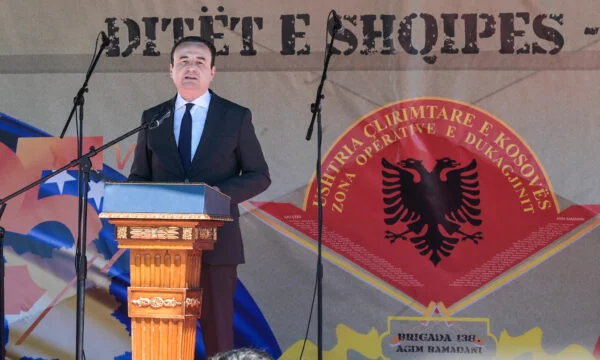
(2 years ago)On the occasion of the 25th anniversary of the Battle of Kostunica, the manifesto of Albania 2024, was held today in the Costore of the Gjakova municipality, under the auspices of the country's President Vjosa Osmani-Sadriu. Prime Minister Albin Kurti, along with Osman, initially paid their respects at the Mood complex “Kostares' witnesses”, in honour of the fall for freedom. “One [...]
On the occasion of the 25th anniversary of the Battle of Kostunica, the manifesto of Albania 2024, was held today in the Costore of the Gjakova municipality, under the auspices of the country's President Vjosa Osmani-Sadriu.
Prime Minister Albin Kurti, along with Osman, initially paid their respects at the Mood complex “Kostares' witnesses”, in honour of the fall for freedom.
A full chronological chronicler, day after day and event, as a total history of the Kostare Battle, would probably be one of the most ideal works for the KLA war”, he said.
Prior to those present in this manifestation, the prime minister resold successive events from April 8th to April 11th, the day the former commander was killed KLA, Agim Ramadani, also known as “Katana”, but also the fall of many other martyrs, including volunteers from Europe and not only, three of whom also died.
Breaking down the border between Yugoslavia and Albania unjustly set in 1913, the prime minister declared that the Battle of Kostare “broke a major partition between Albanians and opened significant inter-interoperation channels in the right fight for Kosovo's deliverance from conquering Serbia”.
“in the history of Europe after World War II, the Kosovo Liberation Army is the military liberation organisation with the most extraordinary and most amazing history”, singled out prime minister”.
At the end of his word, he expressed gratitude to all “the staunch fighters of the Vojare Battle and glory to the martyrs of the Kosovo Liberation Army, fallen in Kostunica, as well as to all the martyrs of our nation throughout”.
Full word of Prime Minister Kurti:
Following the dates of the historic calendar of the Kosovo Liberation Army, as in every other year during these last 25 years, April 9th brought us here to Kostunica in Gjakova today. A full chronological chronicle, day after day and event after event, as a total history of the Kostare Battle, would probably be one of the most ideal works for the KLA war. But in the face of a challenge of history like this, that goes on and is reduced to the time of a speech like this, let me see here some fragments and episodes from the Battle of Koshara, ahead of you who are participants and witnesses of it, and before the new generations who must know it.
The order for the major offensive, which was prepared days earlier, came on April 8, 1999, from the KLA General Staff. So on the morning of April 9, 1999, KLA soldiers attacked the Serb army's checkpoints on the border between Yugoslavia and Albania. Agim Ramadani, known as “Katana”, led the 136 soldiers he had under command in an attack on the Hizhara Plain, forcing a unit of Serbia's soldiers to number twice as high, back from their positions. And in this effort he wasn't alone, but along with others from the Third Operations Group (GO-3) KLA. On Friday, April 9, 1999, the Pukats were martyred by Abush Loku, Bashqi Bashki, Ramiz Krasniqi and Rifat Qelaj. This was just the first day of fighting the Battle of Kostunica, which would last and extend until the last days of the war in Kosovo in mid-June 1999.
The next day 10 April, KLA soldiers managed to take over the post of Kostare, where the special unit “Cobra”, which that day fought alongside the First Battalion and Military Police soldiers. The next day on April 11th, “Oplasi” was scheduled to be taken, but during the fighting at the Kosare Square himself was Chief of Staff, Agim Ramadani.
Besides him, there were also witnesses that day, and Arben Yusuf, Dritton Veliu, Aaron Beka, Taffe, and Sylejman Shala. On the sixth day of the fighting, on April 14, 1999, the twenty-year-old martyr from Poroj in Tetovo, Mujdin Aliu, and four blood-blooded: Kasim Uka, Union Idrizi, noble Salihu and Korab Binxhiu. On another day, the list of freedom martyrs increased by soldiers, while the day with the largest number of NLA martyrs in the Battle of Koshare was April 19th, when 13 KLA soldiers were killed during the fighting. Among them was Salih Cekaj, or “Veterani”, who was actually veteran at least since 1991, when Salih Cekaj coordinated the departure of two military exercise groups to Albania, the Zahir Pajazit group and the Adem Jashar group.
In addition to the two commanders who were killed, <x0) Katanas” and <x2 Veteran”, fighting at the Kosare Battle were planned and headed by many other fellow fighters, commanders and superiors such as Rrustem Berisha, Anton Quni, Skender Hasanjekaj, Fadil Hadrejna, Naim Maloku, Xhafer Gashi, Nasim Haradaj, Gja, Feriz Terzheva, Sjaj, Sjakaj, Shiqaj, Berisha, Thaçuçu, DragHazi Hajaj, Fatar, Fatari, Fatari, Fatari, Dazakirezız, Edazitqi, Edazitqi, Edkatqi, Mercaj, Merceksin Kalkaqi, Mercekshi Bakkashi, Hakkaqi, Mercaj, Hakkashi, Hakkashi, Hakkatqi, Merci, Merci, Hakqi, Mercka, Mercka, Mercka, Merci, Mercka, Kalkatqi, Mercaj, Merckatqi, Mercaj, Mercka, Mercka,
Along with the soldiers of the 131 and 134 KLA's 3rd Operational Group, we find the special unit “Pitbull <x4x1>, soldiers from the Lapi Trives, as well as the “Apocalipsa”, or the Comando “Delta”. The wounded from the fighting helped the medical teams with Agron Jusuf à6>Docu”, as well as Edmond Shabaj, Time Kadrijaj, Ilirana Hakaj, Africa Sylejmani, Fazli Shala, Miftar Zeneli, Bajram Zeqiri, Ryve Loshaj, Mustaf Loja, Sylle Brqi, Armend Agoli, Zeka and Litman Shala. And these are just a few among many other participants and among the thousands of stories of the Battle of Kosare, that only historians will be able to summarize in the future and synthetize in a great and necessary confession to our nation.
During the fighting of the Kostunica Battle of Kosovo, in addition to numerous damage to equipment and logistics, Kosovo Liberation Army soldiers caused many personnel losses in Serbia's military units, killing at least 108 of them.
And among paramilitary units fighting side by side with Serbian forces were mercenaries from Russia.
On the other hand, Kosovo liberation soldiers killed 114 KLA fighters, while more than 380 were injured. The Hive of Kosare, Shkoza, Stanette of the Pukas, Gusha of Botusha, the Maya of Glava, the Vlora and Oplazi returned to sacrificial sites where KLA soldiers were immortalized as martyrs.
Geography of the countries of origin of KLA soldiers who fought at the Kostare Battle lies in almost all of Kosovo and beyond in Albanian-inhabited areas in the Balkans. And since the battle of Kosare was fought under a liberation war, for universal values, the freedom of the people, as freedom fighters she was joined by volunteers from Europe, and not only, three of whom also died: Murad Muhamed Ali from Algeria, Palard Arnaud Pierre from France, and Francesko Giuseppe Bider a Jewish Italian from Italy whose brother is here today among us. Or if the London warrior, who is also here today John Harrison, as well as two Swedish Liberation Army fighters, Pearl Christopher from Malmo and Chim Sundi from Stockholm, who had left Sweden to join the Kosovo Liberation Army war.
Breaking down the border between Yugoslavia and Albania unjustly imposed in 1913, the Battle of Kostunica broke up a major partition between Albanians and opened significant interoperability channels in the fair fight for Kosovo's liberation from conquering Serbia. In the history of post-World War II Europe, the Kosovo Liberation Army is the military liberation organisation with the most extraordinary and fascinating history. The KLA's story is a large collection of events and confessions of a local and rebel army that was conceived on several armed and patriotic groups that carried out guerrilla stakes and fought to stop Serbia's genocide and to free their homeland, Kosovo. Although a liberation-like guerrilla military force, the Kosovo Liberation Army ended its liberation war as an army of thousands of volunteer fighters and as an ally of the great NATO alliance, in the joint struggle for Kosovo's liberation, humanity in the world, for the salvation of the people, for the freedom of the country.
Deep gratitude to all the unmovable warriors of the Mayan Battle and glory to the martyrs of the Kosovo Liberation Army, fallen in Kostunica, as well as to all the martyrs of our entire nation.