7 minutes ago
Freedom House: Year coincided with escalation of violence driven partly by Belgrade's informal ties
Periskopi(2 years ago)
(2 years ago)Despite a turbulent year for civil society and Kosovo citizens, this country's position on the road to democratisation has remained the same as that of last year, Freedom House is said in the international organisation's newest report on the level of democracy in several regions of Europe and Asia. Problems with [...]
Despite a turbulent year for civil society and Kosovo citizens, this country's position on the road to democratisation has remained the same as that of last year, Freedom House is said in the international organisation's newest report on the level of democracy in several regions of Europe and Asia.
Problems with Serbia are cited as among the key obstacles on Kosovo's road ahead.
In the assessment for 2023, of 1 to 7 points, where 1 represents the lowest level of democratic progress and 7th highest, Kosovo continues to score 3.29 points.
As for the countries of the region, Albania and Croatia have not changed, as well, position, while Northern Macedonia, Montenegro, Serbia and Bosnia and Herzegovina have marked a decline in the path towards democratisation.
In addition to Croatia, other Balkan countries are on the list of countries with the hybrid regime of governance, according to estimates by Freedom House, the Washington-based organisation.
Kosovo, however, is cited as a country with a hybrid regime headed towards democracy, Serbia towards autocratia, while Albania, Northern Macedonia, Montenegro and Bosnia and Herzegovina as mixed on both sides.
Protests in the north, incident in Banjska, Kosovo- Serbia
In the part for Kosovo, the report mentions that in 2023, disagreements with Serbia have entered a new phase of escalation of tensions.
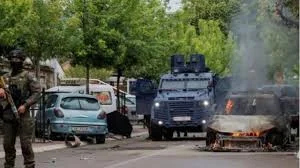
Kosovo Serb professionals have clashed and injured 30 NATO troops in May, and armed Serbs have carried out an attack in September, in which four people, including a police official”, have been said in the report.
The assessment has been reference to the May protests in three municipalities in northern Kosovo, Zvecan, Leposaviq and Zubin Potok as a sign of opposition for the entry of new Albanian mayors into municipal buildings, as well as for the September attack on Zvecan Banjska, in which Sergeant Africa Bulnjak has been killed and in exchange for a three Serb attack on fire.
The responsibility for the attack had been taken over by former Serbian List deputy president ) Kosovo's largest Serb party, Milan Radojic, who is believed to be in Serbia now, and for it there is an international arrest sheet by the International Police Agency (INTERPOL).
Kosovo has blamed Serbia's state for organising and conducting the attack, but official Belgrade repeatedly rejects the charges.
“in many countries, but especially in those of the Western Balkans, political leaders are exploiting the highest focus on regional security as a rationale for overturning democratic institutions and avoiding democratic norms”.
The report also mentioned that the current government in Kosovo, which has launched leadership in 2021, “has tried to remove the country from the legacy of the parliamentary conflict, promoting an agenda of reforms based on rule of law”.
Prime Minister Albin Kurti has initiated the new veto process for judges. However, Serbia's refusal to recognise Kosovo's independence continues to be a major barrier to democratisation. Despite the agreements reached between the two governments at the beginning of 2023, the year has conveyed instability and the escalation of violence in part due to Belgrade's informal ties with organised criminal groups”.
In February 2023, Kosovo and Serbia have reached agreements aimed at normalising relations, while in March for an annex implementation.
However, the parties have not signed the agreements and done little for their implementation.
Freedom House's report also cited Kosovo's international partners' response to the “Kurti's harsh approach to negotiations with Belgrade, and the lack of consultations with the Kosovo Serb community”, according to the report, “has complicated the Government's efforts to rid itself of this long-term:%x3>.
Serbia marks biggest province
In the report for 2023, Freedom House has said Ukraine has marked the greatest progress in the democratisation process, while Serbia falls the biggest.
Of the 3.79 points it had in the previous year, Serbia is now estimated at 3.61 points.
The decline, as it has been said, has been attributed to the efforts of Serbian President Aleksandar Vuciq to consolidate power.
Massive shootings in May had sparked protests over the summer, which the Serbian government has responded to with early elections manipulated in December.
Furthermore, Vuciqi's leadership has been described as maintaining power with manipulated election processes, with dominance in public and private media, through the stain of opposition members and activists, as well as the intimidation of municipal leaders.