2 minutes ago
As for 18 months, it fell for 24 hours in Dubai: Scientists doubt that it was caused by “the artificial generation of clouds”
Periskopi(2 years ago)
(2 years ago)Heavy rains continued to hit Gulf states, causing deadly floods and halting flights to the world's second-loaded airport, the BBC writes. Last June, Dubai Crown Prince Sheikh Hamad bin Mohammed bin Rashid Al Maktoum approved a $2.8 billion fund to expand and [...]
Last June, Dubai Crown Prince Sheikh Hamad bin Mohammed bin Rashid Al Maktoum approved a $21.8 billion fund to expand and re-dissign the drain system.
In January, a new flood management agency was established in the city.
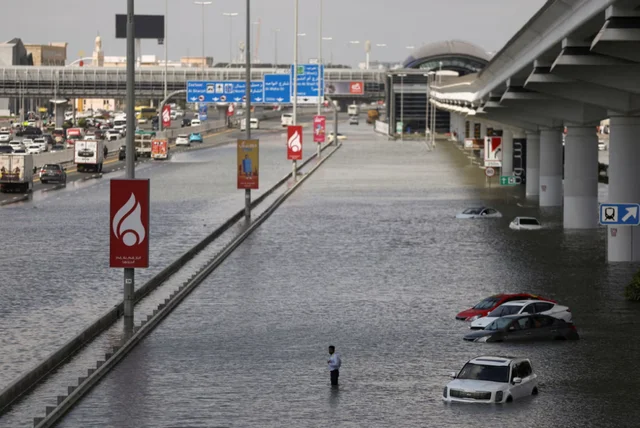
Rain, the most dense in 75 years, which turned the city of Dubai into a large lake, exceeded the plans.
Now, as the waters recede, they are discovering the degree of destruction from the historic storm that claimed 19 lives in nearby Oman and at least one in Dubai.
It is not only the images of chaos at Dubai Airport which is also the most loaded on the planet with travellers gathered on the floor to sleep, nor the ultra-coalxous supermachins that sank under tons of water, nor the roads and sidewalks, where even the famous Sheikh Zayed 12 lanes was flooded, causing hour-long traffic jams in its “ <x01x>, but hundreds of houses turned uninable.
And in some neighborhoods, people were moving in marbles or even surfboards, and part of the city's Metro has been damaged.
Local authorities still have no information on the total value of damage done, as tankers are still pumping water and mud from the most affected areas.
The debate in Dubai is whether <x0 cloud artificial generation” is responsible for the historical storm.
In the United Arab Emirates, this technique has been used since the 1990s to treat anemia because in many cases it can cause rainfall.
In this particular case, however, in response to rumors that an airplane of the Dubai National Meteorological Centre that flew Sunday caused the disaster, meteorologists deny any connection. They say it is impossible to cause such a flood for a human reason.
What scientists say is that Dubai's increasingly hot temperatures and, of course, in the region and beyond, have contributed to the bad historical weather and will do so more often in the future. As they explain, warm air can sustain more moisture (about 7% for each extra degree Celsius) that can increase rainfall intensity.
In Dubai's case, the problem is not only the insufficient drain system because some roads don't even have drains and rain water ends up in the house or get stuck in them. It is also the fact that the city of Dubai has little green spaces to absorb some of the moisture.
Experts say the city should adapt to new conditions and adapt its infrastructure to protect it from the new reality that brings climate change. So besides long periods of drought and heat something normal for the desert in which it is built to be ready for dense rainfall capable of causing flood phenomena.
Because this was the bad “of the century”, the worst Dubai has seen since 1949, when weather data was recorded, but probably not the last of this intensity that will take place in the coming years.