a minute ago
Serbia is closer to recognising Kosovo than NATO”, says Serbian analyst after Ambassador Hill's statement.
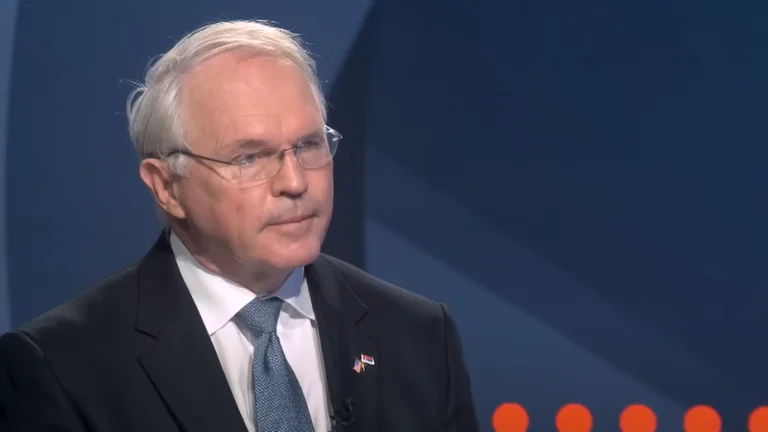
Periskopi(2 years ago)
(2 years ago)Politicians and analysts in Belgrade have commented on US Ambassador Christopher Hill's statement, which said Serbia is closer. NATO rather than Kosovo. They say Serbia is developing partnership with NATO, but that Serbian President Vuciq has pledged that Serbia will not be a member of any military alliance. Serbia today is very [...]
Serbia today is much closer to the NATO alliance than Kosovo, because we work with the Serbian Army every day, we had exercises, we had exercises and a host of other”, US Ambassador to Serbia Christopher Hill said.
As he said of Serbian public television, “now Serbia is leading a policy of military neutrality and I want to be clear, we absolutely respect that policy, but Serbs can reach a different conclusion at a moment”.
That statement Hill made a few days before the 25th anniversary of NATO bombings on Serbia, as well as the publication of news that it is possible for Serbia to give Donald Trump's groom the bombed General Staff building in downtown Belgrade.
The “It is true that Serbia co-operates with NATO, and this speaks a lot about the fact that the ruling regime shows one thing to its audience on TV and Pink, and it does quite another when it comes to military co-operation. Unfortunately, it is also true that they expelled Russian nationals from Serbia who dared to express their opinion of their country. Clearly this situation is unstable”, told “Danas“, Robert Cosmo, deputy of the May Green Front.
He says that “for Serbia's stability -- first of all, it is very necessary to fight for democracy and then there will be conditions to discuss military co-operation and alliances and how to better protect the interests of the citizens of Serbia”.
I personally believe that for us and the European Union it is necessary to develop, first of all, a common European and security policy”, it concludes.
Milos Jovanovic, deputy and president of the New Democratic Party, stresses that Serbia is a military, neutral country, meaning that it has made the decision not to be a member of any permanent military alliance or collective defence organisation.
The decision for military neutrality is a bold decision of a people and state that wants to preserve their independence and identity and is fully in line with the fight to preserve Serbian national interests. Methohia's Kosovo is an integral part of Serbia”, he stresses, broadcasts Telegrafi.
According to politician Fahrudin Kladnicanin, Ambassador Hill's statement that Serbia is now a closer partner NATO that Kosovo can be interpreted as Serbia is now closer to recognising Kosovo than it was before.
“Kosovo is still the main topic of dialogue, given the presence of NATO forces through KFOR, which throughout these years has offered a safe and secure environment. NATO's military intervention halted the war in Kosovo and de facto split from Serbia and the point. Or, even more provocative, after having spent twenty-five years in NATO bombings, it draws attention to a fact that has a foundation in reality, and it is that Serbia is engaged at many different levels through military and political agreements, but also concrete activities in close co-operation with NATO, despite military intervention in 1999, and that all of this burdens Serbia's citizens when it comes to this military alliance<1>, Kladcanin points out.
He says “ambasadori Hill is an experienced diplomat, a mediator in the talks in Rambouille, a good connoisseur of the situation in the region, so this statement can also be interpreted as a message: We respect military neutrality, but Serbia, with NATO you are safer and better”.
“for our stability, first of all, it is very necessary to fight for democracy, and then there will be conditions to discuss military co-operation and alliances and how to better protect the interests of the citizens of Serbia”, he says.
According to politician Kladnicanin, “Ambassador Hill's statement that Serbia is now a closest partner of NATO that Kosovo can also be interpreted that Serbia is now closer to recognising Kosovo than it was before”.
“President Vuciq has repeated several times that while he is supreme commander, Serbia will not join NATO or any military bloc, so we are far from that story. After all, if we reduce this story to the simplest interpretation, one of the foundations of NATO membership is facing the past, it relies on recognition, so we're far from all of this”, Kladnicanin concludes.