7 minutes ago
The drill ignores American officials' statements: No tension with U.S.
Periskopi(2 years ago)
(2 years ago)Kosovo Foreign Minister Donika Grovalla said Kosovo's relationship with the United States is very good, despite some topics that are not fully agreed on. While American diplomats have indicated that the lack of co-ordination on the dinar use issue has damaged partnership with Kosovo government, Mrs. Gervala said “ka [...]
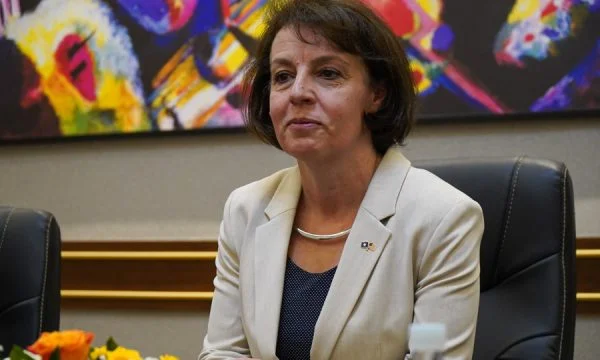
Kosovo Foreign Minister Donika Grovalla said Kosovo's relationship with the United States is very good, despite some topics that are not fully agreed on.
While American diplomats have indicated that the lack of co-ordination for the dinar use issue has damaged partnership with Kosovo's government, Mrs. Gervalla said that “ka several topics where we do not agree 100 per cent technically”, adding that “the questioning of relations between Kosovo and the United States has never occurred”.
During an interview for Voice of America, she also spoke about the lack of progress in negotiations between Kosovo and Serbia.
“If everything we do in Brussels under the mediation of our European partners, the timing has until Serbia withdraws, then we have to ask ourselves what it's worth to spend so much time in Brussels on agreements that, at the end of the day, don't force Serbia to stick to”, she said.
As for the possibility that Montenegro will vote against Kosovo membership in the Council of Europe, Mrs. Gervalla said that “would, of course, be a serious regrass in our bilateral reports, so I don't believe Montenegro will make such a decision”.
Voice of America: Lady Gervalla tomorrow at the assembly of the Commission for Political and Democracy of the Parliamentary Assembly of the Council of Europe, the Kosovo report is expected to be discussed. What are your expectations?
Donika Gervala: We think that if tomorrow the quorum needed for addressing the demand for Kosovo is created, then we think that such a requirement will be approved. And let me find today that rarely in the history of membership after 1990 in the Council of Europe has any state been so prepared to join the Council of Europe. We have acted together with all of the mechanisms of the Council of Europe, the report is positive, all of our homework is done, so we expect that during March, in April, but even during May we will have movement in this direction.
Voice of America: Ms. Gervalla, however, Montenegro officials from the pro-Serbian Democratic People's Party ranks hinted that their delegation will vote against Kosovo's membership in the Council of Europe, though the country recognises Kosovo's independence. Do you fear voting at the Parliamentary Assembly in April or at the Council of Ministers at the May meeting?
Donika Gervala: The vote for Kosovo's membership, to be given by the Parliamentary Assembly of the Council of Europe, will be a massive positive vote for Kosovo, at least this way showing us all the talks we have been holding so far as it comes to Montenegro, we have good relations and I don't believe that our neighbouring states would have to vote against, yet we are left to see over the next few days.
It would not depend on Montenegro's vote for membership or not on Kosovo membership, but it would, of course, be a serious regrass in our bilateral reports, so I don't believe Montenegro will make such a decision.
Voice of America: You said earlier that you did homework. The closure of the Decani Monastery's property issue met one of the criteria directly related to your request to join the Council of Europe. But American diplomats said other issues like that of the Serb majority municipalities' Association could affect the process. Can this issue appear as an obstacle to your course?
Donika Gervala: The Council of Europe report makes it very clear that Kosovo meets all higher standards of democracy, of protecting human rights, of protecting the rights of non-party communities, rule of law and others that are the criteria for membership in the Council of Europe. The open-ended implementation of the institutions of a Kosovo Constitutional Court decision, a topic that has been resolved in the meantime, and the creation of additional conditions -- that is, the addition of conditions that are not envisioned in the report -- would be a very unfair approach to our request, so I don't believe it will happen.
Voice of America: A day earlier, the Kosovo and Serbian delegations met for the second time in Brussels, but without finding success for a solution about the financial support of Kosovo Serbs from Belgrade following the Central Bank decision specifying that cash payments could be used in Kosovo. What are the chances of reaching an agreement?
Donika Gervala: While it must be found that no doubt is the only currency worth in Kosovo, according to the principle of all democratic states worth a state of currency, we have found that there may be a problem here and there for any of our citizens who should seek solutions. However, let's not forget that we have been discussing with Serbia in Brussels since 2011 about the illegal institutions even about their dissolution, which has been a promise of the then Serbian government in 2013. Such a comprehensive breakup has not occurred so far, so we are still discussing old topics. We with Serbia have agreed in Brussels, accepting both sides what was originally called the Franco-German proposal and then became the EU proposal, which resulted in last February's 27th agreement. In what Kosovo we were willing to sign immediately in Brussels. Serbia has refused. Today, unfortunately, we are unable to say we do or do not have legally binding agreements for both sides, because we have remained the only party, so Kosovo, struggling for the full implementation of that agreement. If everything we do in Brussels under the mediation of our European partners, but with the help of our other partners, and those of the United States, the timing of the expiration has only a few weeks, until Serbia withdraws from the ago verdicts, then we have to ask ourselves what it's worth so much time in Brussels for deals that ultimately don't force Serbia to refrain.
Voice of America: The dinar issue sparked disagreements between you and Kosovo's main allies, including the United States. American diplomats said the lack of co-ordination has damaged partnership with your government. Are you worried about undermining this partnership?
Donika Gervala: I think there are many misunderstandings and many misinterpretations regarding a new Kosovo Central Bank regulation that is an independent institution in which the government of the Republic of Kosovo is not involved. But what we're discussing is the matter of implementing that regulation, where we've already agreed, that together with our partners here might be needed for a longer or longer phase for its implementation. I can tell you, relationships with the United States are very good. And they're very good because in all the topics we're dealing with in our region, we have the same attitude and we have the same goals.
Voice of America: However, concern has been present, Mrs. Gervala, over the positions Pristina authorities have held on the dinar issue. Do you think there might be a change of attitude to ease this tension of reports?
Donika Gervalla: We, first of all, don't have the tension in the reports so we should be very careful in the terminology we use. We have some topics where we don't agree 100 percent technically, but that's perfectly normal in the relationship between two close partners. I think it's very normal, not only between partners, between two states, but it's normal in a family, which, again I repeat, we have the same goals, both the U.S.A. and the Republic of Kosovo, on all topics related to our region and the progress of our countries. That we have debate over certain topics is perfectly normal. However, questioning the relationship between Kosovo and the United States has never occurred and there is no Kosovo government, there are no Kosovo institutions, nor those present, nor those that could come in the future that could question such a relationship. / VOA