a minute ago
What happens when Russian gas stops for Europe across Ukraine?
Periskopi(2 years ago)
(2 years ago)Austria's energy company, OMV, was informed by Russian gas producer Gazprom, that it would ban natural gas shipments via Ukraine to OMV from November 16th, after OMV won an arbitration case. But Russian gas supplies to Europe, via Ukraine, can completely stop from January 1, 2025, as [...]
Austria's energy company, OMV, was informed by Russian gas producer Gazprom, that it would ban natural gas shipments via Ukraine to OMV from November 16th, after OMV won an arbitration case.
But Russian gas supplies to Europe, via Ukraine, could completely stop on January 1st of 2025, after the current five-year deal expires.
Kiev has refused to negotiate new transit conditions with Moscow during wartime.
The supply of Russian gas to Europe across Ukraine is relatively small.
Russia sent some 15 billion cubic metres (bcm) of gas via Ukraine in 1923, which is only 8% of the amount of Russian gas it reached to Europe via various roads, between 2018-2019.
Russia spent half a century building its European gas market, where it once sent 35% of capacity.
Moscow was replaced by its rivals, Norway, the United States and Qatar, since it began its full - scale invasion of Ukraine in February 2022.
This caused the European Union to reduce its dependence on Russian gas.
Gas prices in the EU rose in 2022 to record levels as a result of the loss of Russian supplies.
The Road Through Ukraine
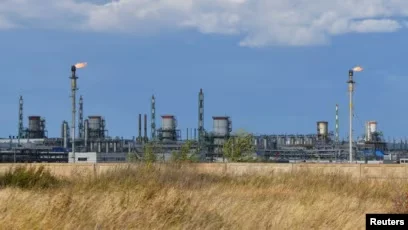
The Soviet-era pipeline Urengoy-Pomari-Uzhgorod carries gas from Siberia through the town of Sudzha now under the control of Ukrainian military forces in Russia's Kursk region. It then flows through Ukraine to Slovakia.
In Slovakia, the gas pipeline is divided into branches going to the Czech Republic and Austria.
Austria still receives most of its gas through Ukraine, while Russia makes up about two-thirds of Hungary's gas imports.
Slovakia receives about 3 billion cubic metres from Gazprom annually, making up about two-thirds of its needs.
The Czech Republic banned almost entirely gas imports from the east last year, but began to draw gas from Russia in 2024.
Most of the other Russian gas routes to Europe are closed, including Jamal-Europe through Belarus and North Stream under Baltic.
The only other operational routes of the Russian pipeline to Europe are Blue Stream and Turkish Stream to Turkey, under the Black Sea.
Turkey sends several volumes of Russian gas to Europe, including Hungary.
Why is the road still working across Ukraine?
Although remaining volumes of the Russian gas transfer are small, the issue remains a dilemma for the EU.
Many EU member states, such as France and Germany, have said they will no longer buy Russian gas, but the stance of Slovakia, Hungary and Austria, which have closer ties with Moscow, challenges the common EU approach.
The countries, still receiving Russian gas, argue that it is the most economic fuel and blame neighbouring EU countries for imposing high tranche tariffs for alternative supplies.
Ukraine still earns up to $1 billion from Russian gas transit fees.
According to Reuters news agency estimates, Russia earns over $3 billion from sales via Ukraine, given an average $200 per 1,000 cubic metres of gas price.
Gazprom suffered a net loss of $7 billion in 1923, which was the first annual loss since 1999, due to the loss of gas markets in the EU.
Russia has said it would be willing to extend the Transit agreement, but Kiev has repeatedly reiterated that it will not.
Another option for Gazprom is to send a portion of gas across other routes, for example through Turkish Stream, Bulgaria, Serbia or Hungary.
However, the capacity through these roads is limited.
The EU and Ukraine have asked Azerbaijan to mediate discussions with Russia on the gas transmission agreement, a Azerbaijani president's adviser for the Reuters agency said, but he declined to provide more details. /Radio Europe Free