6 minutes ago
Tollov in Merdare, Germany's Embassy: We would like the goods to move faster
Periskopi(2 years ago)
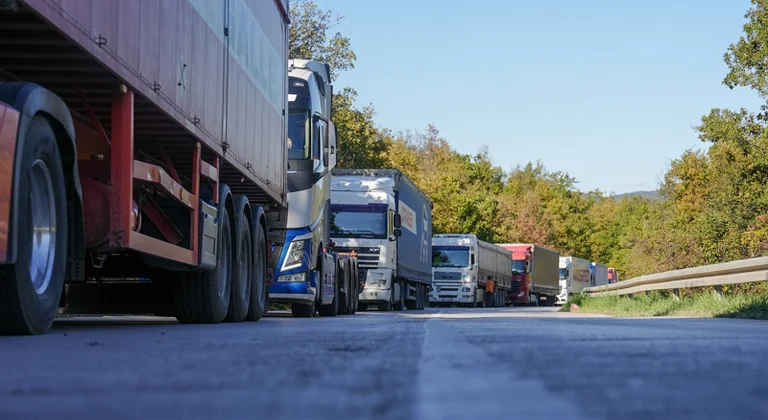
(2 years ago)Two weeks after Kosovo partially lifted the ban on importing goods from Serbia, the Serb side of the Merdare border column is not shrinking. Travelers who are only transitors across Kosovo wait several days in the column, or carry goods that have no origin from Serbia. In a statement about [...]
Travelers who are only transitors across Kosovo wait several days in the column, or carry goods that have no origin from Serbia.
In a statement to Radio Free Europe, the German Embassy in Kosovo said that “would like goods to move faster through border point”, but stressed that the return of import directly from Serbia to Kosovo is a key “achieve”.
“First of all, it is important to admit that the decision [for removing import of goods from Serbia] is being implemented”, the German Embassy said, adding that more work must be done for faster movement of goods to the border.
German Ambassador to Kosovo Jorn Rohde said earlier that he would monitor the import process of goods from Serbia, as his country urged Kosovo to remove the ban in order to unblock CEFTA, or the Central European Free Trade Agreement, and to advance the Berlin Process an initiative aimed at helping the economic development of six Western Balkan countries and their approach to the European Union.
On 7 October, the Government of Kosovo replaced the decision to ban imports of Serbian-origin goods with a new one allowing import, but only through the border at Merdare and with detailed security control.
Other crossings have been warned that import will be allowed only when scanners are secured, which will help Kosovo Customs control goods without physical interference.
The German Embassy said the purchase of these scanners is under way, “in accordance with all valid regulations and regulations for public procurement”.
Otherwise, Kosovo stresses that the decision to ban import of goods from Serbia, in mid-July 2023, was taken for “security reasons”, following the arrest of three Kosovo police officers by Serbian police.
On 17 October, Serbia's prime minister, Milos Vuchevic, held Kosovo authorities responsible for establishing truck columns in Merdare, saying they are doing everything “to make the import of Serbian goods difficult for”.
He said that “is long unnecessary examinations, just to make people nervous”.
The Kosovo government did not respond to the REL's request to comment on these claims, as well as to explain why the import or transitor at Merdare is developing with difficulty.
Similarly, Kosovo Customs did not respond.
Responding to REL questions, Serbia's Oda Economics said that the free circulation of goods, currently, is difficult on the ground and that the partial removal of the ban on import of goods from Serbia, has been counter-effective to the free circulation of goods, there are blockades in Merdare.
Who is responsible for the column of several miles?
Aleksandar Radovanovic, chairman of the Centre for Regional Co-operation in Serbia's Economic Ode, considers that Kosovo Customs is working slowly, with “the leadership of Kosovo authorities” to make it difficult to import goods from Serbia.
He stresses that prior to the ban on import of goods from Serbia, an average of about 250 trucks a day have entered Merdare, while since the removal of the ban, on October 7th, 30 to 40 trucks have entered Kosovo.
Kosovo Customs told Radio Free Europe on October 14th that, on average in a day, eight trucks with goods from Serbia enter Kosovo.
However, on 18 October and 21 October, Dogana did not answer questions about why trucks carrying raw materials from Serbia should pass exclusively at the Merdare crossing, as some carriers and the Serbian Economic Oda told the REL.
Ten days after stopping the import of goods from Serbia in July last year, the Kosovo government changed its decision and only allowed import of raw materials from this country.
But, Sadri Selimi, who imports wheat from Serbia to Kosovo, says that as of 7 October, Kosovo authorities allow the import of raw materials only through Meradres and that they too undergo detailed control of what was not the practice earlier.
Radovanovic speaks of similar situations:
The first “Lands have been distributed normally all the time, able to enter all the crossings and suddenly become a security issue”.
Radovanovic estimates there is no political will for the free flow of goods to actually exist on the ground.
What is the solution?
Kosovo Alliance of Business Chairman Agim Sahini says Kosovo authorities must increase their capacities in Merdare in order to reduce the pillar of carriers waiting for days to cross the border.
He also believes that detailed security control can be conducted manually at other crossings until scanners arrive.
According to him, the current “situation does not make sense”.
If nothing is taken, says Sahin, carriers and companies will have huge financial losses, which will cause price hikes.
There are perishable goods, there are goods transported to other countries, so this problem should be resolved as soon as possible. Businessmen have losses because of waiting. Every day it costs and nobody benefits”, Sahin says.
Radovanovic, on the other hand, says he has a strong interest in Kosovo and Serbian businessmen in co-operating with each other, but that, currently, the message that “this is not desirable”.
When you keep truck drivers for several days in conditions that are not worthy of man, no transporter will accept the offer of a producer who wants to send goods to Kosovo”, he says.
Products from Serbia for years are among the most dominant on the Kosovo market.
According to the Kosovo Statistics Agency, during 2022, Kosovo imported goods from Serbia worth over 372m euros, while in 2023 that value was nearly 199m euros. /rel