7 minutes ago
A volcano explodes in Iceland, washes toward a settlement
Periskopi(2 years ago)
(2 years ago)A volcano has erupted southwest of Iceland for the second time in less than a month, releasing lava in the direction of a nearby settlement. The explosion, shortly before 8:00 a.m. on Sunday, occurred following a series of earthquakes in the vicinity of the city of Grindavik, Iceland's Meteorological Office announced. Its inhabitants [...]
A volcano has erupted southwest of Iceland for the second time in less than a month, releasing lava in the direction of a nearby settlement.
The explosion, shortly before 8:00 a.m. on Sunday, occurred following a series of earthquakes in the vicinity of the city of Grindavik, Iceland's Meteorological Office announced.
Its inhabitants were evacuated during the night, Icelandic television reported.
“Lava is flowing several hundred meters north of the country, so 400 to 500 meters to 148x1>, said Christine Jonsdottir from Iceland's Meteorological Office for RUV Television.
“Lava is streaming towards Greenwick”, he added.
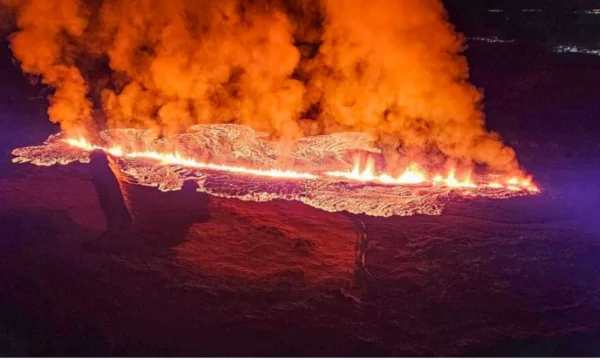
Remote view of the volcano in Greendavik, Iceland, which erupted on January 14th and forced residents to evacuate from the city.
Remote view of the volcano in Greendavik, Iceland, which erupted on January 14th and forced residents to evacuate from the city.
The residents of Greendwick were evacuated from their homes last November and had not returned to town for six weeks after a series of earthquakes and the eruption of a volcano as a result.
They returned on December 22nd. The city of 3,800 residents near Iceland's main airport was evacuated on November 10th when a series of earthquakes caused land cracks between Greendavik and Sylingarfell, a small bjeshkore town in the north.
Pre then protective walls have been built around the volcano, hoping to divert the magma from the settlement. But the walls built north of Greendavik have collapsed and the lava is moving towards the city, the meteorological office said.
The eruption of a volcano every four-five years averages in Iceland. In 2010, the eruption of the Eyjafjallajokull volcano, the largest in recent years, occurred, releasing large clouds of ash in the atmosphere, causing air spaces to close across Europe. / REL