5 minutes ago
The implementation of agreements with Kosovo, EU towards conditioning Serbia's membership
Periskopi(2 years ago)
(2 years ago)The EU is working to condition Serbia's membership on implementation of agreements with Kosovo. The conditioning of membership has to have an effect on President Vucic's political calculations, according to political analysts. Among the binding conditions for Serbia for membership in the European Union are expected to include the implementation of agreements Serbia has [...]
The EU is working to condition Serbia's membership on implementation of agreements with Kosovo. The conditioning of membership has to have an effect on President Vucic's political calculations, according to political analysts.
Among the binding conditions for Serbia for membership in the European Union is expected to include the implementation of agreements Serbia has reached so far with Kosovo in the EU-brokered dialogue. The European Commission is working on this, and the EU Foreign Action Service (EEAS) to change the framework of talks in chapter 35 with Serbia for membership.
“Work in this direction is continuing in line with member states' application”, said EU spokesman Peter Stano.
The requirement for changing conditions in chapter 35 was made by EU member states, as Serbia officially through its prime minister, Anna Brnabiq, said its “Landron would not implement all agreements, which it agreed to with Kosovo”.
Kurti: Serbia does not respect agreement on normalisation
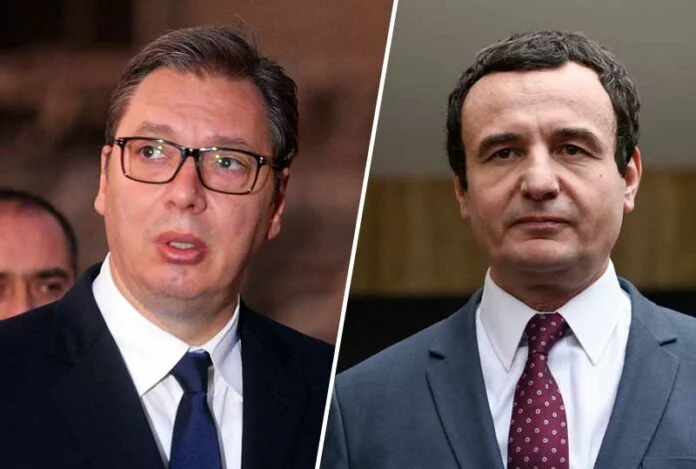
Kosovo Prime Minister Albin Kurti after a government meeting accused Serbia of not respecting the agreement for normalisation mediated by the European Union. “Article one of the agreement says that the parties -- that is, Kosovo and Serbia -- will develop good neighbourly relations with each other based on equal rights. Serbia, however, chooses everything on developing good relations with us, it actually chooses to attack Kosovo, as it did on September 24th 2023 in Banjska, and then to protect the perpetrators of this work at the helm with Milan Radoicicin”, Kurti said.
Former Serbian List Deputy Chairman Milan Radojic claimed responsibility for carrying out the Kosovo Police attack on 4 September last year by a group of armed Serbs. Kosovo and Serbia last year reached an agreement on the road to normalising relations and Aneks for its implementation, known as the Ohrid Agreement. The EU is wanting to make this “legally binding”, though the parties agreed with the agreement, but did not decide the firms.
In October of last year, Germany's leaders, Chancellor Scholz, France's President Macron, Italy's Prime Minister Mellon and representatives of the European Union institutions, urged Kosovo Prime Minister Albin Kurti to establish the Association of Serb Major Communists, while Serbia's president, Aleksandar Vuciq, to recognise Kosovo de facto.
Vuciq: Kosovo independence recognition requested
Days ago, Serbia's president, Aleksandar Vuciq, himself, recalled that “Europe is urging Serbia to recognise Kosovo's independence”. “De facto or de jure, this is required. Let's not lie about it. The greatest power, the European Union is demanding this”, Vuciq said of the media in Serbia.
Kosovo Prime Minister Albin Kurti, in turn, said that “Association is not the top priority of normalisation, it is the basic agreement, so all my colleagues, not only in Kosovo, I urge them not to pull it out of the draft-state package or association as a matter of”, Kurti said, adding that “from 11 articles of the basic agreement, at least eight were violated by Serbia”, so he demanded reaction from the European Union. “We seek legal security, not only for the implementation of the agreement but also for its respect and non-inflict. This is the main reason why we wanted to have signed agreement”, Kurti said.
After this statement by Kurti, the immediate reaction was to the Director of the Office for Kosovo in the Serbian Government, Petar Petkov, who accused Kosovo's prime minister, of saying, “violation of agreements in Brussels”, separately for the Serb majority Communist Association. The “Kurti can neither rewrite the agreement signed in Brussels 11 years ago, whose implementation is guaranteed by the European Union, nor write or speak a word without attacking Belgrade and Serbs in Kosovo, because it is the only thing he knows to do”, Petkovic said.
According to him, Albin Kurti is the key “source of instability in the Western Balkans
Change of Western access to Serbia, British Foreign Minister David Cameron also requested, shortly after returning from a visit he paid with (04.01) in Kosovo. Cameron said that “should be expressed disappointment with the behaviour of the Government of Serbia, following the September events in Zvecan Banjsk”, where an armed Serb group killed a Kosovo policeman. Kosovo authorities blamed Serbia for involvement in the attack, but Belgrade denied it. I am aware how dangerous it was, so it was one of the reasons I went to Kosovo”, Cameron said. He said that “is the time to change the Western attitude towards Kosovo and the Western Balkans, warning that Russia is aiming to destabilise this region”.
But how political analysts view the EU Foreign Action Service initiative, which has called for the Ohrid Agreement for normalisation of Kosovo-Serbia relations to become part of chapter 35 for Serbia in negotiations for EU membership. Demush Shasha, from the Epic Institute, told DW that the next “that this condition affects President Vuciq's political calculations, as in the political sense, but in the economic sense, it is extremely important that Serbia be perceived as a country that remains on its course towards EU membership”.
This condition will also depend on Vuciqi's perception of the EU will for Serbia's EU accession. If he notes that the EU, regardless of what Serbia does, will not open its doors in a short term for Serbia's membership, then, Vuciqi's initiative to compromise over dialogue will fade”, Shasha said.
Serbia's course, US elections, war in Ukraine
The Vuciqi policy course, Shasha, also linked to the US election year and the dynamic of war in Ukraine. According to him, the “consequences of these two developments will also be felt in the Balkan region”. In a scenario where the future US president can be elected Donald Trump and therefore a scenario where Russia's position is strengthened in Ukraine, then, Vuciqi will certainly be in a much more consolidated position to renegotiate Serbia's position and the respective conditions within dialogue”.
Epic Institute Director Demush Shasha says that “this is also the reason why Vuciqi is doing everything to preserve the status quo under dialogue via episodes like my right hand hurts to sign dialogue agreements, or the Banjska episode. Both of these episodes have been part of the same strategy and the same goal: slowdown of dialogue and buying of time while preserving status-quoon in hopes of coming to the most favourable geopolitical circumstances for Serbia”.
Therefore, according to him, Serbia's conditioning under chapter 35 will anchor the obligations of dialogue for recognising the elements of Kosovo's citizenship, as the most powerful European leaders have already sought. “Under the formal process of Serbia's EU membership, many will also depend on the EU's commitment to membership the countries of the region in the EU in a predictable timeline of”, Demush Shasha says. / DW/