6 minutes ago
Germans protest plan to expel foreigners
Periskopi(2 years ago)
(2 years ago)The discovery of an extreme right plan to expel foreigners from Germany mobilized Germans against AfD. Active democracy, despite its vitality, writes DW. Cause for the launch of mass protests was made by investigative journalists at the research institute “Corrrective”, that AfD members had met on November 25th in Potsdam, [...]
The discovery of an extreme right plan to expel foreigners from Germany mobilized Germans against AfD. Active democracy, despite its vitality, writes DW.
Due to the launch of mass protests, the investigative journalists from the research institute “Corrrectiv” were made, that AfD members had met on November 25th in Potsdam, to discuss a plan “rimigration”, if the AfD came to power in Germany. Austrian right-wing Extremist Martin Salner proposed at that secret meeting a plan with which “would turn around, placing the foreigners” in Germany. With foreigners, he understood asylum seekers, persons with residence permits in Germany, but German nationals “equipped with “of foreign origin.
All of these would be deported to a “model state” in North Africa. The extremist process was called euphemism “rimigration” (regramim = read: deportation). This is an analog idea with the idea of the Nazis, who had chosen the island of Madagascar, as a place of deportation to unwanted persons. AfD representatives at the meeting, not only did they not oppose the plan, but supported it.
As soon as the report was released, six German jurist associations, including the German Judges' Federation and the German Lawyer's Chamber, said the meeting is an attack against the constitution and the judicial state. They said the meeting could be turned into a second “conference Wansee”.
As it is known, in 1942, the Wangsee-Conferenz conference, but in Potsdam, established the so-called <x0-> final solution” against Jews: coordinating the most efficient extermination of European Jews.
Policy Reaction
Within hours of the publication of the investigative article, Chancellor Olaf Scholz stated on the X network that any plan to expel migrants is <x0... an attack on democracy and against all of us at”. A few days later, Scholzi and German Foreign Minister Annalena Baerbock took part in the protest of over 10,000 people in Potsdam, against right-wing extremism. A number of politicians have been positioned, with talks and as participants in demonstrations.
Historical Massivity of Protests
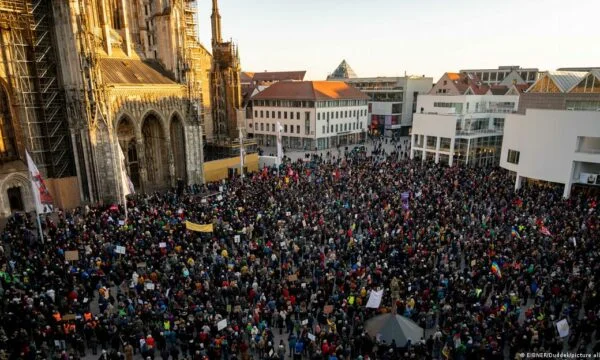
In the protests so far, about 1 million people have participated: the Interior Ministry spoke of 900,000, organisers for 1.4 million people. The most massive protests were on 1901, 20.01. And 21.01. But they continue: 15,000 people have protested in recent days at the Rini-North Westphalia (NRW).
There are the biggest protests in Germany's history, following protests against the Vietnam War and the civic movement in the GDR, one expert recalled. In some cities, such as Munich and Hamburg, organizers were even forced to interrupt demonstrations because of the overload of cities by an extraordinary number of people. In Berlin vs. The AfD demonstrated 350,000 people, in Munich, demonstrated 250,000; in Hamburg 160,000 people; 70,000 people demonstrated in Kiln; 60,000 in Leipzig; 50,000 people in Dresden.
Protesters from all social groups
Massive demonstrations convey the message that there is a limit to all extreme fantasies that could eventually lead to violence.
Present - Day Demonstrators Against AfDs have many heterogenous compounds: they are young, old; liberal, conservative; immigrant; family, single; German, German-Western; homosexual couples. They are the opposite mirror of the population's homogenetic picture, which the AfD demands.
They are often organised in the form of solidarity: protests in one city encourage citizens in other cities to do the same.
European Protest Rating
Their energetic protest is irrefutable evidence that democracy in Germany continues to be alive and active. This is how most German and European experts conclude that they analyze the massity of the protests. In Europe the French daily Le Monde wrote, for example. that demonstrations are a healthy response. There's a big difference, she wrote from the French “neighbours, which are more passive to the right extreme, playing the normal card... in France”. The “Vitizenity of its connection (Germany) to democracy, which once demonstrated, remains its best asset”.
For the first time in Germany, the possibility of AfD stopping is now being widely discussed. But even if the procedure for banning the AfD is enough to require 37 deputies' success before the Federal Constitutional Court is unclear. Only two parties were detained in the RFG until today: 1952 Reich's Socialist Party, which collected Hitler's nostalgics and Germany's Communist Party in 1956.
Some Causes for AfD Support
Even in Germany, as in any country, there is a segment of the population, which does not value liberal democracy: there are antisemitics, there are people against foreigners, there are racists. The AfD's success is explained on the one hand in the situation that the AfD gives political voice to this social segment. AfD generally collects feelings of discontent with the current situation in Germany.
There is another greater number of people on the other hand: they feel either violated by the state and government; or rather, they feel that the state is non-existence and inefficient.
Renowned Sociologists Stephen Mau and Hartmut Rosa told the SZ newspaper that there are disgruntled Germans because they believe that the state intervenes too much: once it brings refugees to the village, where jobs are actually good for them. They find it then that the state is focusing “solely on foreigners”; next, the state will legally change the type of heating in private homes. On the contrary, others feel dissatisfied that the state does nothing - nothing to protect the environment, nothing against homophobic, and so on.
It is a fact that today's world is rapidly changing and people are very tired. They get excited and they move fast. AfD promises the tired return to what they know best, to the traditional. But that, in fact, no longer exists, how they remember.
AfD in polls across Germany gets over 22 per cent. In September, in the elections in three eastern schools, where, according to polls AfD gets over 35%, it is not excluded for the strongest party to emerge. But because of “the Sanitary Accord”, of the decision of all major parties not to co-operate with the AfD, this party is still not expected to come to power.
Some Causes for Opposed Massal AfD
Germany's population rose to 84.7 million this year. Germany is Europe's most populated state. Germany reached that figure because of migration. Without compensation from immigrants Germany would be reduced in number, as more people die here than they are born. This would bring serious economic problems to the German economy, with great thirst for workers. Society would bring social problems.
It is a fact that throughout Western Europe, there is currently a major movement against migration. Is Germany an exception? In Germany as in Europe, discussions are made about the number of refugees to be allowed to cross Germany's borders. But personal history moves Germany at the same time to make exception: maintain an active democracy and support European integration.
Germany's economic interests are another cause of widespread opposition to the extreme fantasies of the AfD. Once AfD is in power, he has said he will organise a referendum to get Germany out of the EU. The ideaology of this party scares foreign investors and qualified employees, who need Germany. This is unacceptable to many Germans.