6 minutes ago
Blinken: US rejects Palestinian shift from Gaza Strip
Periskopi(2 years ago)
(2 years ago)State Secretary Antony Blinken said that at meetings with Israeli officials this week, he will demand that more be done in avoiding casualties among civilians in the Gaza Strip. Speaking at a news conference in Doha after meeting with Qatar's Amy Sheikh Tamim Bin Hamad Al Thani, [...]
State Secretary Antony Blinken said that at meetings with Israeli officials this week, he will demand that more be done in avoiding casualties among civilians in the Gaza Strip.
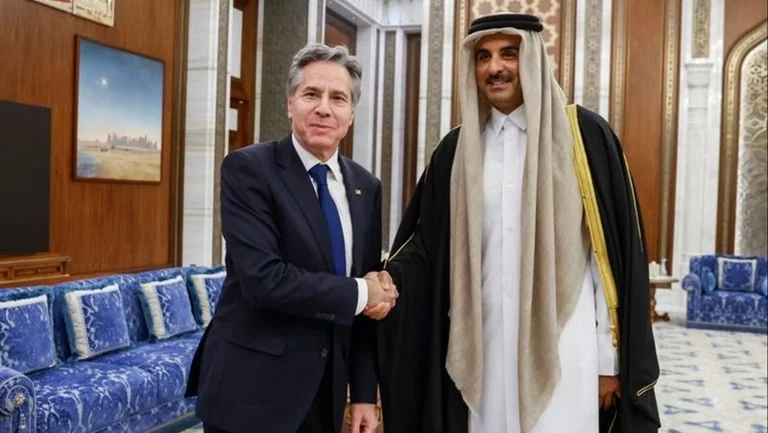
Speaking at a press conference in Doha after meeting with Qatar's Emerie Sheikh Tamim Bin Hamad Al Thani, Secretary Blinken said Palestinian civilians should be allowed to return to their homes and should not be pressured to leave the Gaza Strip.
Secretary Blinken's comments followed concerns raised by the leaders of Egypt, Jordan, and several other Middle Eastern countries for the shift of pale civilians from the Gaza Strip or the West Coast.
At the joint press conference, Qatar's Emiri Sheikh Mohammed Bin Abdulrahman al-Thani said killing a senior Hamas leader in a fearful Israeli attack in Beirut has influenced Doha's ability to mediate talks between Israeli and Palestinian negotiators. However, he said Qatar will continue efforts to find a solution to the Hamas-Israel conflict.
Earlier Sunday, he met with Jordan's king and foreign minister and visited a warehouse of the World Food Programme in Amman, as he continues his diplomatic mission in the Middle East to prevent the spread of the conflict between Israel and Hamas in Gaza, throughout the region. Meanwhile, the Israeli army announced that it has completed the operation to destroy Hamas' military facilities in northern Gaza, killing some 8 thousand militants in the area and sequenting tens of thousands of weapons and millions of documents.
US Secretary of State Antony Blinken met on Sunday with Jordan's King Abdullah II and Foreign Minister Ayman Safadi in a diplomatic effort to find a solution to the conflict between Israel and the militant group Hamas, in the Gaza Strip. Mr. Blinken is urging Israeli Arab neighbours to play a role in the future regarding Gaza's post-war course.
Mr. Blinken also visited a warehouse of the World Food Programme, where trucks are loaded with relief trucks for Gaza.
Jordan and other Arab countries have sought an immediate ceasefire since the outbreak of the conflict in October.
“Turkey is ready to use its influence in the Middle East to reduce tensions and prevent the spread of the Gaza conflict”, Secretary Blinken told reporters late Saturday after holding talks with Turkish President Recep Tayyip Erdogan, a strong critic of Israel's military stake in Gaza.
The US secretary held meetings with President Erdogan in Istanbul on Saturday and later in Crete with Greek Prime Minister Kyriakos Mitsotakis. He launched a diplomatic mission to the Middle East this week, while adding fears that Israel's fight against Hamas in Gaza could turn into a broader conflict.
At a special meeting with Mr. Blinken, Turkish Foreign Minister Hakan Fidan called for a <x0-> immediate ceasefire” in Gaza and for the continued introduction of humanitarian aid. According to Turkish diplomatic sources, Mr Fidan also supported the immediate start of negotiations for a two-state solution.
The United States has sought lasting peace and security for the Israelis and Palestinians. This includes achieving political rights for Palestinians, especially establishing a Palestinian state with security guarantees for Israel.
In another development from the battlefield, the Israeli Army announced that it has completed the operation to destroy Hamas' military facilities in northern Gaza, killing some 8 thousand militants in the area and sequencing tens of thousands of weapons and millions of documents.
Admiral Daniel Hagari, spokesman for the Israeli Army, said at a conference that forces will now focus on southern and central Gaza, acknowledging that this operation will take time.
He said Israel's military effort to wipe out Hamas from central and southern Gaza would be different from what was done in the north, noting that the “refugee camps are full of terrorists”.
Israeli Prime Minister Benjamin Netanyahu also said on Saturday that the fight against Hamas “should not be stopped until Israel achieves three main objectives: “eliming Hamas, returning hostages and ensuring Gaza is no longer a threat to Israel”.
On the other hand, Israel and the militant group Hezbollah continued to exchange fire across Lebanon's border. Sirens for air strikes were fired across northern Israel, while the militant group Hezbollah, backed by Iran, said it fired more than 60 missiles against an Israeli military base.
Israel said it retaliated by hitting a <x0-cellum responsible for missile concessions”. He also announced he hit several Hezbollah targets in southern Lebanon. /VOA