3 hours ago
Online shopping in Europe, which country Kosovo stands in, according to Eurostat

Periskopi(3 years ago)
(3 years ago)The Internet has changed the way purchases are made worldwide, as many consumers aim to exploit the convenience and ease of online purchases. But this is not happening in Albania, as a result of low credit card use, or high informality in retail trade. The latest data of [...]
But this is not happening in Albania, as a result of low credit card use, or high informality in retail trade.
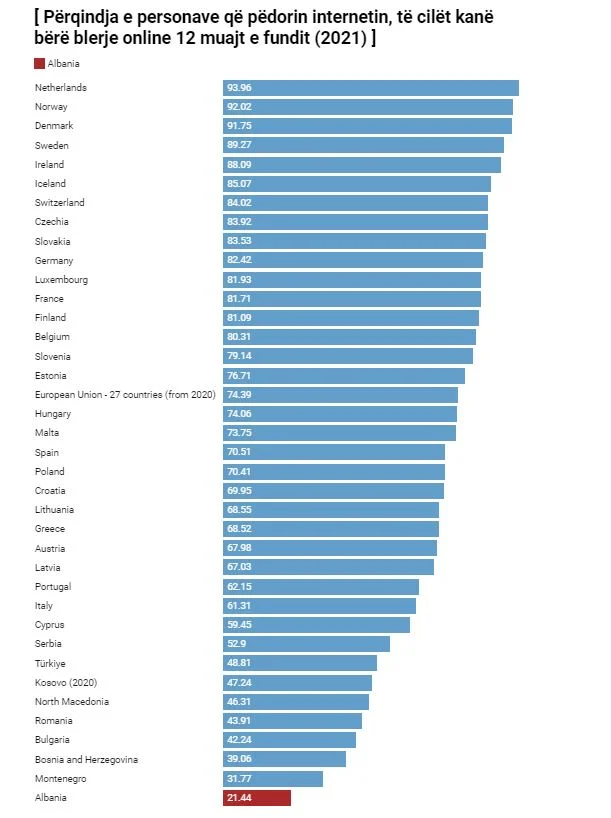
Eurostat's latest data, referring to 2021, shows that only 21% of Albanians who have been using the internet for the past 12 months have made online purchases for the respective period, much lower than the European average of 74%.
The best region ranks Serbia, with 52.9%, followed by Kosovo, which has data for 2020, with 47.7%, Northern Macedonia with 46.3%, Bosnia and Herzegovina, with 39%, while Montenegro is ahead of Albania, with 31.8%.
Valer Pinderi, director of Netrade sh.g., head of the Albanian Online Trade Association [confirmed earlier for Monitor that the biggest market problem linked to lack of investments. If standards are not raised, if infrastructure is not improved, then the quality offered will be small, and as a result, the consumer will not choose it as a new way of buying them.
The other problem relates to informality, the policies pursued to combat formalism not only are not effective, but are producing the opposite results, he claims. Information cannot be solved with rare aggressive attacks on bottom vendors when distributors and customs force these vendors to be informal.
He adds that in order to promote the market, they need to clarify how legislative action is done in online trade, because different inspectors always think of it differently and create problems and help pay processers access second-level banks and the Tax Directorate recognizes their documents, as they are licensed by competent bodies within the state.
Online sales increasing significantly in EU
According to Eurostat, online purchases continue to rise in the EU, as indicated by data from the latest annual survey on use of information technology (TIK) in the family and individuals.
In 2022, 91% of people between the ages of 16 and 74 in the EU had used the internet, 75% of which had bought or ordered goods or services for private use. The percentage of electronic buyers rose from 55% in 2012 to 75% to 2022, an increase of 20 percentage points (pp).
The highest rates of Internet users who bought or ordered goods or services via the internet in 2022 were registered in the Netherlands (92%), Denmark (90%) and Ireland (89%). On the other hand, less than 50% had bought online in Bulgaria (49%).
Between 2012 and 2022, the increase was particularly sensitive in Estonia (+47 pp), Hungary (+43 pp), Czechi and Romania (+41 pp).
In 2022, the most common internet purchases of goods were clothing (including sports clothes), shoes or accessors (ordered by 42% of internet users).
Following clothing equipment, 5 of the most common internet purchases of physical goods were completed by shipments from restaurants, fast food chains and cathering services (19%), cosmetics, products of beauty or well-being (17%), furniture, household access or gardening products, (16%), and printed books, magazines or newspapers and sports goods (with the exception of sports dress) (two 14%).