18 minutes ago
Melza Haradinaj Stublla: The renegotiation the government is making Kurti with the redefination of the Association Agreement is a very dangerous operation
Periskopi(3 years ago)
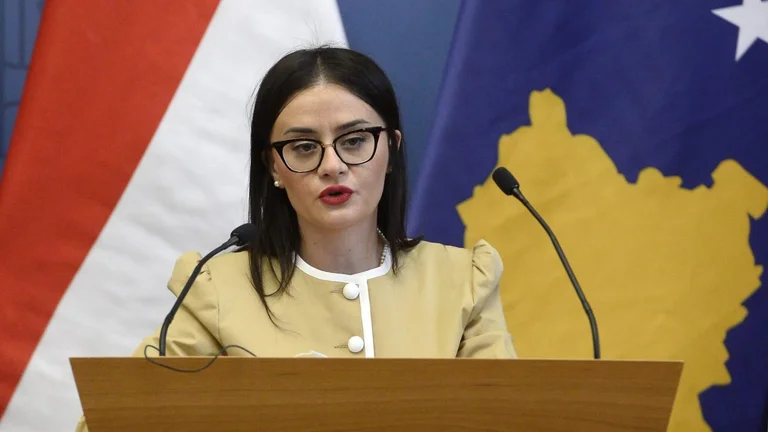
(3 years ago)Former Kosovo Foreign Affairs Minister Melza Haradinaj Stublla has spoken to the newspaper Blic about the agreement between Kosovo and Serbia reached in Ohrid on March 18th. She says this agreement was a must of circumstances and a consequence of history. “Dose of circumstances because a war is taking place on the European continent [...]
She says this agreement was a must of circumstances and a consequence of history.
“Dosoxodoxity of circumstances because a terrible genocide war is taking place on the European continent, and a branch of that aggressor (so Russia) is located right on the border with Kosovo, that is, Serbia. With the unrest in the north in recent months, obedience to the danger of a deeper conflict in the region was created, which would distract the attention of Western allies in Ukraine, and help Putin advance his illegal interests in Ukraine”, she points out.
Haradinaj-Stubla estimates that dialogue was neither defined in time nor in terms of principles for all these years and sometimes renegotiated internal issues, ending with the achievement of some harmful agreements for Kosovo, including Association.
“While the consequence of history because the international community after the supervision of independence brought us into a permanent dialogue with Serbia, claiming normalisation. Unfortunately, this dialogue was not defined either in time or in that of principles, so within the 10-year-old dialogueist Kosovo sometimes renegotiated the Ahtisaari Plan, and renegotiated its internal issues by ending with certain achievements but also with a bunch of unilaterally harmful agreements for Kosovo, such as the Association. The epilogue of final normalisation was never reached, and in all topics that were renegotiated, Kosovo remained at a deadlock: the IBM agreement, recognition of diplomas, license plates, energy, reserved places, elections in the north, travel documents, and recently undiscovered and association, etc. Despite renegotiation, Kosovo has unfortunately not yet made any progress on either of these <x1) topics, the former diplomat for Blic newspaper.
It has said the Ohrid Agreement is not de facto recognition, as Kurti says, and some opposition, but a fragile ceasefire that depends on implementing the agreement.
The aggressive “Intensity based on the urgency of security on the ground and high transatlantic attention in this cycle of dialogue, led to the agreement being completely asymmetric in Kosovo's disparity, which is reflected in the application annex as well.
The Ohrid Agreement is not a defacto recognition as the prime minister claims, and surprisingly some opposition (because Kosovo still figures as an integral “part of the Constitution of Serbia”), but it is a fragile ceasefire that is largely dependent on the rapid implementation of provisions of the” agreement, she says.
Haradinaj-stubla points to the dangerous durability of the political-legal language in this report.
“Like all the EU agreements, even this Ohrid has no clear policy-law language that would avoid deliberate misinterpretation by the parties, but the exact opposite dealt with by the dangerous two-conception that would certainly be misused by both sides. Instead of legally binding signing, the EU put the sentence “in appropriate and confidential order.” Just imagine what level of trust there is between Kosovo and Serbia, and you will reach the answer to how the implementation of these articles will go into practice”, adds Melza Haradinaj-Subla.
The former minister further says the agreement is asymmetric in obligations for both states and that Kosovo has separate articles, while Serbia does not.
“The shake is asymmetric in the obligations it makes for the two states, displacing as the priority certain obligations for Kosovo as specific articles (in the establishment of Association, formalising the legal status of the Orthodox Church), while for Serbia not isolating as a special article neither the historic responsibility for genocide crimes of war, nor for the opening of the Ibri Bridge, nor for failing to prevent holding elections in the north, nor for operating border points under the agreement that IBM, nor for mutual recognition of Kosovo. The only obligation for Serbia to come as a special article in the agreement is point 1 for recognition of residential passports and other documents, and point 4 where Serbia is obliged not to reject any Kosovo initiative for membership in international organisations. This unfortunately does not mean that Serbia will not continue to lobbie for its illegal campaign for recognition of”, she estimates.
The former top diplomat mentioned the fact that in the agreement, it is envisioned that dialogue is not completed until eventual EU membership.
The agreement envisions the dialogue not ending so, leaving the two states in permanent dialogue to eventual EU membership, thus losing Kosovo even a minimum 10 years for internal consolidation, without the continued destructive conditions coming from Serbia through dialogue in the coming years”, Haradinaj-Stubla adds.
And regarding Article 7 and self - examination, she says that she views this word as substitute for Association. While adding that the battle for the competencies of this self-management structure will begin at the upcoming negotiator meetings in Brussels.
“As to the point 7 specifically, “I view as the substitute word for association, while the battle for the competencies of this single management structure will start at the next negotiations' meetings in Brussels, so I don't want to prejudge how much diplomatic and legal skill this government will show to re-evaluate executive competencies which the Constitutional Court rejected in 2015<3>
It stresses that association is not the failure of this government, as Thaci and Mustafa have done so, but Kurti government is to blame for allowing this agreement to isolate itself among a host of other agreements.
I have to stress that the association does not do anything to attribute this government as a failure, because the presence of this harmful agreement is the result of former Prime Ministers Thaci's self-destructive actions. We should hold this government responsible for allowing the association to be singled out as a dominant agreement on the collection of other unconventional agreements, and how it allowed the introduction of the Orthodox Church for the first time as a special point in the Brussels” dialogue, it declares.
All in the end, the former minister stresses that it is a dangerous operation to renegotiate the government Kurti with the redefination of the Association Agreement.
The renegotiation that the Kurti government is conducting with the redefination of the Association Agreement is a very dangerous operation. Now during the renegotiation, the government must be careful to maintain the Constitutional Court's legal protection at the Statu of the self-management structure of the Serb minority, as well as to see that 23 cases are not smuggled from Serbia that failed to pass the Constitutional Court's test in 2015. The government should be helped by all to win the battle against the executive competencies of self-awareness (Association) at the next meetings in Brussels”, the Haradinaj- Stublla Melza concludes.