7 minutes ago
What is the problem now with the Ohrid Agreement?
Periskopi(3 years ago)
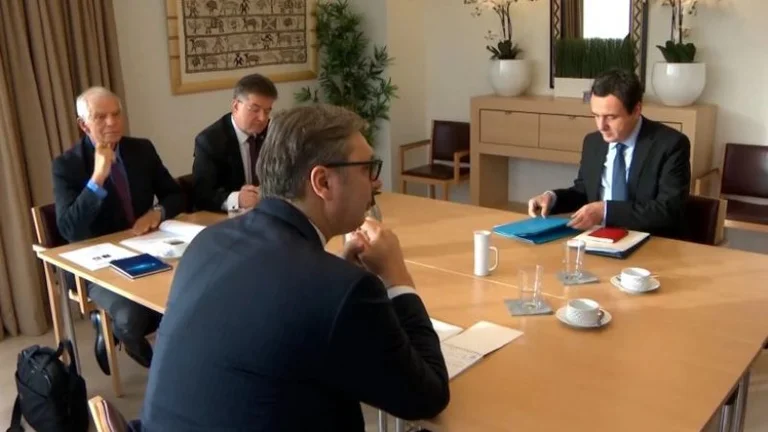
(3 years ago)A new challenge for Serbia - the EU wants to include the Ohrid Agreement provisions in negotiating chapter 35. What does that mean? As Serbia's president, Aleksandar Vucic, “for Serbia, pointed out, does not apply for discussion Kosovo's admission to the United Nations, the UN, and that it has reported French, Germans, Italians, all Europeans, Americans and all know [...]
A new challenge for Serbia - the EU wants to include the Ohrid Agreement provisions in negotiating chapter 35. What does that mean? As Serbia's president, Aleksandar Vucic, “for Serbia, pointed out, neither is Kosovo's admission to the United Nations, the UN under discussion, and that it has reported French, Germans, Italians, all Europeans, Americans and everyone knows this”. Aleksandar Vucic said that “two states are vigorously pushing this initiative”, but did not specify, what states it is about.
The EU's closed doors?
Some Western diplomats stress that Serbia is closing its door to EU membership by rejecting that the Ohrid Agreement is part of chapter 35, and also that Hungarian Prime Minister Viktor Orban has been declared. Orban said that “if the Ohrid Agreement is included in the framework of negotiations, despite Serbia's opposition, Belgrade can always rely on Budapest”.
These statements also noted that the issue dominates the impression of urgency because there is no progress in negotiations between Belgrade and Pristina. This urgency is explained with the need for resolving certain things ahead of the upcoming European Parliament elections in June 2024.
Normalising relations = recognition of Kosovo
The main problem when it comes to this topic is that Aleksandar Vucic acts as if he had not signed the Ohrid Agreement, says of DW, Naim Leo Beshiri, director of the Institute for European Affairs.
If Kosovo officially becomes part of chapter 35, then it is clear that in the future Kosovo's recognition mode will be negotiated by Serbia. If it becomes part of the negotiating framework, it also means that the five EU nations that have not recognised Kosovo are seeking Serbia to recognise it. That also means that if at the beginning of negotiations with the EU it was not clear what normalising relations between Belgrade and Pristina means, I think now, ten years later, it is clear crystal”, Beshiri points out.
Red Line
In Belgrade, the statement is primarily made that Serbia will not oppose Kosovo's membership in all international organisations, points out Igor Novakovic from the Centre for International Affairs and Security. “NESTO, due to the issue of Serbian cultural and religious heritage in Kosovo. If we recall the red lines, the moment both agreements were reached, by Serbia's representatives it was clearly stressed that the red line was Kosovo's entry into the UN, so Serbia's position is not very new”, Novakovic told DW.
Naim Leo Beshiri stresses that “every year Serbia loses with a specific proposal leads to an even worse proposal for the country. Any new proposal that has come to the table has been worse for Serbia”, Beshiri says, and adds that statements by Serbia's president “as the introduction of the Ohrid Agreement in the negotiations process mean that the EU does not want us to continue these negotiations is a bomb and anti-European statement”.
This continues until he faces facts, and these facts prove that nearly 80 percent of the Serbian economy depends on the EU. Vucic's rule does not exist without EU financial support. This is an attempt to intimidate some European leaders that he can address either Beijing or Moscow, but this blog doesn't work, because it's clear to everyone that you can't redirect your economy to any other market except the one around you, the director of the European Affairs Institute.
Igor Novakovic believes that Kosovo's “admission to the UN does not depend on Serbia”, and adds that <x2 if this actually happens, the inclusion of the Ohrid Agreement can complicate Serbia's European integration, but now the question is whether agreement will be reached within the European Union itself”.
Against the EU
We should also stress that Serbia's European integration does not exist, points out Naim Leo Beshiri, and adds that “has so been in the past five years and that there is no apparent change in Serbia's reforms on the road to the EU.” In the past 11 years, Aleksandar Vucic has indicated that he does not want to wage the fight against corruption and organised crime and ensure the independence of the judiciary, because that would imply cutting down the branch in which he and his closest associates have sat. However, EU support in Serbia is still around 50 per cent, despite the slow campaign of the ruling elite against The EU, the West and against social reforms in Serbia”, the director of the Institute for European Affairs concludes.