4 minutes ago
Sonja Biserko: Banjska has shown that the potential for conflict is great
Periskopi(3 years ago)
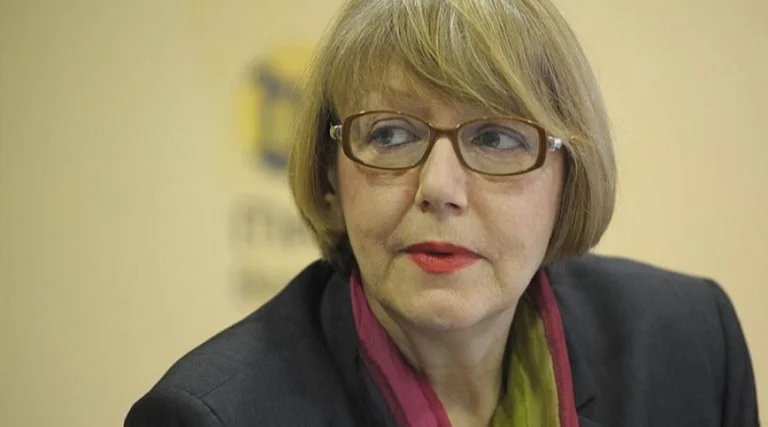
(3 years ago)Helsinki Committee for Human Rights in Serbia President Sonja Biserko has declared that the Banjska case shows that the potential for conflict is great. She in an interview with The Geopost has added that Banjska indicated that the operation was much broader, but was prevented and bloodbath and conflict prevented, [...]
She in an interview for The Geopost has added that Banjska indicated that the operation was much broader, but was prevented and blood feuded and conflict prevented, Klankosova broadcast.tv.
Biserko believes Kosovo is a point through which the West will not tolerate any activity of Serbia or Russia.
The “is not just the issue of Serbia and the Serbian world, but it is a matter of combining at least two Russian and Serbian interests -- American and European” respectively.
In this case, she says, Russia is the only one who is obviously present in some way and that it can easily launch any mechanism that would ultimately lead to some tensions and conflicts.
And this is something that can actually be extended to Republika Srpska and Montenegro”
Serbia, it emphasises, has not closed the Serbian issue, and there is still a trend that seeks to review war losses from the 1990s.
Vuciq is well aware that he can no longer cross that limit, that he will not be tolerated”. Now the question is when and how it will act, perhaps after the elections, as at this stage Kosovo is playing a key card or topic for the campaign, or an important pillar of that campaign, as has always been used so far”.
Biserko estimates that in Republika Srpska there is a network of criminal and gang groups that are very economically powerful, are armed, even have political power given that they are strong in the country.
There's a powerful army that can be very useful in situations when the opportunity arises, so when someone decides to use them“.
She claims Russia is seeking a way to end the war in Ukraine with a kind of Dayton agreement.
Both Belgrade and Russia, Biserko estimates, await possible changes next year, especially at the White House.
Full Interview
The Geopost: When Vuciq says he fears that the year 2017 will bring much more conflict and unrest, referring to the Serb threat in Kosovo, Republika Srpska and other parts of the region, is he actually declaring war?
Biserko: Vuciq is speaking on the heels of all these statements and analyses for the fact that a new front will be possible in the Balkans -- namely, Russia will try to destabilise the region through its domestic acts. This has been discussed since the beginning of the war in Ukraine and the Banjska case actually showed that this potential was great, that the operation was much broader, but it was hampered, stopped, and a greater bloodshed and conflict was prevented. Since then, the West has closely followed what is happening, because this is the red line they will not cross, they will not tolerate either Vucic or Serbia because it directly threatens Europe's own security.
So this is the critical point that has always been during Yugoslavia and the 1990s, and in 1999. It is that critical, strategicly negrological point that is very important for this part of the Balkans, and therefore there has been an intervention not to spread conflict in Macedonia simultaneously, which was probably a Milosevic idea.
Kosovo is the point through which the West will not tolerate any activity of Serbia or Russia. It is not only the issue of Serbia and the Serbian “world”, but it is a matter of combining at least two Russian and Serbian interests -- American and European -- respectively, of course, other Turkish and Chinese interests are being combined. But in this case, Russia is the only one who is obviously present in a way that can easily foster any mechanism that would ultimately lead to some tensions and conflicts. And this is something that can actually lie in Republika Srpska and Montenegro.
As for the Western Balkans, they have three points where they can increase tensions and eventually create a conflict situation.
Geopost: From these three points, which one is in greater danger?
Biserko: Now Montenegro itself is at great risk, as in the last three years this current ruling team, which was installed by the church and Belgrade, is working to clear out Montenegrin sovereignty and all that was Montenegro so far, and this is moving without obstacles. The last rounding tool of this Serbianisation in Montenegro is the census, which should be in a month or later, a postponement was urged, given the very sensitive political moment. What is disturbing is that Serbia is constantly moving towards territorialisation of the Serbian issue, which could happen, for example, in Montenegro.
The Geopost: What are you trying to say?
Biserko: Even a Russian journalist, Genadi Sisoyev, who lives in Podgorica, said something like RAS Krajina (The Serbian Autonomous Region of Krajina) was possible, what was in Croatia and what is now in Republika Srpska, and what has always been an aspirin to be even in northern Kosovo.
The Geopost: In that sense, how do you assess NATO Secretary General's visit to the region?
Biserko: NATO Secretary General Jens Stoltenberg's recent visit was very significant, despite the fact that it was previously in the plan, but the speech at the news conference of both of them (Vuchyq and Stoltenberg) showed that a very serious conversation was taking place in the background. Because somehow the language of his body and the fact that Vucic tried to show that only Serbia can determine where the Serbian military will be located, and that is basically an answer to the Pentagon's request, NATO and other Western countries for the military to pull out of southern Serbia after Banjska because it was located in Sandzak and near the border. For this, Vuciq tried to respond that only Serbia has the authority to decide on it. However, it is evident that it has been a very serious conversation.
The problem is that Serbia is now in the election campaign, which for the first time is speaking in favour of something Vuciq has not learned to see or hear so far, which is that he may not win those elections with a great majority, I think he will win, but there is still a current in society, if he wants to capitalise politically, I don't know.
I think we should mention two important events that determined what is happening today in Serbia ʹ the massacre of young people in early May at school “Vladislav Ribnikkar” (Belgrade) and Mladenov ) that exposed the extent of violence in this society, which eventually initiated those protests in Belgrade and other cities of Serbia and somewhat grew. The feeling I've got is that that fear has simply disappeared, cooling off in fear, and that was the protest of citizens who are not political, but either way, they bear that frustration that now explodes every day in Serbia in different cities.
The second, of course, is the Banjska event, which showed how potential Serbia has for destabilisation. It was known so far, but here it became clear for the first time that it still unconsciously wants something like that to happen, that is, it shows that Serbia has not closed the Serbian issue and that there is still a current that is still trying to review war losses from the 1990s. In a way, he stumbled, and I think Vucinic is very aware that he can't cross that line anymore, that he won't be tolerated. Now the question is when and how it will act, perhaps after the elections, as at this stage Kosovo is now playing a key card or topic for the campaign, or an important pillar of that campaign, as has always been used so far. Kosovo has always been important for Serbian elections.
Then there's another element I forgot to mention, which is that Seshel is part of his coalition, which means he (Vuchic) cares about any vote that might be taken that belongs to that block. Sheshel's electorate is not big, but anyway, those votes are definitely counted, and in that sense, rhetoric and the turquoise of the campaign is mostly radicalized and similar to the 1990s, and I think that in this context, among other things, the incident with Croatia and the expulsion of their diplomat. Although it has some other things to do with Banjska, but this part also concerns the electoral body that views Croatia as a great enemy.
Otherwise, progressers perceive Croatia as an advanced enemy and it is always easier to raise that tension, and it can be said that since the Progressives have been in power, diplomatic and political relations with that country are almost zero. Economic relations are at a very uncomfortable level, at the level it once was, with the fact that Croatia has greater investments here than Serbia. But in general, I think that Serbia's relations with the region are at a very low level precisely because of its aspirations and that Serbian project, which is naturally perceived in the region by a huge distrust, and Serbia can't actually develop normal regional relations as long as that level of distrust is so high and, among other things, it's high because Serbia doesn't know any responsibility for the 1990s, and that's a starting point taking into account all the outstanding issues that arise from the breakup and interpretation of Yugoslavia, which, of course, of course, many problems arise. And all of this is somehow here in Belgrade, in Serbia, and not only the government but also most of the opposition and society. And this is that Serbia is not responsible for those wars and similars, and in parallel with that is the revision of the history of the 1990s and earlier, and of course the legalisation of convicted war criminals who now interpret everything that happened in Croatia, Bosnia and Kosovo, and that kind of forms the opinion of new generations that somehow or otherwise teach it in schools. In each case, a public opinion arises that involves such tensions, frustrations, and hostility.
The Geopost: Return to Kosovo. As Stoltenberg has said, the Serbian Army's <x0-docullation near the border does not help calm the” situation. Serbia has still deployed forces on the border with Kosovo. Where does this lead?
Biserko: It is a muscle show now ahead of the elections, but I think NATO is watching and carefully pursuing everything that is happening on the ground. So they have announced that they are preparing that operation in northern Kosovo, that KFOR has discovered and signaled to Albanians what will happen there. As far as this goes, Serbia is surrounded by NATO countries or countries that want to join NATO. The only countries left behind in the NATO system are Bosnia, which has EUFOR, which is part of NATO and Kosovo, which has KFOR. So it remains Serbia, which has a high degree of co-operation with NATO, has the IPAP Agreement, which is the last step towards NATO membership. So, it's constantly on a certain context, on the one hand, is this particularly with Ohio, the American Army, British and Norwegian, they're the three NATO countries at the helm of Serbia, and on the other hand, there are all these strategic agreements with Russia and the exercises it conducted until Russian aggression against Ukraine and buys weapons from all sides and China, and Russia and Turkey and the West. Now she got some military helicopters. Serbia, on the pretext that, as a supposedly neutral country, is building its military system so that it can be protected as no one threatens it, neither of the neighbouring countries has the potential nor the intention to show any aspirations to Serbia.
The Geopost: BiH Defence Minister Zukan Helez said training led by Russian-led paramilitary formations is being organised in the Republic of Serbia. How do you see it?
Biserko: The fact is that in Serbia and in the Republic of Serbia, there are numerous groups, mainly criminal groups that are well-connected, primarily pro-rus, and mainly serve to pressure the country, to the disobedient. But it is a powerful army that can be very useful in situations when opportunity arises - when someone decides to use them. Either way, it's a network of criminal and gang groups that are very economically powerful, they're armed, they even have political power given that they're strong at the local level, so it's a reserve system, as it were. NATO knows all of this and they follow it all.
The Geopost: You say NATO monitors everything. Montenegro is a member of the Alliance and president-elect of the Parliament (Andrija Mandiovina), a prominent prorus man, has access to sensitive intelligence data by function
Biserko: I think NATO will limit their access to that sensitive information. They did so once during DPS, when someone responsible for co-operation with NATO apparently presented some information and denied access to such sensitive information. I don't think NATO will let Montenegro go, given that it is about the Adriatic and Montenegro's important strategic location, though they missed the opportunity to react on time and stop the proserbous and prorus forces that now actually run Montenegro full-fledged. Montenegrins, Bosniaks and Croats were excluded from the new government. What this new government of Montenegro is now showing is that it is in Belgrade, that it is highly influenced by Belgrade and that it is inferior.
The Geopost: Albanian Prime Minister Edi Rama proposed in Skopje that the future format of the NATO summit be made with the presence of other Western Balkan countries that are not members of the Alliance. How do you see this?
Biserko: This is a region that is not essentially ready and has no potential to enter full EU membership, as estimates are now being discussed expanding specific aid packages, including loans. I think the first step for these three non-member NATO countries is to become NATO members as soon as possible. In my opinion, this is just one of the priorities when it comes to the Western Balkans.
The Geopost: It is often said that the future of this region depends largely on the outcome of the war in Ukraine. More and more, however, the West is presenting options to redefine Ukraine's past success in war and to force Zelensky to negotiate. What does such peace in Ukraine mean for this region, and what kind of message does it send to Russia?
Biserko: Russia for a long time and its various analysts believe Russia should be an example in the final settlement of the Balkan issue, they believe this is not the final solution, they talk about recompliance and talk about a role of Russia itself in those negotiations. I think the West should not allow this because, as you know, both Russia and Serbia constantly want to turn the Kosovo issue into the UN, but, of course, this will not happen because the UN would include China and Russia, which are still hindering Kosovo's admission to the UN, given that both are members of the UN Security Council, but in the first place doing so for some of their interests. Russia, above all, because it uses it as a precedent for everything it does in its immediate neighbourhood in those wars and territories annexed by Crimea and now east of Ukraine. In fact, Russia is leading the whole story in a way that Ukraine will eventually conclude with a kind of Dayton agreement. Russia is already tired of war, as it is looking for a way to end that war. Now the big question for Ukrainians is if they can let the war end so that part of the territory remains occupied, they eventually went to war to release those parts. This is now a big question and depends on many circumstances that are taking place each day. But all those new points of instability such as now the Middle East, which could eventually pass to another end in the Far East through North Korea that launchs rockets every hour despite the deal it has with South Korea, respect nothing. Wherever it's weak and where it's possible to do something, I think Russia's pushing it everywhere because it's obviously looking for a way out of that war in Ukraine, but we'll see how things will develop further. First of all, I think that everyone expects changes in America, the White House, then we saw that Europe with its choices next year, that the Netherlands took or gets a very right government, and that could happen in other European countries. This is what Russia expects as an opportunity to actually stop Ukraine's support and send weapons and all that was necessary to carry out that war. So there are many unknowns and many expectations. In that sense, Belgrade itself expects and withdraws from any implementation of the Ohrid and Brussels accords pending possible changes next year.