2 hours ago
Vuciq says Serbs living in Kosovo “are unconditionally seeking” forming Zajednica
Periskopi(4 years ago)
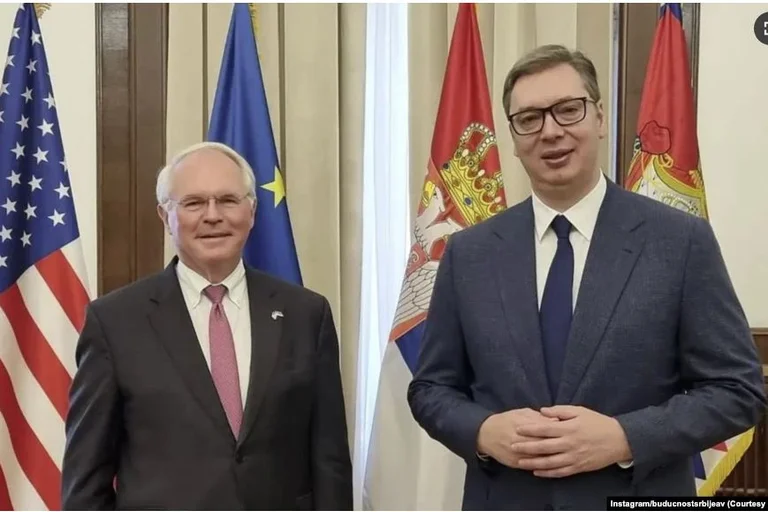
(4 years ago)Serbia's president, Aleksandar Vuciq, said Serbia is seriously dealing with finding a “solution to the current crisis caused by Pristina's unilateral movements”. Those comments he made after a meeting with the US ambassador to Serbia, Christopher Hill, on August 23rd in Belgrade. According to the communiqué issued by the Serbian presidency, two [...]
Those comments he made after a meeting with the US ambassador to Serbia, Christopher Hill, on August 23rd in Belgrade.
According to the communiqué issued by the Serbian presidency, the two officials have talked about the situation in the region, with emphasis behind last week's dialogue between Serbia and Kosovo, as well as bilateral co-operation.
The Serbian president, reportedly “, has explained Serbia's Hill positions he represents in the dialogue with Pristina” and has added that he is participating in dialogue with “responsibility and constructiveity”.
He added that Serbs living in Kosovo “seek unconditionally” forming the Association of Serb majority municipalities.
Vuciq, reportedly in the announcement, has said it is important that Kosovo maintain the agreement that Kosovo special forces can move to the north only with the consent of NATO and the heads of four municipalities, inhabited by Serb majority.
However, the agreement with NATO envisions that Kosovo should seek the consent of the North Atlantic alliance for entry into the north only for the Kosovo Armed Forces (FSK).
At the last summit in Brussels, which was held on 18 August, Kosovo Prime Minister Albin Kurti, and Serbia's president, Aleksandar Vuciq, have not reached agreement on these issues.
The US envoy for the Western Balkans, Gabriel Escobar, and the European Union's special envoy for dialogue between Kosovo and Serbia, Miroslav Lajcak, are expected to visit Pristina and Belgrade this week, teaches Radio Free Europe from diplomatic sources in Brussels.
According to these sources, they will make efforts to convince the parties to reach agreement on exceeding tensions in northern Kosovo, as well as on the issue of car license plates and Serbian documents.
Meetings in Brussels were called after local Serbs on July 31st and August 1st set barricades as a sign of dissatisfaction with the Kosovo Government's decision to implement two decisions -- for license plates and Serbian documents.
Kosovo and Serbia have free movement agreements since 2011.
Serbia has implemented it immediately.
The Kosovo Government's decision has had to be implemented by 1 August, but official Pristina has decided to postpone the start of implementation for a month, following EU and US demand.