4 minutes ago
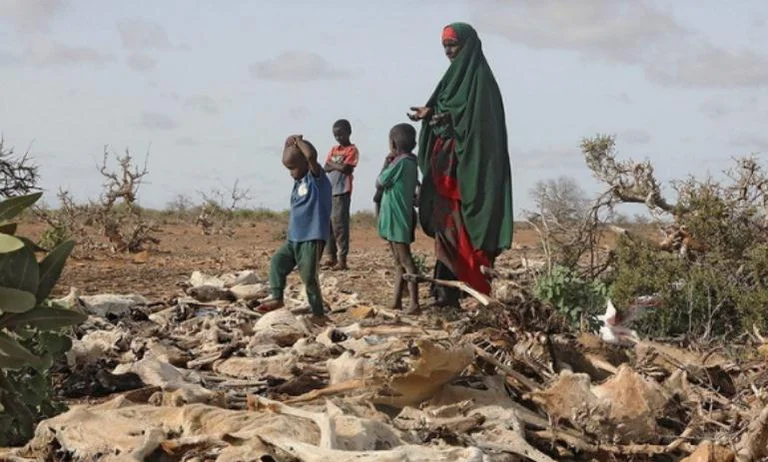
Somalia is on the verge of starvation
Periskopi(4 years ago)
(4 years ago)For three decades Somalia has plunged into chaos and anarchy. While the government controls only a few areas of the country, the rest is in the hands of jihadists, who are capable of blowing themselves up in crowded places. For many Somalis life is poor, brutal, and short. They live [...]
For many Somalis life is poor, brutal, and short. They live in the fifth poorest and eight most violent countries. Their life expectancy is the world's sixth lowest. Droughts and floods have added to their misery. In 2011, rains contributed to the world's largest famine crisis of the 21st century.
More than 250,000 people died, half of them children. A decade later, history can be repeated. The largest drought in four decades includes the drying of crops and the death of livestock in Somalia, Ethiopia, and Kenya.
More than 18 million people in the region are trying to find food to eat; children are dying in all three countries. But fragile Somalia is expected to be hit by drought.
If we don't do something now, there will be thousands of dead”, said Mohammed Abdi of the Norwegian Council of Refugees, a charity.
Political dysfunction and poverty are the main factors for the crisis. But the responsibility is also beyond its limits. Since Somalia releases just a little more carbon dioxide than Andorra, it can hardly be blamed for climate change that seems to affect droughts, reports abcnews.al.
Nor would the most intense conspiracy theory consider Somalia guilty of the Russian invasion of Ukraine, which has caused a global food crisis. Somalia imports nearly 80% of its food. Russia's conquest and higher fuel prices have also pushed up the price of food.
As a result, it is now much more expensive for Somalis to buy food to meet their needs. The highest grain prices have also increased the cost of providing aid. Since the start of the war in Ukraine, the UN World Food Programme's operational bills have increased by 44%.
Donors have raised only 30% of the 1.5 billion dollars the UN says it needs to avoid a disaster in Somalia. Britain recently stopped paying essential “” to avoid spending the budget due to the cost of humanitarian aid in Ukraine. All of this forces relief workers to make difficult decisions about who to help and who not.
About 7 million people, more than 40% of Somalia's population, are struggling to find food. Relief workers estimate that 1.4 million children suffer from malnutrition. Hundreds, perhaps thousands, have already died. At the time of the proclaimed “hunger crisis” in 2011, an announcement issued a stream of funds from donors, half of the victims had already occurred.
The last “disaster”, meaning a famine that leads to at least 1 million deaths, occurred in Ethiopia in the 1980s.
“The Great Bridge”, of what causes 100,000 or more victims, has also become less frequent due to improved early warning mechanisms and more effective humanitarian interventions.
There have been only three “hunger crisis” this century, the most recent and deadly of which was Somalia's in 2011. Somalia has long been prone to droughts, but they are becoming more common, according to Christophe Hodder, UN envoy for climate in the country. Although the current drought cannot be directly linked to global warming, it is the largest in 40 years.
With the average Somalia temperatures projected to rise by 3-4 °C by 2080, droughts like this will probably become more common. Only drought rarely causes <x0 bready>”. In 1991 Somalia was destroyed by a civil war and a jihadist uprising following the fall of her dictator Siad Barrett. A country that once did a reasonable job of feeding the country has seen the crop drop by 60% since 1989 to satisfy only one fifth of the need.
Instead, Somalia imports most of its main products, including rice, pasta, and cooking oil. Decades of fighting have also destroyed infrastructure, destroyed the economy, forced millions to flee their homes, and left the state largely unable to provide basic services such as health care and education.
Somalia's new president, Hassan Sheikh Mohamud, took office in June. He hopes to change what happened under his predecessor, Mohammed Abdullah Mohammed, almost restored the civil war when he tried to remain in office beyond his mandate. The government and its allies control the capital, Mogadishu, and its main provincial cities.
But al-Shabab, Al-Qaeda's richest and most deadly branch, controls most of the village. These rural communities are bearing the main burden of the crisis. Guriel, in the state of Galmudag, is the central Somalian shopping center.
Normally, its cattle market would have 1,200 animals a day. Nowadays, there are only 150. Before the drought, Hasan Abdullah Ali would sell goats for 40 dollars each to feed his ten children for a month. Now his pasture is gone, the water wells have dried up, and his flock has been affected by disease.
Nearly a third of the livestock in the hardest - hit parts of central and southern Somalia may have died since the beginning of the drought in 2020, including 250 of Ali's 300 sheep and goats and 15 of his 20 camels.
Trying to sell the rest is complicated. “Today I brought two to the market,” he said. I sold one, but nobody wants to buy the other.” The increase in wheat costs means that selling a goat now costs a lot to buy food to feed his family for only ten days.
After the reds and corn that grew up were dried up, said Hawa Mustaf Hassan's husband, who fled to southern Somalia to find work. Five dollars a month he sent them was not enough. The youngest of her three children, two-year-old Adani, became ill. For weeks he's been fighting between life and death.
I felt there was no hope he would be cured,” she said. “But after 14 days I saw him smile and I knew he'd be fine. ”
Others are less likely. The children are dying,” said Abdullah Ahmed Ibrahim, a doctor at Baidoa General Hospital. “The mothers come too late and bury their children on the way.” After all the livestock died eight months ago, Isaac Nur Ibrahim brought his wife and two little sons to a nearby camp of Kismayo.
He could only earn $1 a day as a worker. After rations were cut short, his two - year - old son Obadiah became ill of anemia because of malnutrition.
The boy died on June 8th. When crops are lost and animals die, those in the richest or most powerful clans can receive help from their relatives. Such clans generally have more people living abroad or in the cities of Somalia; during the drought, they can rely on them to send money to the village, or to accommodate those who move to cities in search of food.
But members of the poorest clans often have no choice but to live in poor, sick camps. That's because aid workers rarely go to the village for fear of being killed by al-Shabab. About 2,000 camps surround Somalian cities, sheltering most of the 2.9 million people who have been displaced from the country.
Many of them are controlled by the heads of organizations, who distribute very little help in camps and expel residents who are no longer useful to them. Help for the people of Somalia will require not only more money for food but also greater efforts to get these aid to areas where al-Shabab is controlled.
To save lives, aid agencies will have to take the risk, according to Daniel Maxwell of Tufts University in Boston. These dangers are not only for their workers but also for their reputation and ability to raise funds, reports abcnews.al.
Some worry about facing criminal charges in America under anti-terrorism laws if aid falls to jihadists. However, not trying to do more to help also poses danger to the safety of Somalia.
People suffering from hunger may be forced to support jihadists. The drought could further exacerbate the conflict, as communities struggle for scarce resources. It may already be too late to avoid disaster in Somalia, fuelled by rebellion and drought.
But the longer the world expects to help, the greater the result. /The Economist/