4 minutes ago
Putin thinks he's winning and his three major war goals
Periskopi(4 years ago)
(4 years ago)Everything's going according to plan. That is the position of President Vladimir Putin. The war in Ukraine in its fifth month, which does not seem to be the end of the horizon, can be exhausting. But senior Russian officials continue to reiterate that Russia, which is gaining ground in eastern Ukraine, will manage to [...]
The war in Ukraine in its fifth month, which does not seem to be the end of the horizon, can be exhausting. But senior Russian officials continue to reiterate that Russia, which is gaining ground in eastern Ukraine, will achieve all its goals. This may seem hard to believe. All in the end, Russia has been forced to step down from Kiev, undergoing several military setbacks, has faced sanctions of the unprecedented scale, and has become subject to a sound international condemnation. Calling success a long series of failures can be an attempt to empower propaganda, hypocrisy, or even self-deception.
But this is what appears to be the Kremlin believing. For over two decades, I have been closely following Putin's statements, behavior and decisions, creating a sweeping view of the president's calculations. Based on the rhetoric displayed in public, political decisions and informal discussions with reliable people, I have been able to create -- as much as I can -- the contents of the Kremlin's current mind. What is very clear is that by the end of May, the Kremlin came to a determined conclusion that he is winning the long-term conflict. And Putin, unlike the first chaotic months, now has a clear plan.
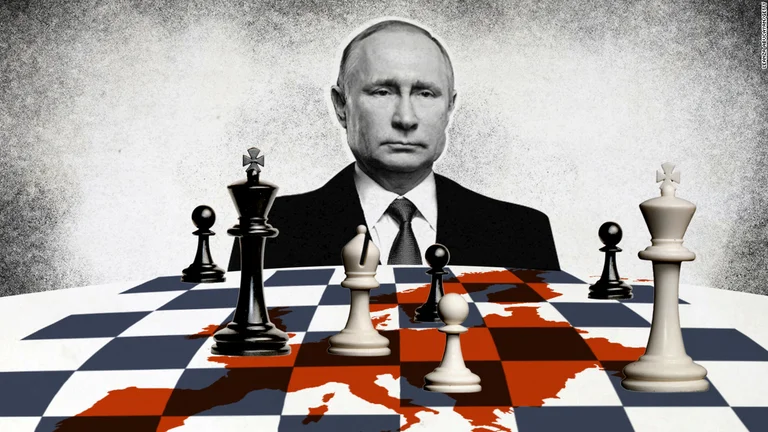
Made up of three main dimensions, the plan is a kind of Russian strategic doll. Each aspect matches the other leading to a scheme far beyond Ukraine. It may sound extremely surreal, and this clearly reveals how separate Putin is from reality. But it's very important for the West, whose response has shifted amid confrontation and reconciliation, to understand Putin's full scope of hopes as the West continues to assess its role in protecting Ukraine against Russian aggression.
The slightest and most pragmatic goal concerns Russia's territorial ambitions in Ukraine. Following the failure to advance deeper in Ukrainian territory in the early days of the war, Russia significantly lost its ambitions, fleeing the idea of capture Kiev. The current and most real goal seems to be to take control of the Donetsk and Luhansk regions, which the Kremlin views only as a matter of time -- a view supported by the successful capture of the Luhansk region by Russian troops and land corridors that would provide escape to Crimea.
To that end, which is of minimum geopolitical importance to the Kremlin, Putin seems to believe that time is on his side. You can understand why. Western military support has shown its limit, while Washington has signaled that he is not prepared to risk promoting Putin's anger by crossing red lines. His early threats to using nuclear weapons seem to be taken into account: The West will not be directly involved, nor will it help Ukraine to the point of leading to Russia's military defeat. For today, for all vows of contrast, conventional wisdom in the West is that Ukraine will not be able to restore regions occupied by Russian troops. The Kremlin believes that sooner or later the West will completely abandon this idea. The eastern part of Ukraine would then effectively be under Russian control.
The next goal seems to be to focus on the obligation to capitulation Kiev. This has nothing to do with occupy territories; this is about the future of the remaining Ukrainian territory -- something of much more geopolitical importance. On a practical level, the capitulation would mean that Kiev would accept Russian demands that could be summed up as the country's deucratisation and érusification. This would mean criminalising the support of national heroes, changing roads, rewrite history books, and ensuring a dominant position in education and culture for the Russian-speaking population. The goal, in short, would be to deprive Ukraine of the right to build its own nation. The government would be replaced, the elites would be cleared and co-operation with the West would be cancelled.
The second goal seems amazing, of course. But to Putin this seems inevitable, even though it may take longer until it is achieved. In one to two years, when the Kremlin expects Ukraine to be exhausted from war, unable to function normally and deeply demoralized, conditions for the chapter will mature. At that stage, the Kremlin count seems to be: the elite will be divided and an opposition seeking to end the war. It will unite to bring down the Zelensky administration. There would be no need for Russia to invade Kiev militarily; it would fall itself. Putin apparently sees nothing that can prevent him.
There is a big discussion about what is really most important for Putin in his war: stopping NATO's enlargement to the doorstep, or his imperialist ambitions to expand Russia's territory and annex at least part of Ukraine. But the two issues are related. As Ukraine slides straight NATO and the Donbas war are stuck, Putin became more obsessed with the country. The land he believes to have historically met Russia was captured by Russia's worst enemy. As a response, the urcan territory has been made but not rather, as some think the target of confronting NATO.
This brings us to Putin's third strategic goal in the fight against Ukraine, and is the most important geostrategic goal of all: building a new world order. We're used to thinking Putin sees the West as a hostile power wanting to destroy Russia. But I believe that for Putin there are two kinds of West: A bad guy and a good one. “Bad West” is represented by the traditional political elite that now leads Western countries: Putin sees them as narrow-minded slaves to their electorate, not taking into account overall national interest and unable to think strategically. The “Good West” consists of ordinary Europeans and Americans who, he believes, want to have normal relations with Russia and businesses that are eager to benefit from close co-operation with their Russian homolages.
Putin's thinking, the evil West is on the decline, as the good West is slowly challenging the status quo with a group of national orientation leaders, such as Victor Orban in Hungary, Marine Le Pen in France and even Donald Trump in the United States, ready to break the old order and design a new one. Putin believes that the fight against Ukraine and all its consequences, such as high inflation and rising energy prices, will fuel good Westing and help people rise against the traditional integrity of politicians.
Putin's bet appears to be that the fundamental political overcoming in Western countries in time will bring about a transformed and friendly West. Russia would then be able to return to its security requirements, which it made public in its December ultimatum to the United States and NATO. This may seem like a desire to the point of impossible. But that doesn't stop Putin from happening. If the West wants to avoid a catastrophic crash, he should really understand what he's facing when it comes to Putin. /Periscopi/
Tatiana Stanovaya for New York Times