10 minutes ago
Future steps for Albania to become European Union member
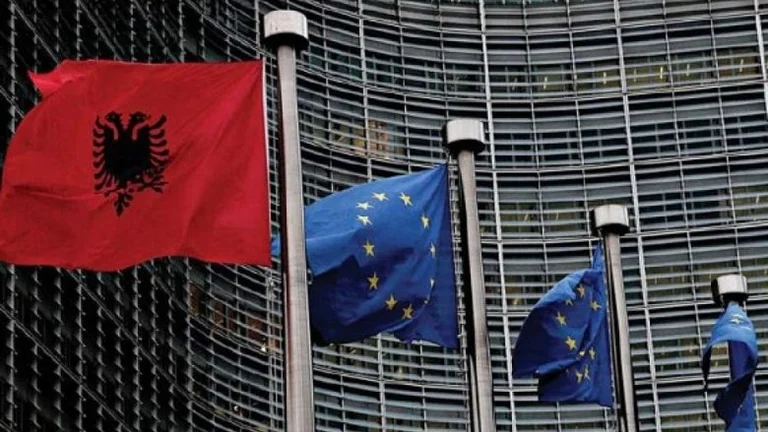
Periskopi(4 years ago)
(4 years ago)After Skopje resolved its long-standing dispute with its neighbour, Bulgaria, Northern Macedonia, and with it Albania, green light was opened for the start of accession talks leading to membership in the European Union. “This was a key movement towards bringing the Western Balkans closer to the EU”, said Czech Prime Minister Petr Fiala, the country [...]
“This was a key movement towards bringing the Western Balkans closer to the EU”, said Czech Prime Minister Petr Fiala, whose country currently holds the rotating EU presidency, as praise for both countries was flooded by top bloc officials.
But what are the next steps to be taken on the road to full membership? How do candidate countries become members? Before the start of membership negotiations, the candidate country and the European Commission decide the so-called “pre-membership strategy”, which leads to the drafting of a negotiating framework on both sides. Negotiations cannot begin work until the mandate is unanimously approved by the bloc's member states.
In this process, the European Commission should be satisfied that the candidate country meets three conditions, the so-called Copenhagen criteria. For the start of the talks, the candidate country must meet only the political criteria, while others can be met during the negotiation phase. The first step includes a rigorous process of reviewing candidate country legislation to see how much it agrees with EU laws or with the acquis communautaire.
The acquis is divided into 35 negotiating chapters, collected in six groups, covering every legislative aspect, which individually can only be closed with the unanimous blessing of all EU member states. Negotiations on several chapters can be conducted simultaneously. After all chapters have been closed, the Commission recommends candidate countries for membership, and the country signs the Association Treaty, specifying a date for membership, making it a “accession country”.
The treaty must be ratified by all 27 member states and the European Parliament, which must approve the text in absolute majority. The pace of negotiations depends on the speed of reforms and the approach to EU laws in any country, and their duration may change. The European Commission describes the candidate countries' progress in annual reports. For Northern Macedonia and Albania, the EU executive said in last year's assessment the two countries were roughly prepared in most of the six groups, and a kind of progress has been seen. Currently, closing chapters could last several years, as has happened to Serbia or Montenegro.
Any EU country may object to closing or opening chapters, and Bulgaria has reserved itself the right to do so if the bilateral protocol is not implemented by Northern Macedonia. The fastest to negotiate accession were Austria, Finland and Sweden, in a little less than two years, while Croatia took slightly less than eight years from the start of negotiations to become a full member of the bloc. /ToopChannel/Acquis is divided into 35 negotiating chapters, collected in six groups, covering every legislative aspect, which individually can only be closed with the unanimous blessing of all EU member states. Negotiations on several chapters can be conducted simultaneously. After all chapters have been closed, the Commission recommends candidate countries for membership, and the country signs the Association Treaty, specifying a date for membership, making it a “accession country”.
The treaty must be ratified by all 27 member states and the European Parliament, which must approve the text in absolute majority. The pace of negotiations depends on the speed of reforms and the approach to EU laws in any country, and their duration may change. The European Commission describes the candidate countries' progress in annual reports. For Northern Macedonia and Albania, the EU executive said in last year's assessment the two countries were roughly prepared in most of the six groups, and a kind of progress has been seen. Currently, closing chapters could last several years, as has happened to Serbia or Montenegro.
Any EU country may object to closing or opening chapters, and Bulgaria has reserved itself the right to do so if the bilateral protocol is not implemented by Northern Macedonia. The fastest to negotiate accession were Austria, Finland and Sweden, in a little less than two years, while Croatia took slightly less than eight years from the start of negotiations to become a full member of the bloc. / TCh/