a minute ago
War crisis in Ukraine
Periskopi(4 years ago)
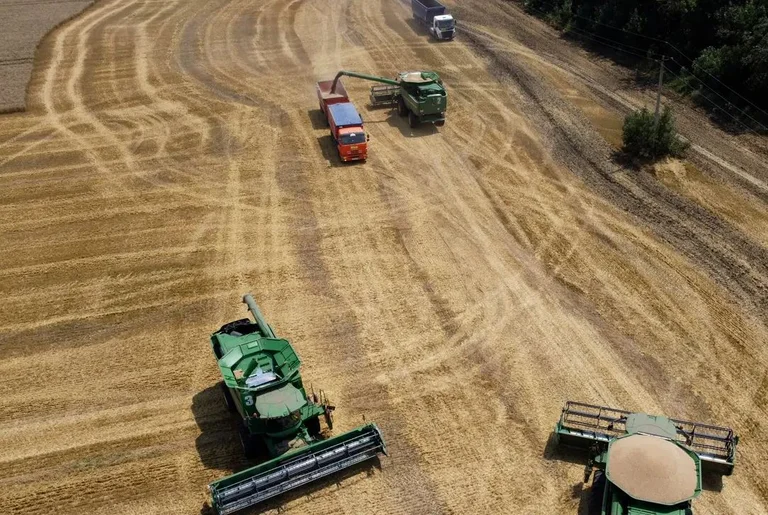
(4 years ago)Russian armies in Ukraine are preventing wheat from being transported from the world's “food transport and is making food more expensive worldwide, threatening to exacerbate supplies, hunger and political instability in developing countries. Together, Russia and Ukraine export almost a third of the wheat and barley [...]
Together, Russia and Ukraine export almost a third of the world's wheat and barley, over 70 percent of sunflower oil, and are large corn suppliers. Russia is the world's largest producer of agricultural waste.
World food prices have only increased, and war has made matters worse, preventing some 20 million tons of Ukrainian cereals from being exported to the Middle East, North Africa, and parts of Asia.
Weeks of negotiations on safe corridors to enable the extraction of cereals from the ports of Ukraine to the Black Sea have achieved little progress as the emergency grew as the summer harvest season approaches.
This should happen in the coming months or it will be a terrible situation”, said Anna Nagurney, who studies crisis management at Massachusetts Amherst University and is also a member of the Kiev Economic School board.
She said 400 million people worldwide depend on Ukrainian food supplies. The United Nations Food and Agriculture Organization has predicted that up to 181 million people in 41 countries can face a food crisis or hunger levels will deteriorate this year.
Here you can learn more about the global food crisis:
What's the situation?
Usually, 90 percent of wheat and other grain from fields in Ukraine are sent to the world markets across the sea, but these agricultural cultures are found in ports because of the Russian blockade of the Black Sea coast.
Part of the cereals have been altered by the route of transportation across Europe through railway, land routes, and shipping across rivers, but the amount of exports is extremely small compared to exports that could be transported by sea. The shipments are also being delayed to reach their destination because Ukraine's railway system is overloaded and does not function like its Western neighbour's systems.
Ukraine's Deputy Agriculture Minister, Markian Dimtrasevych, has asked European Union lawmakers for help to export more grain, also demanding the expansion of Romanian Black Sea port, the construction of more goods terminals on the Danube River and the elimination of bureaucracy for passing goods to the Polish border.
But this means that food is even farther away from those who need it.
“Now must go through Europe to return to the Mediterranean. This has indeed added an incredible cost to Ukrainian grain”, said Joseph Glauber, senior researcher at the International Institute for Food Policy Research in Washington.
Ukraine has been able to export only 1.5 million or 2 million tonnes of cereals a month since the war began on February 24th. This amount is much smaller compared to the period before the war when it exported up to 6 million tonnes per month, said Glauber, former chief of economists at the US Department of Agriculture.
Even Russian grain cannot be exported. Moscow argues that Western sanctions on its banking system and transportation industries are making it impossible for Russia to export artificial food and garbage. Likewise, Moscow argues that sanctions are scaring foreign transport companies to transport Russian cereals. Russian officials insist that sanctions should be lifted so that grain can reach global markets.
European Commission President Ursula von der Leyeen, and other Western leaders, however, have argued that sanctions do not affect food.
Attitudes of the Side
Ukraine has accused Russia of promoting agriculture infrastructure, burning crops, stealing grain and trying to sell Syria because Lebanon and Egypt have refused to buy it. Satellite images performed by Maxar Technology at the end of May showed Russian ships at the Crimea port carrying grain shipments, and a few days later those ships were seen docking in Syria and unloading goods.
Ukrainian President Volodymyr Zelensky has said Russia has provoked the global food crisis. The West has agreed, while officials, like European Council President Charles Michel, and US Secretary of State Antony Blinken, have said Russia is using it as a food weapon.
Russia has said exports can return when Ukraine removes mines located in the Black Sea and ships arriving at ports are checked if they have weapons.
Russian Foreign Minister Sergey Lavrov has promised that Moscow will not renegotiate “with its naval advantage and will take all necessary steps to ensure that ships can freely leave the ports”.
Ukrainian and Western officials have voiced sceptical of these Russia pledges. Turkish Foreign Minister Mevlut Cavusoglu has recently said it would be possible to create safe corridors without the need to remove mines because the location of explosive devices is known.
But there are other questions to the issue, as if insurance companies will provide coverage to ships carrying out shipments.
Dmytrasevych told EU Agriculture ministers that the only solution is Russia's defeat and unlocking of ports: “No other temporary measure, like humanitarian corridors, would address this issue”.
How did it get to this situation?
Food prices rose even before the invasion began, because of many factors, including bad weather and poor crops, causing supplies to be reduced as global demand rose greatly from the coronary pandemic.
Glauber said that the poor wheat harvests last year in the United States in Canada and the drought that damaged Soybe's productivity in Brazil have contributed to increased food prices. He has also mentioned that the situation has deteriorated due to climate change, Africa's Briri is facing one of the worst droughts in four decades, while the record heat wave in India is March lowering wheat productivity.
This, along with rising fuel and waste prices, has prevented other countries that are large cereal producers from filling supply shortages.
Who's hit the hardest?
Ukraine and Russia mainly export key materials to developing countries that are more sensitive to cost increases and lack of supplies.
States such as Somalia, Libya, Lebanon, Egypt, and Sudan are highly dependent on wheat, corn, corn and sunflower oil from exports from Ukraine and Russia.
The bar of crisis is above the shoulders of the poorest”, Glauber said. “This is a humanitarian crisis, there is no doubt about this”.
Besides the threat of hunger, the high increase in food prices risks causing political instability in such countries. Political instability was promoted by the Arab Spring and now fears the same scenario will repeat itself.
Governments of developing states must either allow food prices to increase or subsidise costs, Glauber said. An average prosperous country, such as Egypt, which is the world's main importer of wheat, can afford increased food costs, Glauber added.
For poor states like Yemen or states in Africa, they would really need humanitarian aid”, he said.
Hunger has hit parts of Africa. Prices of basic products such as wheat and cooking oil are in many cases more than twice as expensive, while millions of livestock that families use for milk and meat have died. In Sudan and Yemen, the Russia-Ukrainian conflict came at a time as these two states for years face internal crises.
The UN Children's Agency (UNICEF) has warned of a <x1 loss of child deaths” if the world focuses solely on the war in Ukraine and does not react. UN agencies have estimated that more than 200,000 people in Somalia face disaster hunger “”. According to the UN, approximately 18 million Sudaneses can face acute hunger by September, and 19 million jennas can face food uncertainty this year.
The grain prices in some of these countries have increased by 750 percent.
In general, everything has become more expensive. Whether it's water or food, and the situation is becoming quite impossible”, said Justus Licu, food security adviser to the CAR aid group. He made these statements after recently visiting Somalia.
Liku said a vendor selling cooked foods did not have <x0ps or animal products. No milk, no meat. The saleswoman told us that she was standing in the store just for the fact that the store was her”.
In Lebanon, bread ovens that once had a variety of products are now selling only white bread in order to pay off flour.
What's going on?
For weeks, UN Secretary General Antono Guterres has attempted to reach an agreement to unblock Russian exports of artificial grain and waste and allow Ukraine's exports from the key port of Odessa. But progress in this regard has been slow.
Meanwhile, a large quantity of grain has been blocked in Ukrainian storehouses or in farms. And it is expected that more grain will be harvested in the winter season in Ukraine will soon start, increasing pressure on grain - storage objects, even though some fields are likely to remain uningathered because of fighting.
Serhiy Hrebtsov cannot sell grain from his farm in the Donbas region because transport lines have been cut off. Low buyers imply that prices are so low that the agriculture sector is unstable.
There are several opportunities to sell, but it's like pardoning products”, he said.
US President Joe Biden has said he is working with European partners on a plan to build temporary warehouses at the Ukrainian borders, including on the border with Poland, as a solution that could address both the overload of the railway transport system of food products between Ukraine and Europe.
The idea is for grain to be transported to these storage sites and then “across cars to be transported to Europe, then by sea transport to reach the world. But that's taking a long time, said Biden.
Dmytrasevych said Ukraine's grain storage capacities are down to 15 million of 60 million tons, as Russian troops have destroyed warehouses or occupied locations where cereals were stored in the south and east of the country.
What's costing more?
World grain, rice and other cereals are expected to reach 2.78 billion tons in 2022, 16 million tonnes less than last year. This is the first time in four years that production of these products has fallen, the UN Food and Agriculture Organisation said.
The grain prices rose by 45 percent in the first quarter of this year compared to the same period last year, the Food and Agriculture Organisation's price index says. The price of cooking oil increased by 41 percent, while prices of sugar, meat, and fish increased in dual figures.
The price hikes are driving up rapidly inflation worldwide, making food more expensive and raising costs for restaurant owners who are forced to increase prices.
Some countries are reacting to try to protect their domestic supplies. India has limited sugar and wheat exports, meanwhile Malaysia has banned the export of live chickens, alarming Singapore, as this neighbouring state secures a third of the birds from Malaysia.
The International Institute for Food Policy Research said food supplies would become more acute as the war drags on, could lead to more export restrictions and further increase prices.
Another threat is scarce and very expensive waste, which means that crops can be less productive as farmers can save agricultural waste, Steve Mathews from Gro Intelligence, an agricultural data company and data analysis said.
There are huge shortages separately for the two main trash chemicals, which Russia is a major supplier.
If we continue to have a lack of potassium and phosphate, as we have now, there will be a drop in productivity”, Mathews said. “There is no doubt that this will happen in the coming years”.