15 minutes ago
Spreading 5G network brings public discussion in Kosovo
Periskopi(4 years ago)
(4 years ago)5G is the fifth generation of wireless network technology, and this network is standardised by the international industrial group called 3rd Generation Partner Project (3GPP). Even Kosovo is learning to have services based on 5G technology, writes Periscopi. Radiational Authority of Electronic and Mail Communications - ARKEP is claiming that in [...]
Radiational Authority of Electronic and Mail Communications - ARKEP is claiming that in line with EU recommendations, it will facilitate the extension of the 5G nets by ensuring the availability of a significant amount of the French spectrum, in line with market demand. The goal is to make services based on 5G technology feasible as soon as possible, thus promoting industrial and social transformation and economic growth in the country.
ARKEP has put into public discussion “Review plan for the opening of generations of economic value for mobile services IMT& IMT 2020”
The public consultation process with interested parties started on June 08th, 2022, and ends on July 07th 2022.
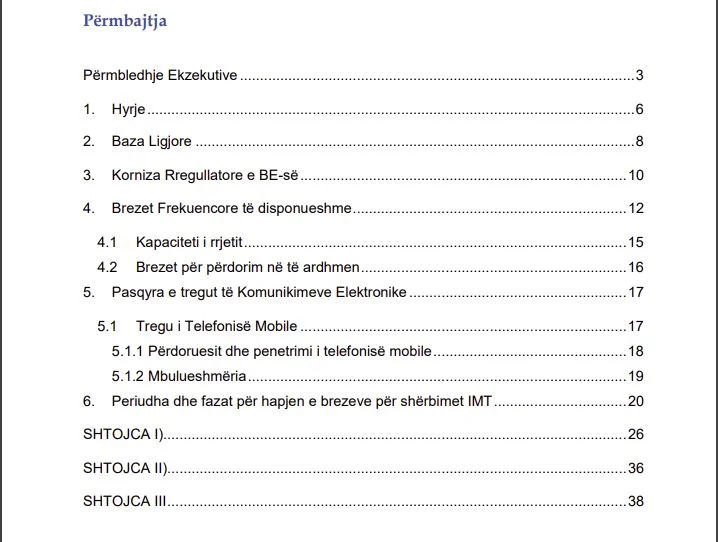
The document record “Plani for Opening Generations” describes the regulatory framework in the Republic of Kosovo and the European Union regarding the French generation of special economic value for IMT & IMT20 services, the restraint capacity available in Kosovo for each generation, the mirror of electronic communications with a focus on the mobile phone market, and a significant number of questions for the interest parties have been put forward so that the process can be managed better.
As says in the report that Periscope has seen, in this process of assessment of the French generation, the commission in the review and analysis of international documents for providing services to the universal resources of the 3400- 38000 generation. MHz has found out: 3400- 3100 frequency generation assessment needs to be revised MHz in the present period of time as a suitable and defined generation in the application of advanced 5G technology.
ARKEP, through this plan for opening generations for IMT-2020 mobile services, is intended to create the necessary preconditions for the development of broadband electronic communication services, with a focus on 5G nets. In this way, it is intended that in Kosovo important objectives be achieved in the development of broadband services in effective and efficient use of all the French generation designated and dedicated to these services.
ARKEP, through application of adequate regulatory measures, is aimed at achieving goals/ goals as follows:
Enhancing the number of new services that will be available for end users;
Access access to generation services in more distant countries, such as rural areas and isolated locations;
Further promotion of competition in the electronic communications market;
Ensuring greater speed and better quality of generation furniture services;
Effective and efficient use of universal resources as recent resources and application of new advanced technologies in providing mobile services to generation;
Meeting obligations in utilisation of universal resources in line with
EU regulatory framework and regulatory targets in the country; and
Further increases in the ratio of broadband communication services.
“In fulfillment of the defined objectives in the Regulatory Framework, taking into account the importance of this process, ARKEP will have priority in developing competition and providing better services and higher quality, through creating facilities and applying basic principles to regulate electronic communications activities.
On the other hand, operators, taking into account these priorities, should be able and aim at significant investments in the entire territory of the Republic of Kosovo to realise the extension of generation-based networks and furniture services based on latest technologies (now generation 5G), so that benefits can be overall for both operators and consumers”, the report says.
Plan for Opening the French Generations
ARKEP plans to complete the second phase of opening generations during 2022, aimed at realising this process in the third quarter of 2022 (TM3-2022).
Yeah, right. ARKEP plans and announces that the universal capacity that will be determined in the 800 MHz generation and 3400-700 MHz will be provided in the package at the shared capacity for both generations and those with the capacity ceiling of 2-810. MHz at 800 MHz and 100 MHz generation 3400- 3000 MHz for the operator.
Stage III - Opening/Vania in generation use ʹ this process included opening up the French generation: 700MHz, 2100mHz, 2nd. 6GHz, 26 GHz, and remaining capacity in the 900MHz monthly generation.
ARKEP plans the IIIth generation opening phase to begin in 2023.
Mobile Phone Market
Mobile phone services in Kosovo is offered by three mobile network operators in the space belt 900/18000 MHz included the temporary and limited authorization operator in the mts D.O.O. infrastructure. ;
Kosovo Telecom Sh.a/Vala licensed by date; 30/07/2004 ( ART No. Prot. 111/04) with a period of validity for 15 years, and
) IPKO Telecommunications LLC licensed by date; 06/03/2007 ( ART No. Prot. 77/07) With a 15-year worth period
Mts D.O.O., temporary authorisation
“Krahas the three authorised MNO web operators (Mobile Netek Operator), currently exists a virtual mobile operator (MVNO)14, Duagjini Telecommunications sh.a. (D3mobile) which offers M2M” services.
So far, the Electronic and Post Communications Regulatory Authority (now referred to as RECEP) has authorized 2 operators ( MNO Mobile Network Operators) for providing mobile electronic communications services and communications networks throughout the country. Based on data sent by operators, the Republic of Kosovo currently covers over 90% of its territory and 99% of its population.
Currently, Kosovo and Serbia have signed an agreement at the White House in Washington. One of the provisions of the agreement signed by the former prime minister, Avdullah Hoti, and Serbia's president, concerns hiring parties to prevent the use of suspicious equipment for 5G linked to Chinese companies, Periscope reports.
Although often with a poor signal, about five years ago, 4G was present, which the operator had launched. IPKO.
The telecommunications industry has been making noises for this new generation of high-speed service. Companies around the world have started testing and the first wireless equipment supporting 5G has begun to emerge. But the 5G transition is not as close as thought. First, operators will have to completely change their massive infrastructure. The 5G revolution does not merely include the internet, but is designed to connect smart devices at home, drones, cars that drive themselves, and billions of other related objects, Periscop reports.
The basic problems discussed over 5G affect the Balkans as well. In all Southeast European countries, the US Embassy had published on its website, open calls demanding the expulsion of Chinese competitors. Even in the agreement reached between Kosovo and Serbia in the US, “The two sides will ban the use of 5G equipment supplied by unreliable vendors on their communication networks. When such equipment is present, the two sides engage in the removal and other timely mediation efforts”.
As in Kosovo, there is neither a functioning 5G connection nor a date to start with it. The Frequency needed for 5G is oversized. Access only has Telekom Albania and Vodafone Albania. Vodafone had made a public demonstration of 5G in Albania. Vodafone Albania used for this Chinese component because of the closer ties of the mother Vodafone with Huawei. This was criticised by the US Embassy and since then all plans were interrupted. How and when there will be a 5G signal in Albania without Chinese participation, it is still unknown.
In Montenegro, there have been few developments in terms of the 5G signal. State regulators there will publish the 5G strategy and tender for 5G frequencies in the second half of 2021 this year. Because of existing co-operation and the general non-recognition of Chinese technology, it is likely to be used by this technology. The plan is for the 5G signal to extend to the site at the end of 2022.
Northern Macedonia has no 5G signal either. Skopje, however, is expected to have a 5G signal at the end of 2023. The government set that condition for participation in tenders expected to be held by the end of 2020.
In Serbia, 5G is located in the testing phase. Norwegian concert Telenor established the first 5G station in June 2019. Telenor has abandoned Huawei's components, instead uses components of the Swedish bidder Ericsson. But this production center is in Nanjing, China. It is still unclear when and what other 5G bidders will be in Serbia.
The development of 5G in the region does not differ from those that distract other European countries. Instead, they are closely related to decisions in Germany or Austria. Deutsche Telekom or A1 co-operation in Austria with Huawei makes it almost impossible for many Southeast European countries to give up the Chinese bidder. The region cannot resist pressure from major world powers like China, Russia or the US. /Periksopi/