13 minutes ago
Government Versus Axiza Down for Oil
Periskopi(4 years ago)
(4 years ago)Due to rising fuel prices, oilers, opposition parties and economic connoisseurs are demanding that the Kosovo government make reliefs so that prices can be reduced. In Kosovo on Monday, 13 June, a liter of oil has cost 1.88 euros, 2 cents more than the day before. These awards, according to representatives [...]
In Kosovo on Monday, 13 June, a liter of oil has cost 1.88 euros, 2 cents more than the day before. These awards, according to representatives of the oil company in Kosovo, are at the highest level that has been marked in recent years.
Opposition subject, the Democratic League of Kosovo and oilmen have called for oil to be lowered by excises and Tax on Added Value (TVSH), in order to enable price cuts.
But, Finance, Labour and Transfers Minister Hekuran Murati said on Monday through a Facebook post that the call for reducing the excise for oil is being made for “it has enriched the profits of businessmen”, arguing that the removal of the excise would not even mean lowering prices.
And since we received the mandate, we as Government have not raised a single tax. No VAT, no oil excise. In other words, there is not a single government action that would have affected the increase in the price of oil”, Murati wrote.
Murati said the oil price increase is taking place due to the rise in import price.
The VAT or excise reduction in inflationary situations is not necessarily reflected in lowering the consumer price”, he stressed. Murati reiterated the executive plan, which is working to set a maximum margin for fuel prices.
“... it is necessary that the Government intervenes in the market to stabilise prices, which is also provided with legislation in force”, he said.
Through a letter to Kosovo Prime Minister Albin Kurti, and the economy line ministers, oilmen on June 9th demanded that the free market economy be preserved and that the minimum margin (the maximum price) be: for sale by 3 per cent and retail by 12 per cent.
Because of the rising price of oil in international stock exchanges, today the Government of Kosovo from every litre of oil and fuel sold collect about 64 cents, or 12 cents more than prior to the global litre crisis”, it was said in the letter.
According to oilmen, if the Government wants to protect consumers, it should lower the excise and Tax on the Common Value for Oil, as they said, other countries in the region and the European Union have done.
Debts in the Assembly for Fuel Prices
The opposition Democratic League of Kosovo has demanded that the country discuss the issue of fuel prices.
LDK MP Arben Gashi said his party has sought to reduce the excise of derivatives and T VV's for essential products.
We as a parliamentary group have also proposed a resolution. We requested that this debate be held on Thursday, but the ruling party [ Vetevendosje Movement] insisted that the agenda is too busy and remains for next Thursday”, Gashi said.
Critics of the government's response to oil prices said Ferat Shala, the opposition MP, who is chairman of the Commission for Business, Labour and Transfere.
He said that by his actions, the executive is hitting businesses to increase budget revenues.
Kosovo fuel prices, among highest in region
Fuel prices in Kosovo on 13 June have been among the highest in the Western Balkans region. On this day, the most expensive have been in Albania, while the cheapest in Montenegro. The constant increase in prices particularly affects Russia's war in Ukraine.
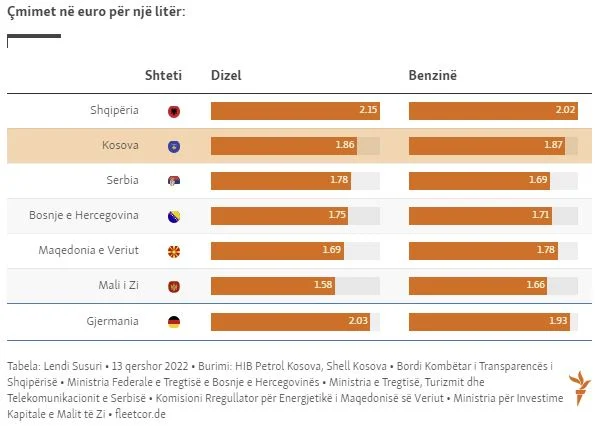
Serbia, for example, has set Friday the maximum price of 1.78 euros for a litre of diesel and 1.69 euros for a litre of gasoline. That award will be in effect by June 30th.
The head of the Kosovo Business Alliance, Agim Sahini, demanded that the government lift the excise for a certain period.
The state and budget will lose nothing because importative bases have increased. T The VSH and Dogana have already achieved the effect and with 25 to 28 cents to fill the customs-planned budget due to price hikes. These good examples should follow the Government, taking over the mode of several states such as Slovenia, Montenegro, Hungary and Northern Macedonia, he told REL.
According to Sahin, because of a research into the matter, the government is reluctant to take action on the issue.
“predicts that it risks filling the state ark, but I still say it does not endanger the budget, rather increase circulation, supply and purchase from other states”, Sahin said.
In order to regulate oil prices, the Ministry of Industry, Intervention and Trade announced on June 8th that the Government is learning to issue sublegal acts for regulating oil prices and other safeguard clauses.
Citizens in Kosovo are facing rising prices of basic products, while according to official data, inflation has been 11.2 percent in April. / REL