17 minutes ago
German Emissary: I am sceptical about the open Balkans, visas for Kosovo must come now
Periskopi(4 years ago)
(4 years ago)German government special envoy for the Western Balkans Manuel Sarrazin warns of the risks to come if there is no progress on the enlargement issue. Deutsche Welle: Mr. Sarrazin, the EU Commission placed at a record time for candidate status for Ukraine and the Republic of Moldova. How did you comment on this recommendation regarding the Western Balkans? Manuel [...]
Deutsche Welle: Mr. Sarrazin, the EU Commission placed at a record time for candidate status for Ukraine and the Republic of Moldova. How did you comment on this recommendation regarding the Western Balkans?
Manuel Sarrazin: From my point of view, if the EU Commission and the Council of the European Union makes enlargement policies credible, it is good for the countries of the Western Balkans because it speaks of the geostrategic importance of EU enlargement and that the enlargement process follows.
Bosnia and Herzegovina and Kosovo remain abroad. What should be offered to these two countries?
The promise of expansion made at the 2003 Thessaloniki Summit is still valid. For Bosnia and Herzegovina, 14 essential priorities remain to be met and reforms implemented so that candidate status can be granted. In Kosovo the government is making reforms and we want to reward them. Visa liberalisation for Kosovo citizens is one of those necessary steps to follow. But even the normalisation dialogue with Serbia must resume, and both sides must be ready for progress.
Hard dialogue for normalisation: EU special envoy Miroslav Lajcak (left), Kosovo Prime Minister Albin Kurti (centre) and Serbian President Aleksandar Vucic on 4 May 2022 in Berlin
Serbia continues to import gas and grain from Russia and send it to other Western Balkan countries and also to EU countries. Do you need more air conditioning towards Serbia?
We import gas ourselves. Therefore, caution must be taken to make it clear to Serbian President Aleksandar Vuciq that we expect him to support EU sanctions against Russia, but also not give him the opportunity to say that we are shutting off the lights in his country, because we also make sure that the decisions we make are economically reasonable.
Serbia is at the centre of Russian deninforms and the hybrid war that is spreading throughout the region. What do you suggest as measures to curb this influence?
The most important move against this is the credibility of the promise of European Union enlargement. So it is so important that we finally correct these mistakes we have made with enlargement policies, visa liberalisation and the opening of membership negotiations with northern Macedonia and Albania and show that when making progress, Europe keeps its promises.
There seems to be no progress with the opening of negotiations with northern Macedonia and Albania. Should not the two candidates split up and start negotiations with Albania?
You just talked about Russian dezination. Northern Macedonia will be a key target of Russian deninforms, but not only, which for us may strategically be an open wing to influences. Therefore, it is extremely important for the moment negotiations with both countries finally begin.
As the enlargement process is moving very slowly, the idea of regional co-operation, dubbed the Open Balkans, is increasingly shifting. What do you think of this concept?
In essence, I am very skeptical of the open Balkans. It should be clear that initiatives in the region should first be inclusive and offer real opportunities to get involved. And on the other hand, it is important that parallel structures not be opened. In addition, it should always be clear that they in no way replace EU membership.
The Balkan summit on 8 June 2022 in Ohrid, Northern Macedonia. Left to right: Zoran Tegeltija, chairman of Bosnia and Herzegovina's Council of Ministers Aleksandar Vuciq, president of Serbia, Dimitar Kovacevski, Prime Minister of Northern Macedonia Edi Rama, Albanian Prime Minister Dritan Abazovic, Montenegro's Prime Minister
Another format is the Berlin Process, which has had no major success in recent years. What specifically do you offer for it to become an attractive format for Western Balkan countries?
The Berlin Process has always been an attractive format. We've achieved a lot, for example, with the youth office RYCO. We have four agreements on the table that would take a major step towards developing a common regional market. We offer to resume work to achieve these worthwhile goals for all, with new powers and new themes. The new federal government is determined to take intensive care of the region throughout its mandate. We will have a long-term and strategic commitment.
Germany aims to participate again in the EUFOR Althea mission in Bosnia and Herzegovina after a ten-year pause. What signal do you link to this?
It was very important for us as a federal government that we proposed to Bundestag to make it clear that Germany is willing to engage in security policies in Bosnia and Herzegovina. The second is that it is important for us to hold elections in October 2022 in a safe and reliable environment.
Bundeswehr soldiers at the EUFOR mission in 2005 near Sarajevo. Germany wants to take part in the mission again
Four months ago, you took over the Federal Government Charge for the Western Balkans. Do you see things a little different today than when you started your mandate?
I wish the terrible experience of Russian war had influenced more key actors in the region to change, not to reinforce their former ways. We need to know that our “enemies in the Kremlin know very well that much negative things can be promoted in the region. So I would ask everyone as soon as possible to have as much cooperation and positive statements as possible before the Kremlin tries to take advantage of our disputes, lack of unity between us and within the region.
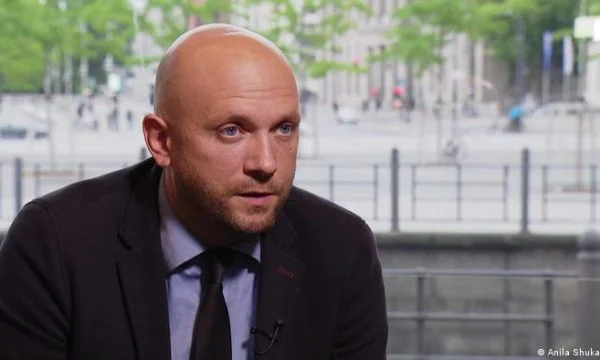
Manuel Sarrazin, 40, has been the deputy of Bundestag for Bündnis 90/Die Grün from 2008 to 2021 and is president of the Southeast European Society, the most important institution of academic and political consultation for Balkan affairs in Germany. As of March 1, 2022, he is the special representative of the German Federal Government for the Western Balkans.