4 minutes ago
“expects alive”, father of four missing boys refuses DNA
Periskopi(4 years ago)
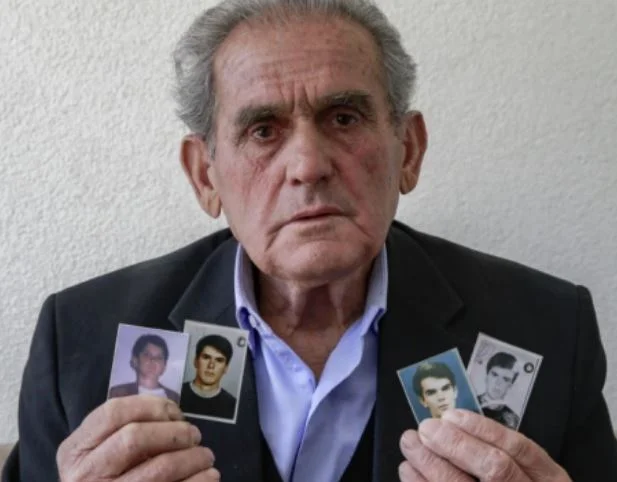
(4 years ago)Halil Hasani, 77-year-old from the village of Caber of Zubin Potok municipality, lives with confidence that his four sons, missing for more than 20 years, are still alive somewhere in Serbia and that one day will return. Hasani says his sons have been kidnapped by Serb forces in the village of Zabar [...]
Hasani says his sons were kidnapped by Serb forces in the village of Zhabar in Mitrovica on June 8, 1999, a few days before the war in Kosovo ended.
The world, the oldest son, Fadhil, has been 32 years old, Gazmendi 24, Armendi 20, and Hasani 15.
Their father says that, immediately after the war, he has established contacts with at least two persons of Serbian nationality who, as he shows, have told him that his sons have been sent to Serbia as <x0-beder war”.
They, according to information I have, first went to Belgrade. In Belgrade they have stayed less than a month. They have then taken them to Pozharevc [Serbia's city]”.
I've had connections and almost every week I've talked to one [of the contacts] and another every two weeks. They've always told me they're alive”, Hasani claims.
There's a lot more alive than you think, and they keep them conditioning... They're prisoners of war”, they're the words of one of his contacts, according to Hasan.
Distrusting the Institutes
Hasan does not want to identify the people he says he has talked to. He says the information he received from them has offered to representatives of Kosovo institutions.
But institutions' representatives, he says, have told him his sources are lying and that the information is false.
Hasan says that, later, representatives of institutions have offered him IDs found by both of his sons.
I was told: come get it. I didn't go after them. Why? Yeah, where were the 10-15-year-old IDs they didn't tell him? Where they were and who kept them” asks Hasani.
He says he has refused to provide samples of his blood, which would help eventually identify his sons via the DNA method in case they are among the morto remains in the mass cemetery or Pristina morgue.
The reason for his refusal, Hasan explains it this way:
Because, I don't trust them. As for bones, never find them. I think there's still alive and I expect them alive. As for bones, what do I need lying bones...”
At the Pristina morgue, now and for many years, some 400 unidentified mortary remains of missing persons during the war remain.
This, for the fact that many family members are reluctant to give blood for DNA analysis, which makes identification, mainly because of distrust in institutions.
Over the years, there have been times when remains have been incorrectly identified, based on traditional identification method based on anthropomorphic data, on clothing worn by victims, or on objects found in tombs.
Infographics mass cemetery locations identified in Serbia
ICMP: Unidentified bodies in morgue may be the result of misidentification
The International Commission on Missing Persons (ICMP) says the DNA method is reliable and that identification should be made through it.
This commission tells Radio Europe that it is necessary to review the traditional identification method even of some 2,000 other mortar remains found during the 1999-2001 period that may have been incorrectly identified.
Wrong <x0d authentication results in a large number of unidentified cases in the morgue. Today, at the Pristina morgue, there are about 400 cases of unidentified human remains that were exhumed two decades ago. These remains may belong to people whose families believe they buried them, while, in fact, buried someone else”, the ICMP says.
As an example, The ICMP mentions a project in Bosnia and Herzegovina, through which a detailed review of 12 morgues has been made and, in that case, a large number of missing persons have been identified.
The International Commission for Missing Persons will help Kosovo and is willing to help other countries in the region to take this important step in order to identify missing persons and resolve the issue of possible wrong identification”, the ICMP statement said.
IML: Mortore waste revision, long process
The Institute of Legal Medicine (IML) in Pristina says ICMP's data on unidentified human remains in Pristina's morgue are “only an assessment” and that the exact number will be known only after the mortor waste revision process is complete.
In the statement given REL, this institute says that, at the end of 2021, has formed a working group for revising mortore remains at the Pristina morgue, which is led by experts from this institute.
This process, according to the Law Medicine Institute, has begun to apply “in close co-operation with other members of the working group: E ULEX (European Mission for Law Rule in Kosovo), Government Commission for Missing Persons (KQPZH), International Red Cross Committee (ICRC) and International Commission for Missing Persons”.
“Reviewing the mortor remains in the IML will be a complex and long process, since, in addition to reviewing the mortor remains, there will be a complete review of individual files of all cases, so that we can finally have a clear mirror regarding the number and individual status of all”, the IML says.
Graichevi: Disbelief of Traumatized Families
Cases where families of missing persons do not want to offer blood samples and do not trust DNA analysis have enough, says Ahmet Gajchev, chairman of the Co-ordination Council of Associations of Families of Undiscovered Persons in Kosovo.
According to him, these family members believe their loved ones are alive and expect them to return one day, despite the fact that the institutions have offered evidence that they are not alive.
The families don't want to understand that. Meanwhile, institutions, especially the government commission [for missing persons] have insisted on this. He also insisted on giving away samples. But to convince family members, to be easier, it takes a large group of psychologists to work with them and convince them, because people are traumatized. There's a man who has three-four family members, five or ten [missed]. It means, it's painful this”, says Gajchev.
According to him, when family members realise that identification through the DNA method is safe and provide blood samples, the work of responsible institutions, but also of organisations representing the family of missing persons, is greatly eased.
That, Gajchev says, would also help identify several hundred mortore remains, which remain in Pristina's morgue.
But, he adds, institutions must initially work on identifying those cases that can be identified in Pristina's morgue so as to pave the way for family members who are reluctant to give blood samples.
The moment it [proves] that they're inside the morgue, people start to conscious and report themselves. Until the institutions are behind us in this direction, it's very difficult for us to convince family members to give five drops of blood”, says Gajchev.
Declaration of the Missing
In July 2018, at the Western Balkan Summit in London, the prime ministers of Croatia, Kosovo, Montenegro and Serbia, as well as the chairman of Bosnia and Herzegovina's Council of Ministers, along with nine leaders of European governments in the Berlin Process, have signed the Joint Declaration of Missing Persons.
The declaration emphasises the dedication of countries in the region and their partners to support efforts to find at least 11,000 still missing persons as a result of wars in the former Yugoslavia.
The joint declaration also supports the rights of all families of missing persons for truth and justice.
The issue of missing persons is also the subject of talks between Kosovo and Serbia, within the dialogue on normalising relations.
Serbia's President Aleksandar Vuciq has said on June 14th that Serbia is ready to sign an agreement with Kosovo on missing persons in the war, but has not offered more details.
During the Kosovo war, in 1998/99, about 13,000 people have been killed, over 800,000 have moved, while around 6,000 have disappeared.
Extinct, to this day, more than 1,600 remain.
Hundreds of victims of Kosovo Albanians have been found at mass cemetery in Serbia. / REL