16 minutes ago
Vladimir Putin is preparing Russians for the start of the fight NATO
Periskopi(4 years ago)
(4 years ago)Experts say the recent threats made by Russian officials concerning the countries that intervene in the war under way in Ukraine could serve a double goal to warn Western powers on one side, and on the other to prepare Russian citizens and have their support [...]
Experts say the recent threats made by Russian officials regarding revenge on countries that intervene in the ongoing war in Ukraine could serve a twofold goal to warn Western powers from one side, and on the other to prepare Russian citizens and have their support if a full-scale conflict with NATO breaks out.
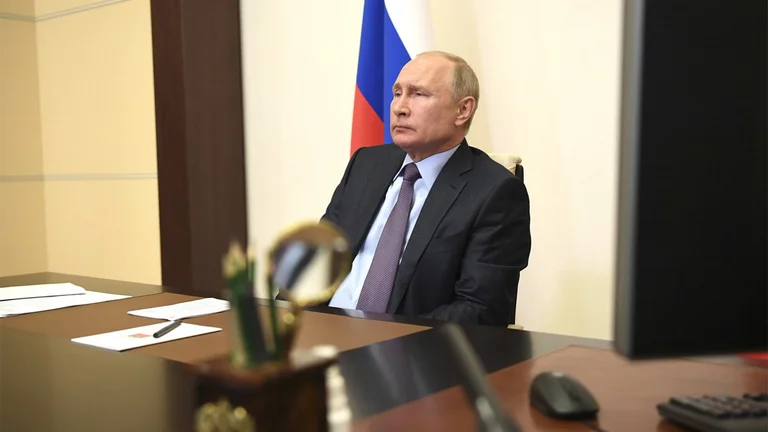
Russian President Vladimir Putin stated during a speech delivered last week that any country that “creates a strategic threat to Russia” during its war in Ukraine should host “revenge attacks” on the part of the Russian army that would be the Quick “as lightning”.
Several days ago, Russian Foreign Minister Sergey Lavrov said during an interview that “NATO is heading towards a war against Russia, through the Ukrainian Army, which is arming it to the maximum of”.
Various experts who have spoken of “NewsWeek” recently have indicated that Russian officials have added their threatening rhetoric as a way to fuel fears in NATO allies. Meanwhile, some experts think it is a Kremlin attempt to win the hearts and minds of the Russian public.
“all the time, the regime's internal propaganda has stressed that Russia is not at war with Ukraine, but with NATO and the West” -- declared Newsweek, Yuri Zhukov, associate professor at Michigan University.
There's an officer after that, after every Ukrainian military success. NATO, who tells Ukrainian where, when and who should shoot Ukrainian troops. This framework makes it easier to explain military losses to local audience”- he stresses.
Zhukov also says this Moscow approach helps him to create political support for possible full mobilization in the event of declaring the state of war in Russia, which the regime has so far been reluctant to do. This also creates political pressure to crack down on NATO targets, starting with supply lines”- says Zukov.
“I think that from Moscow's perspective, Russians want to build a narratory, under which everything starts from NATO and the United States”- says Jonathan Katz, director of Nima for Democracy and associate in think-tank “German Marshall Fund” with headquarters in the United States.
Katz thinks Putin “is exploiting the greed of NATO, the United States, to justify the actions it is taking against the Russian internal population”. Meanwhile, British “Financial Times” noted that when Putin mentioned during Wednesday's speech that Russia has “networks it needs for revenge attacks, similar to any”,
He could refer to an interccircular ballistic regate capable of carrying nuclear weapons that Russia had recently tested.
Meanwhile, Reuters news agency reported that Lavrov also went on to risk nuclear war during the conversation he held with Russian state media journalists last Monday. US President Joe Biden stopped on Thursday in threats such as coming from Russian officials, calling rhetoric a sign of the “punishment Russia is feeling for its terrible failure”.
However, John Kirby, the media secretary at the Department of Defence, said on Friday that these threats should be taken seriously, while he added that Putin must refrain from stimulating statements. It's completely irresponsible for a nuclear power to speak in this way about the possible use of nuclear weapons of any kind, of any size, and of any ray. We call on Russia to halt the escalation of rhetoric regarding nuclear weapons”- Kirby declared during a press conference. Zhukov thinks that if Western countries ignore Putin's threats, the Russian leader may feel pressured to take more decisive action.
There is a general impression in Europe and the US that Russia's revenge threats are bluffs. I think it is more likely that Russia will at last feel obliged to take certain kinetic actions against NATO countries, only to make its threats of revenge appear more reliable.” he stresses.
On Thursday, Russian missiles hit Kiev just moments after UN Secretary General António Guterres had completed a meeting with Ukrainian President Volodymyr Zelensky in Ukraine's capital.
Katz says that attack, which took place only two days after Guterres met with Vladimir Putin in Moscow, was meant as a clear Russian message to the West. “Sulmi with rockets in Kiev has been a message to everyone, that Russia is willing to take every kind of step, including missile attacks, to prevent Ukraine's partners from engaging in this conflict and helping Ukraine”- says Katz. Newsweek also contacted the Russian Foreign Ministry for a comment, without results. Newsweek