16 minutes ago
Who are the neo-Nazis fighting for Russia in Ukraine?
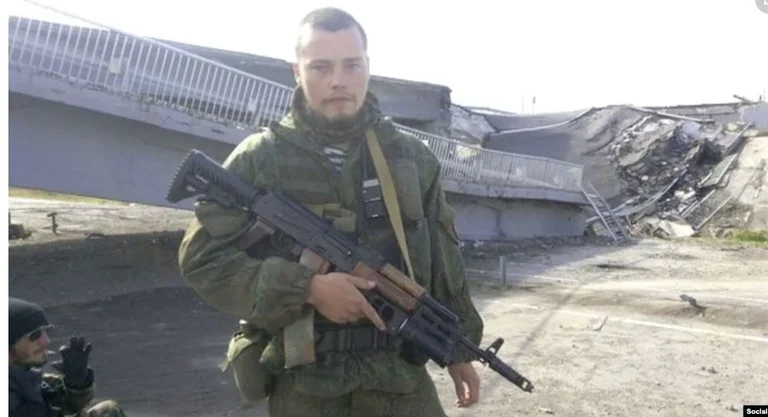
Periskopi(4 years ago)
(4 years ago)A video published in December 2020 shows two Russian men dressed beautifully wearing jackets and silk tiers drinking American whiskey and discussing the Ukrainian killing. I'm a Nazi. I'm Nazi”, heard by Alexei Milchakov, who was in the focus of the video published on [...]
A video published in December 2020 shows two Russian men dressed beautifully wearing jackets and silk tiers drinking American whiskey and discussing the Ukrainian killing.
I'm a Nazi. I'm Nazi”, it's heard saying Alexei Milchakov, who was in the focus of the video published in a Russian nationalist channel on YouTube platform.
I won't go that deep and say I'm nationalist, patriotic, imperialist and so on. I'll put it straight: I'm a Nazi”.
You need to understand that when you kill a person, you feel the desire to hunt. If you've never gone hunting, you should try it. It's interesting”, he said.
Apart from being a notorious Nazi, known for killing a puppy and posting photos in social media, Milchakov is the leader of a Russian paramilitary group known as Russia, which openly embraces Nazi symbolism and radical Nazi ideology. The group, and Milchakov himself, are faithfully linked to atrocities committed in Ukraine and Syria.
Along with members of the Russian Imperial Movement, a group of white supermacists who two years ago recognised the United States as a global subx0 terrorist organisation”, Russia is one of several right-wing groups that are actively fighting in Ukraine, in collaboration with the regular Russian armed forces or separatist units.
According to a confidential report by Germany's Federal Intelligence Service, which Der Spiegel has secured, and on May 22nd reported it, many rightist Russian and neo-Nazi extremists are fighting in Ukraine.
German analysts wrote that the fact that Russian military and political leaders have welcomed neo-Nazi groups undermines Russian President Vladimir Putin's claim, and his government that one of the main motives for launching the invasion was the desire to “denified” Ukraine, Spiegel wrote.
This fact, according to the report Spygel quoted, reportedly causes the alleged war motive, the so-called Ukraine denaziification, to be absurd”.
From Syria to Ukraine
Even before the invasion of February 24, war in Ukraine had attracted a considerable number of soldiers and warriors with the leanings of extreme right ideology. Most of the attention has long been focused on right-wing militias and paramilitaries who fought side-by-side or part of the Ukrainian armed forces a phenomenon dating back to the beginning of the conflict in the Donbas region in 2014.
Ukraine's famous Azov Regiment was formed by a right-wing militia named Battalion Azov, who gained fame in the early days of the war. The leaders and founders of the group have openly supported xenophobic rhetoric and have expressed themselves against immigrants. The logos of this battalion had great similarities with some logos used by Nazi entities during World War II.
Later, this battalion was included in the Ukraine National Guard and Azov softened extremist rhetoric, but has maintained the reputation of a formidable combat unit.
Russian officials for years have used Azovin and other nationalist figures of the 20th century, such as Stepan Bandera, for propagandistic purposes, often distorting or exaggerated their views and actions in support of the false claim that Ukraine is controlled or dominated by neo-Nazis.
In declaring the invasion on February 24th, Putin tried to justify it, saying the goals were “demilitarisation and denotation”. Governments in Kiev and the West have said that this argument is insincere and have indicated that even if it were true, it would not justify the launch of an unprotested invasion against a state with a democratic elected Government.
In recent years, however, less attention has been given to Russian right-wing militia fighting in the name of Russia, not only in Ukraine but also in Syria.
While some fighters are believed to have joined Russian private mercenaries company Wagner is the best-known Russian mercenary company, an unknown number of fighters have joined and trained by the Russian group, but also by the Imperial Russian Movement and its paramilitary unit, known as the Imperial Russian Legion.
Milchakov, a former parachutist, has been identified by experts as co-chairman of the Russian group, along with another Russian named Yan Petrovsky. Some experts say the group is effectively linked to the mercenary company Wagner.
The Russian group was officially founded in St Petersburg in 2014 under the name of the Sabotation and Russian Attack Intelligence Group.
Both Milchakov and Petrovsky have fought against Ukraine as volunteers in Donbas in 2014 and 2015 and have openly shown medals won as part of the “Donbass Volunteer Union”. At that time, however, Russia has repeatedly denied that its forces were fighting in Donbas, often saying decisively that local forces fighting Ukrainian troops were just local supporters.
In September 2014, near the village of Schaastia in Luhansk, Russia's militants fought the Ukrainian paramilitary group called Aidar. According to Ukrainian media reports, dozens of Ukrainian soldiers were killed in these wars. Later, images of disabled bodies and burned online, and Milchakov later openly boasted that he had photographed the bodies of murdered soldiers.
Milchakov also gained fame the same year that bloggers and journalists discovered a series of photos and videos from two years ago, in which he was seen killing a puppy, cutting his head and pretending to eat it.
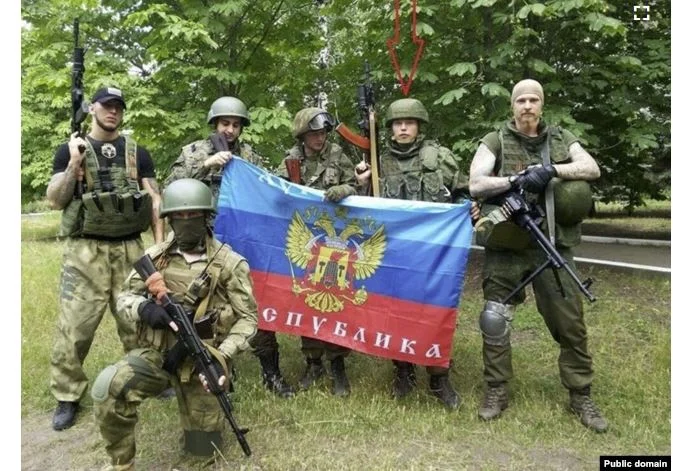
Russian Tabliod Moskovsky Komsomoletts entitled the article on the incident this way: “The fascist butcher from St Petersburg has gone to fight for rebels”.
Early in 2015, Milchakov and Petrovsky were sanctioned from Canada, Britain and the European Union. Milchakov “has actively supported the actions and policies that undermine Ukraine's territorial integrity, sovereignty and independence and further destabilise Ukraine”, Britain said when it announced its sanctions.
In October 2016, Petrovsky was arrested in Norway, where he was living and working with a Norwegian man who is linked to the far right group, the soldiers of Odin. He was expelled from Norway the same month.
Photos and videos published on social networks in 2020-2021 show that Russia's fighters were in Syria, where Russia has conducted a military operation to support the Syrian regime and eliminate the opposition fighters in Syria.
Media in St Petersburg, Fontanka at the end of 2017 also found photographs of Milchakov swimming in a swimming pool near the Syrian city of Palmyra.
The German intelligence report said the Russian group's fighters have been in Ukraine since early April.
There is no confirmation whether Milchakov or Petrovsky have been or are in Ukraine since the invasion began on 24 February. However, on May 27th, a channel on the social platform Telegram, which appears to be connected to Russia, published a photograph of the date when this photo was fired is unknown ) showing Milchakov and Petrovsky in Ukraine, standing next to a semi-torn armoured car.
“Milchakov... has returned to action”, written in post. It is now somewhere in Ukraine's vastness, actively engaged in densification and demilitarization”.
reserve team
On the day Russia began the invasion, the head of the Russian Imperial Movement, Denis Gariyaev, posted a message to its channel on the telegram, saying: “No doubt, we are for liquidating separatist entity Ukraine”.
Founded in 2002 in St Petersburg by Sranislav Voroboyov, the Imperial Russian Movement supports the monarchist ideology, partly motivated by the belief that Russia should be led by a descendant of the Romanov dynasty, the family of the last Russian Czar.
In April 2020, the U.S. State Department imposed sanctions on this group, as well as on Vorobokov, Gariyev, and another person.
The “group has provided pre-militar-style training to white supermacists and neo-notists in Europe and actively works to gather these kinds of groups on a common front against their perceived enemies”, the UN said in the statement. The “movement has two training centers in St Petersburg, likely used for forest and urban attacks, with tactical weapons and other combat training”.
A few weeks after Gariyew's post at Telegram, the war training center of this organisation near St Petersburg, called Partizan, announced the recruiting of volunteers to fight in Ukraine.
Gariyaev has also established an organisation called the Reserve Team, which, according to the German intelligence report, has received multimillion orders from the Interior Ministry, the Federal Security Service and the Federal Defence Service, which is the government agency in charge of offering bodyguards to senior Kremlin officials.
Like Rusich, warriors in the Imperial Russian Legion joined in fighting Ukraine's birth in 2014-2015, and according to information provided by militants, at least six members of this group were killed in that period.
According to German intelligence, Gariyaev was wounded in fighting in mid-April, and his deputy, Denis Nekrasov, was killed, likely near Izzium, in the Harkiwi region.
Alexandre Verkhovsky, an expert on extremist groups in Russia and head of the SOVA research centre, said it is likely that there will now be far fewer Russian extremist fighters in Ukraine than in the early years of the war in Donbas.
“Nationalists have played a key role in the first phase of the war”, he told Time Current.
“They were an important part, not most, but they were significant parts. Now we don't see large numbers of volunteers from Russia... maybe the maximum number is just a dozen”.
Artifact written by Mike Eckel based on the reporting of Dmitry Coshur of Time Current. / REL