17 minutes ago
The interview of Russian prisoners of war: Despite the slightest noise, I was sent to Ukraine completely unprepared
Periskopi(4 years ago)
(4 years ago)Still getting used to his sense of gun and military clothing, Anton suddenly found himself surrounded by Ukrainian forces as bullets flew very close, with one that hit his arm. It was the first confrontation with the enemy: we didn't even have a bullet. [...]
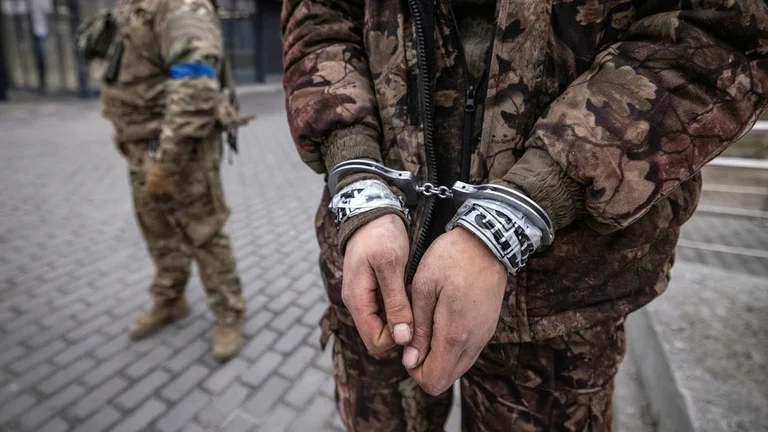
It was the first confrontation with the enemy: we didn't even have a bullet. They flooded us and we couldn't resist. We were forced to surrender”, Anton, a 21-year-old Russian servant, says in an interview for The Guardian.
Anton had been captured by Ukrainian forces near Mykolaiv on March 2nd, with five other soldiers from his unit as Russian forces staged an offensive to the heavily strategic shipbuilding city near the Black Sea.
Anton, who asked not to be identified by his real name, would spend the next 45 days on Ukrainian capture. He had finally been released in mid-April after Moscow arranged an exchange of prisoners with Ukraine and spoke of The Guardian from Russian territory.
Anton's story is an extremely rare tale of a Russian war prisoner who has since been exchanged, while both Russia and Ukraine have revealed very little information about the fate of hundreds seized Russians.
Moscow does not publish the names of its servants caught in Ukraine. During his capture, however, Anton was interviewed as a Russian prisoner by a prominent Ukrainian vlogger. He was also named a captured Russian soldier on websites close to Ukrainian authorities.
A family member of Anton further confirmed to The Guardian that he was caught in Ukraine and then exchanged. The Guardian was unable to verify all the details of his story.
Anton, who comes from a small and distant Siberian town, said he had signed the contract to join the army in late December, shortly after he graduated a vocal school.
In his reflection, he said he must have done everything” to avoid the military.
Anton's unit had first been transferred to the Crimea province- annexed by Russia in the last days of December, where he was told he was taking part in a week-long training course.
Until then, he claimed that he had not accepted practically any military training that would prepare him for a full-scale war.
As the weeks were passing on in the Crimea, Anton said some members of his unit began to worry that they would be sent to a war, a development he still considers as completely “absurd”.
A lot of young people couldn't imagine going to war. They lapped us in the last few moments of this, the night before the<x1..., he said.
“Fly, it's not fair how the Russian authorities treated me. I was sent to Ukraine completely unprepared”.
Anton's confession, which features a military unit that was kept in darkness about the invasion, highlights a number of other Russian soldiers who had similarly said they did not know they were going to a war until they entered Ukraine. Military experts have argued that the decision not to show a large number of its troops about the invasion is an indication for the stagnation of Moscow's military campaign.
On February 25, a day after Ukrainian troops entered Ukraine, Anton's unit was ordered to enter Ukraine from Crimea.
He said they had been sent with armed vehicles to the suburbs of Mykolaiv, which was under fierce attacks by Russian forces in the early days of the war.
As they marched on foot, part of the unit was separated from the main group, and they were cut off by Ukrainian forces on March 2, less than a week after their entry into the country. Anton said he was hit by a Ukrainian bullet while he was caught, breaking a bone of his hand.
Shortly thereafter, Ukrainian forces placed a bag in his head as he was being transferred to a prison cell, whose location he says he still does not know.
At first, life in captivity was dominated by fear. You're shaking at even the slightest sound. Every day you hope it won't be your last day and you won't be killed”, remember Anton.
He said he had not been physically abused during his capture, but assumed that Ukrainian guards now traumatised him and other Russian soldiers.
We were constantly told that Russia is finished, that we belonged to the mud of society. They threatened to let us starve”.
Anton adds that while some guards looked like “they wanted to hurt you”, most of the others were quiet and “did not allow their animal instinct to surface”.
Ukraine's deputy prime minister, Iryna Vereschuk, who is leading negotiations on exchange of prisoners, has not responded immediately to the requests for comments. According to the Geneva conventions, the ban on prisoners of war after capture should be viewed, not as the form of punishment, but as a measure to avoid further participation in a conflict.
But it was daily frustration that soon became the biggest challenge, Anton said.
If we were lucky, we were given something common to read. Sometimes they allowed us to watch Ukrainian propaganda on television. Most days we just looked at the walls before us”, he said, adding he was carrying three times during the capture.
At one point, he was asked to record an interview about his capture with a well - known Ukrainian vlogger.
Ukrainian officials have given journalists and vloggers access to interview Russian prisoners of war. Videos like this have been seen by hundreds of thousands of people on YouTube, but they have also faced criticism for breaking Geneva conventions.
In such a situation as a prisoner, you understand that it is not a real solution to say "no." You agree regardless they say you can refuse”, Anton said.
Later, in early April, Anton was told that he would trade for a Ukrainian soldier.
As Russia and Ukraine have agreed in exchange for some prisoners, the two countries have not published almost any details on mechanisms behind these exchanges. On April 4th, Ukraine had said it was holding about 600 Russian prisoners of war. Russia does not publish the exact figure, but at the end of March, the Ombudsperson had said there are more than 500 Ukrainian prisoners of war in Russia.
Since then, that number has increased to significant subservations, since at least 1,000 Ukrainian fighters -- including members of the Azov battalion -- had been transferred to the territory held by Russia when the Azovstal steel factory in Mariupol was taken by Russian forces last week. Ukraine has said that Azovstal fighters will be involved in an exchange of prisoners, but some Russian officials have said they could be punished or even executed.
According to Anton, he was part of a head-on exchange involving 17 Russian soldiers that had occurred near the Ukrainian town of Melitopoli.
As soon as he had returned to Russia, he had been immediately questioned by security services for his period in Ukraine.
They wanted to know if they could still trust me. It was a standard procedure”, he said.
But only a few days after he left a Russian hospital, he felt that his time in maintenance had touched his body and mind.
During capture time, I had blocked most of my emotions. I just tried not to think about my life”, he said.
But now, I have terrible dreams. I can barely sleep. I added a lot of weight”, he said.
Anton said authorities have given him about two thousand pounds as compensation for his injuries. Under Russia's military law, servants do not accept any special compensation because they have been prisoners of war, and Anton was waiting to return to the service as soon as he recovers from injuries.
But after his experience in Ukraine, Anton is now looking for ways to leave the military.
I just want to go home, that's it. All I want is to go home” /Periscope. Sokol Berisha/