17 minutes ago
British scientists analyze Putin's precious fighter aircraft's secrets: Findes
Periskopi(4 years ago)
(4 years ago)British and American scientists are analyzing the secret mechanism of long-range targeting Russia's most advanced fighter plane last night, reports Britain's Express-uk according to this medium, findings can make a huge difference in how the West conducts air-air fighting with Russia and China. Ukrainian troops knocked down [...]
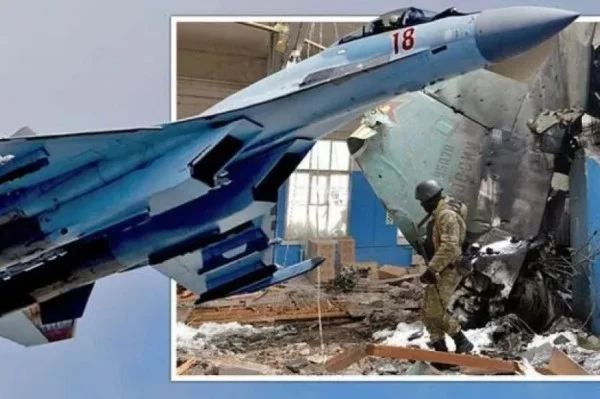
British and American scientists are analyzing the secret mechanism of long-range targeting Russia's most advanced fighter aircraft last night, reports Britain's Express-uk.
According to this medium, the findings can make a big difference in how the West conducts air-air fighting with Russia and China. Ukrainian troops knocked down Sukhoi Su-35S using short-range firing missiles two weeks ago.
Ukrainian Air Force specialists were able to take vital elements from its burned remains and informed British intelligence. Systems were transported to the Government's <x0 Government Defence, Science and Technology Laboratory in Porton Down, Wiltshire, where two experts from the US Air Force have spent ten days examining them.
The initial assessment was considered so promising that systems have now been sent to Nevada, the US, for more forensic examination.
Called “Flanker” from NATO, the fighter plane was conducting an operation called “Hospitalization of Enemy Air Defence” (SEAD), when it crashed suddenly near Izium, about 75 miles from Kharkiv, in eastern Ukraine on April 3rd.
Her pilot was caught after being thrown safely.
Flanker is Russia's equivalent to fifth-generation F-35, which is currently used by RAF and 14 other NATO nations, although it does not possess hidden technology.
And the prospect that NATO powers examine its sophisticated internal functions will cause concern among the air force chiefs in Russia, which operates 47 of them.
It has also caused shocking waves in China, which, as Russia's biggest defence partner, is now proud of the second largest fleet in the world to have signed a $2 billion deal for 24 of its combat aircraft in 2015.
Although the plane was severely damaged, sources say that there is much left of the target system for detailed analysis.