7 minutes ago
Waiting for elections in Serbia ? Wuchiqi again?
Periskopi(4 years ago)
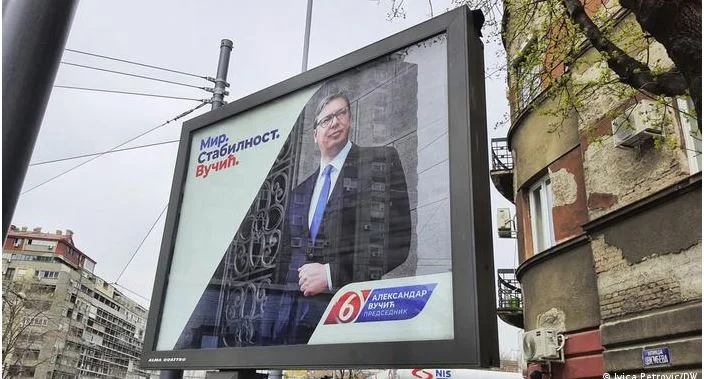
(4 years ago)Presidential and parliamentary elections will be held in Serbia on April 3rd. It is believed that the major election winner will again be President Aleksandar Vuciq. Wherever Serbian President Aleksandar Vuciq appears, he is received with national flags and great applause. It is difficult to say how real such applause is. [...]
Wherever Serbian President Aleksandar Vuciq appears, he is received with national flags and great applause. It is difficult to say how real such applause is. But the fact is, they're all well organized. Thousands of his sympathies go to bus manifestations. Independent Serbian media claim participation in these manifestations is mandatory for employees in municipal administrations.
“We want to gain deeper than ever before and show that Serbia is choosing future, freedom and stability”, Vuciq says.
Serbia stands before super-elections, which will be held April 3rd, 2022. This day presidential elections, early parliamentary elections and local elections are held in Belgrade. The victory of President Vuciq and his Serbian Progressive Party (SNS) now seems certain. A large betting office in Belgrade offers only two euros in profits per hundred euros of bet for Vucic to win. Polls also suggest Serbia's strong man could win presidential elections in the first round. It certainly seems even the absolute majority that is pro-SNS. While the divided opposition is given only chances in the capital, Belgrade.
As a camp commander
The Vuciki is repeating two words Every day at every television interview. A message that has accompanied his campaign since the beginning of the Russian war against Ukraine. The EU membership candidate country supports Ukria's territorial integrity, but has not backed Western sanctions against Moscow. Not only because most Serbs see Russia as a cultural and historical brother state. Serbia has its own interests, because it depends on Russian gas and energy. While in the Kosovo issue, Russia supports Serbia and does not recognise Kosovo's independence.
The fact that the war in Ukraine is dominates media headlines there is also very appropriate. As a camp commander, he calculates how many tons of grain, corn, or canned sardines there are reserves in this country. He promises that there will be peace with him in the Baltic powder barrel.
“Propaganda aims to scare people,” says philosopher Vladimir Milutinovic, who wrote a book on Vuciqi's rhetorical techniques. “Tabloids write that an economic collapse is inevitable elsewhere, that Germany is threatened by hunger as well. Such statements are intended to present Serbia as an oaz of stability. ”
No work without party booklet
Aleksandar Vuciq has kept all the brakes in Serbia for ten years. His party SNS controls key landscapes and televisions, state companies and local governments. Political opponents are regularly demonised as thieves and traitors in the toilet show. Vuciq himself describes his party as a “movement Catch-all” A gathering place for all, mostly free of any ideology. The SNS has about 700,000 members who are one tenth of the country's population. For a good reason: Without party booklets, a job in state administration, public service or state companies is almost impossible. What about the party program? The program is called Vucinq.
“The SNS also defines public opinion,”, says Dejan Bursaq from the Institute for Political Studies. This allows Vuciqi to send conflicting messages and appeal to voters on all sides. He makes agreements with Kosovo, but spreads harsh nationalist rhetoric. Or he boasts that Serbia was almost the first country to have enough vaccines against the corone. ”
“
The opposition, on the other hand, has little chance of gaining support. Their main topics of corruption, environmental destruction and alleged links between government and mafia are currently getting even less attention because of the war in Ukraine.
Just a few months ago, Vuciki's opponents hoped their topics would have priority. At the time, environmental activists blocked highways across the country to protest a planned lithium mine in western Serbia. The British-Russian mining company Rio Tinto will destroy nature, while the country will not benefit anything, critics of the project said.
It was the first time Vuciqi had to go to crisis management. And he knew it could jeopardize his campaign, so he took his license off Rio Tintos.
The weekly magazine Vreme writes that such political dominance would not be possible without the co-ordination of most media and almost unlimited financial resources of the ruling party. Investigation reporters recently found that between 2015 and 2021 The SNS spent about 23m euros solely on election campaigns three times as many as all opposition parties combined. The regime has everything under control and can play cat game with the mouse with its political opponents, Vreme comments.
The opposition has largely boycotted the previous 2020 parliamentary elections due to unjust conditions. Some coalitions are now expected to be introduced into parliament. The United Coalition for Serbia (US), comprised of a wide spectrum of centre-left and right democratic parties, could get between 15 per cent of the vote. Their presidential candidate, Zdravko Ponos, former chief of the Army General Staff, could win even more votes. The new left-celled coalition “Moramo” could also pass the three per cent threshold of votes and enter parliament.
Nationalism
The right nationalist scene, which ran with five presidential candidates and five lists, is going through a much harder time. True, many voters are open to patriotic and nationalist slogans. Over 80 per cent of the country's citizens refuse Serbia's NATO membership, and about two-thirds view Russia as the most important partner. However, the rightist and nationalists do not really have good chances of entering parliament.
Politologist Bursack has an explanation for this. People have been a little less interested in topics like the Kosovo issue than in social and economic issues. Nationalism today is not the basis of populism but simply an addition.
New Debts
Vuciki's top voters have been the biggest losers in economic crisis since 2012, pensioners, households and middle-income workers. During the election campaign, the president promises new factories, highways and hospitals. The message is clear: there is hope for Serbia and for all”, Bursaq says of the DW.
Some observers warn that the government can respond to the current crisis only by receiving large amounts of new debts. After the elections, food and energy prices threatened to increase. Analysts are also convinced that even pressure from Brussels will be great to participate in sanctions against Russia. / DW