6 minutes ago
Russia's new weapon in Ukraine: What's hypersonic rocket?
Periskopi(4 years ago)
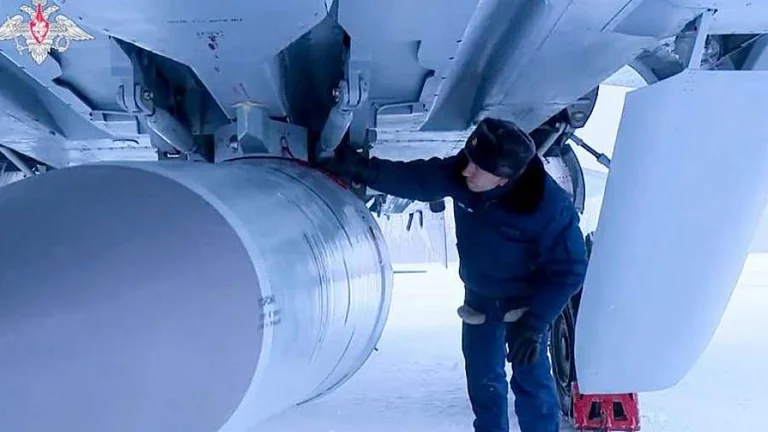
(4 years ago)The Russian Army said on Saturday it launched hypersonic missiles in Ukraine -- the first known use of the new weapons system in a combat environment. Defence Ministry spokesman Igor Konasenkov says that the weapon '%s' means a Russian knife destroyed a large underground missile depot and [...]
Defence Ministry spokesman Igor Konasenkov says that the Kinjal é, meaning a Russian knife, destroyed “a large underground missile and ammunition depot” in western Ukraine, Euronews writes.
Vladimir Putin has described hypersonic weapons as <x0 possible”, but what exactly are they?
Moscow claims that these missiles fly at extremely high speeds of up to 12,000 miles [12,000 km] per hour, which combined with maneuvering makes it extremely difficult or impossible to retaliate. However, some Western military experts think Russia could exaggerate their weapons' hypersonic air-land.
“Raceta hypersonica has a greater capacity of extenuation and destructive power due to very high speed”, explains military analyst Vassili Kachine.
Another military expert, Pavel Feugenhower, said the use of the Kinjal missiles does not give Moscow a strategic advantage, but is more of a psychological advantage.
The “essentially does not change the field of battle, but certainly there is an effect on the aspect of psychological propaganda, to intimidate all”, he explained.
Moscow has developed this range of hypersonic weapons to be able to avoid defence systems as American missile shields in Europe, but China has also successfully tested an hypersonic aircraft, and North Korea claims it is also developing hypersonic weapons.
The U.S. “does not have this weapon at the moment”, says Vassili Cash.
Various types of Russian hypersonic weapons
Kinjal:
Successfully tested for the first time in 2018, Kinjal struck all of their targets during the evidence at a distance of 1,000km to 2,000km, according to the Russian Defence Ministry. But this range can expand.
Avangard:
Russian hypersonic missiles Avangard are able to change their course and altitude at very high speeds, making them virtually impregnable “ ”, according to Putin, which compares their scientific and military development progress “with the creation of the first artificial Earth satellite”, the famous Sputnik.
Successfully tested in December 2018, their speed later reached 27 times the speed of sound and hit a target set about 6,000km away, according to the Russian Defence Ministry. They were put into service in December 2019. hypersonic aircraft Avangard are capable of carrying nuclear loads.
Zirkon:
Hypersonic rockets mix from a ship or a surface submarine. The first official departure was in October 2020 and flew nearly 12,000km to hit targets on land or sea.
Other tests have been held since October 2020 in the Russian Arctic.