13 minutes ago
Russian threat: Germany Towards Great Military Power
Periskopi(4 years ago)
(4 years ago)The historical twist in Germany's foreign and security policy is a turning point towards Europe and the West, not closure. Public opinion in Germany strongly supports this transformation. Little concrete was suggested by this historic twist of Germany's foreign policy and security. The new government coalition programme bears the title “Let's dare [...]
Little concrete was suggested by this historic twist of Germany's foreign policy and security. The new government coalition programme bears the title “We dare make more progress”. It is a fact that this programme of two leftist parties, with pacifist wings, and a right party does not fall behind Merkel's conservative governments' programme in foreign and security policy.
But the new government's first steps reminded us of the continuation of the policy up to date. The government did not specifically state that the Nordstream 2 gas pipeline would be suspended, though it meant that. Sending Ukrainian weapons was ruled out. His attitude toward Russia was explained with the past.
This was the situation when Russia's offensive against Ukraine brought a tectonic shock of Germany's basic foreign policy and security principles.
Week When Everything Changed
This was the situation when Chancellor Olaf Scholz announced on Tuesday (22.02). Russia had recognised separatist republics in eastern Ukraine. Four days later (26.02). Germany decided to send weapons to Ukraine. Russia had just launched an offensive against Ukraine. And one day later (27.02) Chancellor Scholz gathered the federal parliament, Bundestag, at a special session, due to the situation in Ukraine.
There Chancellor Scholz gave a historic speech. With it he announced the reshaping of elements of German policy identity after Germany's reunification. It is a historic change in Germany's foreign policy and security course. This change will redefine Germany's role in the world. Chancellor Scholz's word contained five basic points. From the way the talk was built and the atmosphere, not a few people were reminded of the ten - point talk by Chancellor Helmut Kohl, with whom he determined the steps for Germany's reunification.
Turning Elements
Of the five “tasks for action” listed by Chancellor Scholz in his address, major changes affect security policy first. And second, Germany's energy policy.
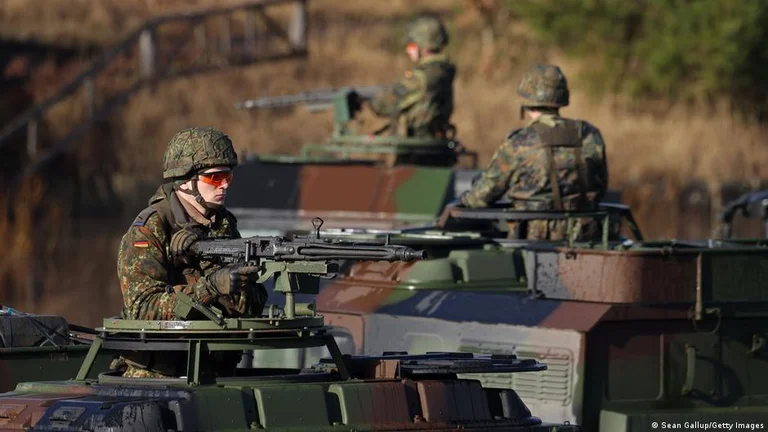
A revolutionary change can be discussed in security policy. Chancellor Scholz said Germany would triple its defence budget this year. Another 100 billion euros -- special funds -- will be added to 49.9 billion euros, military expenditures planned for this year.
But revolutionary change consists, first of all, in future defence spending. Germany will spend on defence since next year, more than 2 per cent of GDP. So it will spend more than 71 billion euros a year. That means Germany will become the world's third military spending power, after the US and China. Germany will become a major European military power. Not only this year, but also from next year, Germany will spend more than any other European state on defence.
German Finance Minister Christian Lindner told the ARD that our “objective... is to have one of the most effective, most powerful armies in Europe” in this decade. It will also be fixed in Germany's constitution for military funds not to be affected, to be used differently, even if governments are changed.
The number of German soldiers has not yet been covered. Until 31 years ago, Germany had 500,000 soldiers. Today the number of soldiers is 183,758. Germany aims to preserve the structure of professional soldiers and volunteers, prepared for time duties. Calls for reintroduction of mandatory military service are rejected by most parties, at least as long as Germany's territory is not endangered. Reincreasing facilities for compulsory military service would receive urgently needed funds.
Scholz: „vs. ”
It is noteworthy that it was the threat of the Soviet Union to democracies and peace that led Germany to re-arme following World War II. Resigned only five years after World War II.
Now it is the Russian threat to democracies and peace that Germany decided to become the world's major military power.
Chancellor Scholz said in his speech that we are experiencing “a age change of”. “This means that the world later is not the same as the world before”. “We will need to invest much more for our country's security. ”
Germany's Foreign Minister Annalena Baerbock said that “Germania leaves behind today a particular and lonely form of restrictions on foreign and security policy”. “When the world changes, our policy must also be”, the German Foreign Minister said.
Germany's turning towards Europe, not itself
Such a large military investment will highlight a new role in Germany. Chancellor Scholz designed the events of this role. With massive military investments, Germany will not only become much better able to defend itself. Scholzi declared that Germany is determined to support with its ability NATO, protect the alliance.
With the review of basic foreign policy and security principles, Germany responds to the expectations of Europe and the West. The major turning point in German politics is a turning point towards Europe and the West, not national closure in itself.
In his speech Chancellor Scholz especially stressed the goal of an even stronger relationship with Europe with the European Union. Scholzi said in the speech not to be forgotten in Germany to be asked, what is best for Europe, for the EU, not just Germany, in Brussels.
The Chancellor stressed that defence skills, Germany will develop together with European partners. He called the “absolute priorities” the construction of the other <x2bres of fighter aircraft and tanks, along with our European partners, especially France”.
Until the modernisation and development of future European aircraft, to transport American nuclear weapons to Germany, Germany will purchase American F-35 aircraft. They will replace Germany's current Tornado aircraft. The Chancellor also noted the purchase of armed drones - innovation in Germany.
Warnings came immediately from the leftist circles in France for the risk posed by Germany's “a rearmatation”. But Germany is aware of the need to calm the partners. They don't have to be afraid of today's Germany, which is becoming a leader even in foreign and security policy, not just economic policy.
Back to Energy Policy
In the same spirit, in his speech Chancellor Scholz determined the goal of overcoming Germany's dependence on importing energy “from special suppliers”. The word is primarily about cutting Germany's energy dependence on Russia.
To that end, the expansion of renewable energy will be promoted, even more so. But by that time, the length of the operation of coal power plants is now under consideration. At the same time, the duration of the operation of nuclear power plants in Germany is under consideration. Bavaria is even discussing the restoration of a closed nuclear plant. A national coal supply is also being created by buying coal on the world market. Two terminals will be built quickly to import liquid gas.
Returns to Public Opinion and Party
The return to Germany's foreign and security policy was supported by all government coalition parties in the German Bundestag, as well as the CDU/ CSU.
The Social Democrats acknowledged the new reality in relations with Russia and the end of efforts to draw closer to Putin; the Greens acknowledged the need as well Hard power, Military power to protect Germany and Europe; The FDP liberals acknowledged the need for indebtedness with special defence funds.
Impressive is the German public opinion's support for the shift in Germany's security and foreign policy. According to the demoscopic Forsa Institute, sending weapons to Ukraine and increasing Germany's military spending support 78% of Germans. We remember that no further than 2010, former president of Germany Horst Köhler resigned after criticism of the statement that a country of our size... should also know that in case of emergency, military engagement is needed to preserve our interests. ”
Chancellor Scholz also used this change of public opinion to present major changes. Peace marches, with hundreds of thousands of participants in Germany, give him the right.