10 minutes ago
NATO: Lipsets Reconception in Defence and Prevention · Global Voices
Periskopi(4 years ago)
(4 years ago)Russia's invasion of Ukraine puts NATO under pressure not only now from actuality. Even in the long term perspective, war will cause the alliance to massively increase its weapons capacity: land, sea and air. Jens Stoltenberg hits the hammer table three times so that participants can concentrate. Secretary - General NATO, [...]
Jens Stoltenberg hits the hammer table three times so that participants can concentrate. Secretary - General NATO, a Norwegian, is not easy these days. On the agenda again is war in Ukraine.
On Wednesday (16.03) the defence ministers of the alliance's 30 member states gathered in Brussels. Also invited were their counterparts from Ukraine, Gjerogia, Finland, Sweden, as well as EU representatives, who partially participated through the online connection.
The meeting is seen as preparation for NATO summit in the presence of US President Joe Biden next week.
Lately with the start of Russia's „absurd war” in Ukraine, that is how Stoltenberg describes it, the North Atlantic Pact must face several questions. First of all, with a demand that Ukraine's president Voldymyr Zelensky makes for it. Like. Why NATO does not create a no-fly zone over Ukraine.
Even though very few NATO partners, such as Etsonia, neighbouring country with Russia, call for blocking airspace over Ukraine, the alliance has so far persistently rejected this. To realise such an area, NATO warplanes would have to fly into Ukrainian space and shoot Russian aircraft.
So far NATO has always stressed that it will not directly intervene directly on Ukrainian territory, says Lena Coyala, director of Tnktank „Eastern Europe Studies Centre” in Vilna, Lithuania. A no-fly-zone coalition partners won't even set up in the future as an option.
Not NATO Troops in Ukraine
German Defence Minister Christine Lambricht stressed in Brussels that, of course, we are stationed on the Ukrainian side, but it is important to preserve the reason. ” We need to make it clear that this is not war, in which NATO” participates, says Lambrecht. The goal of the alliance should be to avoid spreading it.
Even if NATO and its members repeatedly make clear, that they will not mix themselves in Ukraine, because this state is neighbouring, but is not a partner of the alliance, one thing is clear: NATO cannot continue as before after 24 February, the day Russian tanks marched across the border in Ukraine.
Secretary General Stoltenberg said on Wednesday that „the brutal invasion” of Ukraine will change security in Europe, that Russia's war will have long-term consequences for the entire alliance.
More troops on the east flank
Among these long - term consequences is the question of practical matters: How many bodies must be deployed, and where? What military pass is needed? How much to invest?
But the principled question also arises: What can NATO do about defence and prevention? Is it her intention only to dislocate some troops or, in case an attack on a member country can really protect him?
Tony Lawrence from Tank „International Centre for Defence and Security” in Tallinn in Estonia, says NATO has so far sufficed with small troops made up of individual coalition armies.
According to Jens Stoltenberg, there are currently about 40,000 men and women under NATO command on the east wing, mainly in Baltic and Poland. Since the beginning of the war in Ukraine are also hundreds of thousands of soldiers in Europe willing to intervene, if necessary, he added in Brussels on Wednesday.
Because the security situation has deteriorated much more than months ago, NATO must deal with it very seriously, if the current prevention approach is still appropriate for the present time”, Tony Lawrence declares in a discussion of the DW.
Secretary NATO Jens Stoltenberg from Wednesday's meeting in Brussels sent a signal that things will change. NATO faces a new reality, Stoltenberg says. “We must reorient our collective protection and prevention. ”
Is the Foundation Act an obstacle NATO-Russia?
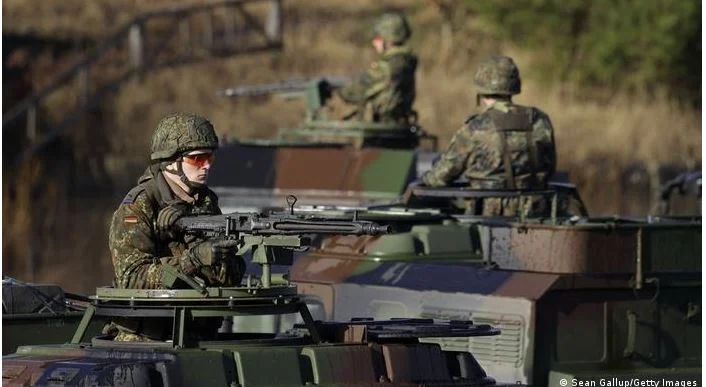
On earth it means much more troops on the eastern side of the alliance. With a better weapon and a readiness for faster mobilization, on the one hand, on the other side of the sea more warships, in the air, a stronger antiaircraft and rocket protection.
Antiaircraft protection is now what is missing in eastern NATO, says Tony Lawrence from the “International Centre for Defence and Security”. “The war in Ukraine is now telling us how important air protection is. ”
According to Lena Kojala from Tinktank „Eastern Europe Studies Centre” in Vilna in this context, a role also plays, which the eastern border of Vilna NATO has become more fragile. “Belarus is already a protracted wing of the Russian Army, is not an independent country”, Kojala says. This is primarily because this country allows Russia to launch missiles from its territory.
How many troops will be deployed in the future under NATO command in Europe, and when Stoltenberg did not say so, but he made clear, which does not consider the Constitutional Act as an obstacle NATO-Russia. The declaration, signed in 1997 by NATO and Russia, stipulates that NATO is not allowed to delocate long-term troops in significant capacities at borders with Russia.