26 minutes ago
The Law Battle Between Church and University for Land Over 4 hectares of university campus
Periskopi(5 years ago)
(5 years ago)Two months remain until the Pristina Constitutional Court is expected to consider the question of who has the right to exploit land on 4 hectares, at Pristina University's campus (UP), where there is an Orthodox church. That land will be faced in court UP and the Serbian Orthodox Church. E [...]
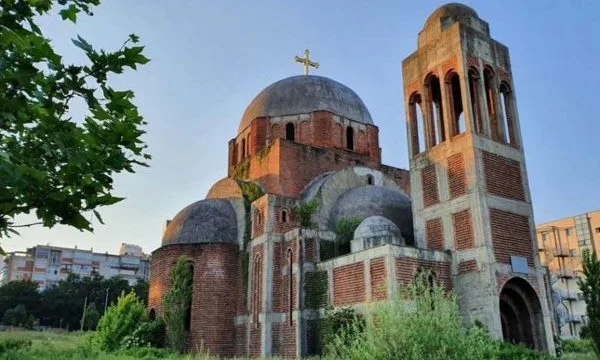
Surrounded by several faculties and parts of the university campus, the unfinished building of the Orthodox Church called the Church of Christ Savior stands.
The silence and emptiness that own this facility was broken on June 10th, when a liturgy from the Serbian Orthodox Church was held, which Kosovo institutions called “violation of public safety regulations”.
What should happen to the church and how the disputed land should be exploited has been subject to controversy for a long time.
UPP students consider that the political problems surrounding this issue are trying to exploit the entire land that they think would have to meet the university.
Donat Prekopuka, a student of the Jurydic Faculty, said the unfinished church should serve to reflect war crimes in Kosovo from 1998-99.
I don't think it's fair, since I know there's no permission. But if it isn't already destroyed, I think there should be a museum to see war crimes done by the occupant himself who built the church”, he said.
Meanwhile, the Burrnik Stand, a student of the philosophical faculty, considers that religious objects of any kind have no place near or within the university campus.
I don't think the church should be found at all in faculty courtyards. Just some park or something more attractive, not church or glass or whatever it is”, she points out.
Keeping liturgy at church in June was considered political action by Culture, Youth and Sports Minister Hajrullah Ceku as well.
To organize political liturgy makes you political church. So instead of uniting people, you start conflict”, he wrote on Facebook.
Representatives of the Serbian Orthodox Church have not responded to the request for comment on the matter from Radio Free Europe.
However, the representative of the Serbian Orthodox Church in Kosovo, Igumeni Sava Janjiq, in 2015, had declared that this church is legal and is not Milosevic's, as portrayed.
We consider that it is not a political church. Our attitude is and we have repeated several times, that we have all the documents that the church has become legally and that it is not Milosevich's church. He didn't build it”, he said.
Despite reactions to church liturgy, Milica Radovanovic, law student who also works at the New Social Initiative organisation in North Mitrovica, thinks no one can prevent the use of land to the Orthodox Church, since they are currently the legal owners of this parcel.
Whatever is often forgotten in Kosovo is that at this time, the Serbian Orthodox Church is the land's legal owner in accordance with the legislation in effect in Kosovo and has the right to use the land and property built on it. The court has confirmed the ownership of the Serbian Orthodox Church twice so far and until the end of this trial, and perhaps even after it, the Serbian Orthodox Church is full owner in accordance with Kosovo's law and its right to exploit the land should not be questioned”, she said.
Kosovo: Orthodox Church Christ Savior, at Pristina University campus
Maratonic Court
The issue of land exploitation at the UP's university campus has been the subject of trial since 2012.
Pristina University had lost its initial trial in this case after failing to appear in court at the conference in 2015.
Later, the Court of Appeals in 2017 also granted the church the right to land ownership by rejecting the UP's indictment.
In the same year, the university initiated a new indictment for which no court hearing was held until early 2021.
At the trial session held on March 25th, University of Pristina legal representative Esat Kelmendi had called for delaying the process with the aim of collecting evidence.
That, according to him, in the absence of cadastre documents for the 1990s, has been difficult to collect evidence showing how land had been passed into church exploitation.
The UP in this case, claims that land owned by the Pristina municipality has been in free and unhindered exploitation since 1975.
Kelmendi has not answered Radio Free Europe questions about the collection of these evidence, calling “sensitive process”.
In view of the importance of this subject, I regret to tell you that at this stage there is no information available. The subject is under trial, so we don't want it to be in any way interferable in the process, maybe even damaged by the” process, says the UP's written answer.
Although the land issue has been described as a political and political problem, until now, the government and the state attorney have not been formally involved in this court case.
Sami Istrefi of the state attorney told Radio Free Europe that the university does not represent it in court, but that they could do so in case of an excuse made by the latter.
I've had a meeting with the university secretary, a prodecan and a lawyer who committed it. Exclude this consultative meeting, no meeting, no representation or other matter. We have no written requests, except for a consultative meeting, and there we have been trying to explain our property rights in that box”, he said.
In this process, neither representatives of the Serbian Orthodox Church in Kosovo have answered questions.
Church or museum?
The unfinished structure of the church, located on the controversial land, was built in the 1990s, respectively, at the time of Slobodan Milosevic's regime.
In December 1992, the foundation of the church was laid, and by the beginning of 1999, this church was built to its present form.
Historian Jusuf Bujowi, for Radio Free Europe, said this church is one of the clean evidence of the Belgrade regime, Milosevic at the time, respectively.
According to him, nor is the trial currently under way expected to favour the UP.
This church has no history, it is violent, and politics should be brought in accordingly. I have to say that this process is unfortunately completed at the expense of the University of Pristina, because in 2017 it was not presented to the court. ”
Students, scholars, and even nongovernmental organizations have been pushing the idea of this church becoming a museum.
According to historian Bujovi, this would be an acceptable solution but that it would have to be reached even with an agreement between the political level in Kosovo and the international factor.
Perhaps with an agreement between the Government of Kosovo and the European Union, but other factors, for this object to at least become a Kosovo museum, in a cultural museum and others, but these are just theoretical possibilities”, he said.