12 minutes ago
Scholar Attacks Surro, VV member for History Rewrite
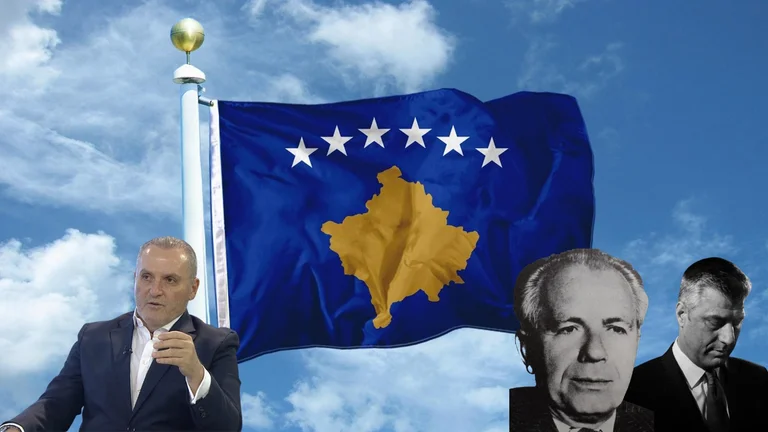
Periskopi(5 years ago)
(5 years ago)Scholar Artan Mustafa has published a scripture on Sbonker blog challenging the versions of Veton Surroi and Besnik Pula about Kosovo's history from 1945 onward. Mustafa has witnessed inconsistency in the interpretation of Surroi and Pula in three topics raised. Surroi as well as Pula have repeatedly denounced corruption [...]
Mustafa has witnessed inconsistency in the interpretation of Surroi and Pula in three topics raised.
Even Surroi, but Pula has repeatedly denounced corruption in Kosovo's post-war politics, as the first has also related the role of the KLA. This, especially in terms of corruption and inequality, Mustafa says Surroi has hidden it for the Yugoslav Communist League.
And Surroi, and Pula, who seems to be a member of the VV General Council, have had relatives in the high hierarchy of this party.
The top social subx3>, unfortunately, has longer history than the years under the Democratic Party of Kosovo (PDK), the Democratic League of Kosovo (LDK) and the Alliance for the Future of Kosovo (AAK). There is also a party that has been very corrupt, state catcher and that has governed the country twice as long as the Kosovo Communist League. Distinction from the inequality trajectory requires a break from the legacy of that period, however, more controversial from the broader perspective.” ) wrote Mr. Mustafa, here comes Periscope.
Mr. Mustafa:
High social inequality, unfortunately, has longer history than the years under the Democratic Party of Kosovo (PDK), the Democratic League of Kosovo (LDK) and the Alliance for the Future of Kosovo (AAK). There is also a party that has been very corrupt, state catcher and that has governed the country twice as long as the Kosovo Communist League. Distractment from the inequality trajectory requires a break from the legacy of that period, however, more controversial by broader perspective.
After publishing the results of Exit Polls in connection with the February 14th vote, social science researcher and member of the Vetevendosje Movement General Council (until late or not), Besnik Pula wrote on Twitter: “This means that none of the ruling parties, who have been in power in Kosovo over the past 20 years will be in government. A truly historical change and opportunity change... ”.
Three days later, February 17th, publicist and former party founder O RA, Veton Surroi, made a Facebook post congratulating among others on the anniversary of Kosovo's independence, former communist leader Fadil Hoxha, but not even leaders issued by the former Kosovo Liberation Army as such. Hashim Thaci, Kadri Veselin of Ramush Haradinaj.
Surroi does not say in the post in question, but can be assumed based on a series of his writings of recent years that he thinks Fadil Hoxha has done more for Kosovo's independence than KLA leaders. In the book “Snake Legs” (2017), Surroi argues that Hoxha's definitions towards autonomy are essential “for building Kosovo state identity” (fq.185). While in the same book (and other scriptures) repeatedly highlights the element of the “state capture” from parties emerging from the KLA.
Surroi also says the KLA had not reached “to structure as army” and that it had not “managed to free the country” (f.81-2), but that it had done so NATO. It also raises human rights violations after the war by KLA structures, such as when, referring to the case of Nazim Blace's testimony, writes that “proved there was a group of people identified as members of SHIC [Kosovo Information Service], liquidating opponents...” (fq51).
Pula and Surroi (even in the book “Fadil Hoxha on the first person”, 2010) recognize and highlight the positive aspects of Hoxha and the Communist League of Kosovo as creating autonomy with the 1974 Yugoslav Constitution and various structural advances especially in the education of the Albanian language population. But their criticism of the controversial and dark side of that period has not been seen to date.
I'm going to try to prove why their attitude is unprogressive, focusing on three key topics:
Topic 1: The state was caught and inequality was too high even in Communism
At “The legs of the snake” (if.184-185), Surroi suggests that Fadil Hoxha is oriented for the autonomy option after understanding, in the context of post-World War II, that the requirement for joining Albania would lead to destruction and rooting of the Kosovo Albanian people in its territory. In that definition, according to him, Kosovo's state identity originated. But the same could be posed as the question of what would happen to Kosovo without Fadil Hoxha; would it perhaps be united with Albania? Or what if Albanian leaders (for example, after 1966 and later when Hoxha led the commission to draft the autonomous Kosovo Constitution) insisted on higher political status? Would this higher status be achieved? Would the Yugoslavia - torn struggle later have another nature?
But these suggestions are not options that have been followed, and we cannot know the answer. Hence, we must judge the events and solutions that have been followed.
What Does the Bible Really Teach? Blogs, academic articles and chapters in editions, I have argued that Kosovo's period under self-government socialism (1952-1989) has been indisputable nationalisation if the nation would be understood (as John Clarke understands) as an attempt to live the nation through state institutions, policies and practices that define and promote a way of life for one nation. With Yugoslav constitutional reform in 1974, Kosovo's Autonomous District (KSAK) was established, its public policies were unique and spread throughout the territory, large asphaltd road and railway infrastructure were built, as well as public buildings, the work was interpreted through industrisation, the country's most electrified, life expectancy increased, and generally the quality of living, marked great progress in reducing illiteracy and shaping the country's educational and cultural system, as well as increased the degree of urbanisation. The greatest achievements were especially marked in 1966-1985. The Kosovo Communist League, like the only party to run the country, was the main agency behind this social transformation.
At the same time, however, Kosovo's transformation has been much lower than all other entities in Yugoslavia and had in time remained prominently behind them. For example, the employment rate has never been higher than 23%, the elderly pension-covered population did not exceed 45%, the population's social security coverage rate was about 60%, of pre-school child coverage about 2% of that age group. Branko Milanovic says the gap between Slovenia and Kosovo in terms of domestic production Bruto (GDP) was deepened, and by 1990 it was the same as the difference between Spain and Honduras, England and North Africa (fq.77). Within this country's GDP and public policies, the rural area was so deeply under-represented or disfellowshipped that Isabel Ströhle rightly says self-governance socialism created “an Albanian rural subcretion”. Due to this disproportionate development, the country's social inequality at the level was twice as deep as within the Federation and close to the most uneven capitalist societies of the day (the income-independent Gini coffient was around 38% at the peak of socialist self-government). The concentration of income in the poorest 20 percent of society was higher than today when overall inequality has deepened further. Therefore, the Yugonostalgia is also less intense in Kosovo.
An illustrative example could be that apartment-invented by public politics. As the Rory Archer's study shows, although these dwellings in Yugoslavia were financed mainly with labor contributions, they were generally given white shirts. The same has happened in Kosovo, where more than 100,000 of these dwellings are the symbol of modern urbanization of time and the promise of a modern Socialist life for all have been divided through lists selected by the Communist League's leading elite. In the early 1990s, those dwellings in most cases had been privatised, giving priority to existing residents who bought them with minimal sums. Here goes the quick and unfair privatization.
After the war (1999), inequalities of this type of ʹ in terms of residential residence and education of origin in socialism have created major social differences. From a completely right point of view where the input is looked at, in public contests it would have to be seen for example. experience of work, schooling, foreign languages, and so on. From that point of view, the appointment of many people from remote rural regions without these attributes has been equal to nepotism, corruption, and so on. But from the point of view of the result, which is the most important approach left, maybe this particular intervention was needed to establish a historically discriminated against and destroyed layer of war.
If the greatest testimony to the capture of Kosovo's state after independence is “Scandal Pronto”, where the discussions of PDK leaders were recorded in public sector positions, their strategy is widely inherited from “the Gjakova” Group with Fadil Hoja, Jhavit Niman, Ymer Pula, the other Gevdet Hamza, as evidenced by the drawings are being read on the most senior officials, or Rexheses of the Qdredi, or other editions, as well as the publications of the Ars, for the Arscretzaret.
Of course, structural causes such as high fertility, low education, and low professional skills have contributed to slower socialism. Perhaps Kosovo society at the time would achieve greater equality with development and greater employment. But, broadly, the same logic the explanation would apply to the post-1999 period.
There are dozens of evidence that the KLA leadership was involved in personal and family benefits and a culture of vicious consumption, abuse, arrogance and even humiliation of political rivals. Tens of research articles have been directed to the Life Journal in Kosovo (2011-13). But there is the story of the Pronto Apher, as well as all the customeristic behavior of leadership emerging from the former The KLA (like that of the Communist League), which also testifies to an indirect and undeniable contribution to strengthening certain levels in need through employment and survival of infrastructure. All the basic socioeconomic indicators, in addition to inequality, of course because of the improvement of the social structure, are better, though far from the surrounding countries. And above all, Kosovo is independent.
So, to be consistent, if we praise Hoxha for autonomy, we must also praise the KLA leadership for independence and if we criticize the latter for corruption, the capture of the state and inequality, we must accept the heritage and lessons learned from the corrupt practices of the Kosovo Communist League.
Topic 2: UNC was less army and freed country less than KLA
As mentioned earlier, Surroi argues in his writings even that the Kosovo Liberation Army had failed to structure itself, so it became, indeed, an army. Also, argues Kosovo freed NATO and not the KLA.
But again, just as Pula and Surroi did not mention Kosovo's Communist League as the capture party of the state and corrupt, Surroi does not do the same analysis or treatment for the National-Clarging Army (UNÇ), whose commander was Fadil Hoxha.
As noted by his book, “Fadil Hoxha in the first self”, UNC was even smaller in number and fought less than the KLA. Its greatest battle may have been fought in the mountains of Dragas. If the KLA failed to structure itself in the army, with clear command lines, did there not have the UNC, as Fadil Hoxha himself shows, even weaker structure?
Isn't it also true that partisan forces managed to set down “Yugoslavia, only after Nazi units were on the verge of full capitulation and were they withdrawing after military losses on all fronts?
NATO was crucial to the liberation of Kosovo, but so with the help of the international context, most of the people around us have been released. NATO intervention also because of limiting post-war retaliations does not diminish, but it is magnifys the KLA war and reading the international context of its carriers.
But as Fadil Hoxha's removals from the mountains of Prizren and Gjakova included hunger, mud and trouble to find delegates for the Buyan Assembly, have not border crossings with Albania (1997-1999) been even more difficult, as well as more impressively organising a more autokton force in the displaced and backward environments?
After all, why was Fadil Hoxha's family so important that he be buried under the presence of troops from KLA?
Topic 3: Human rights are a much darker side of “the Gjakova” group than the “Drenica Group”
In his book Surroi quotes political opponents from structures derived from the KLA. In November 2020, Thaci, Wessel and other KLA leaders -- named in various media reports, as well as the “Drenica Group” -- were formally charged by the Special Prosecutor's Office in The Hague, among other things, with inhuman treatment and the murder of minority civilians and political opponents.
Based on the war victims' records, about 1,500 minority civilians were killed during the war and shortly thereafter (by the end of December 2000) by all forces involved in war and public have also been mentioned by dozens of Albanians (political opponents). Thaci and the others are charged with 39 cases (the number of victims remains uncontested) killings. It remains to be seen whether the Court's decision will shed light on them.
But no investigation and trial has taken place against “the Gjakova” group, led by Fadil Hoxha. Kosovo, unlike countries in the region, has not even adopted the Council of Europe resolution on condemning crimes of communist totalitarian regimes.
At the time when this formation had great power in the Kosovo Communist League, with its leader Hodge, far darker events have taken place in Kosovo: In the book “Kosova” (2001, fq.86), based on archives research, Hakif Bajrami numbers 49,000 Albanians killed in remaining areas under Jugislavi under party orders between 1945-1948; Noel Malcomi, Oliver Jens Schmidt [Oliver Jens Schmitt] and other historians have mentioned over 100,000 Albanians and other displaced Muslims in Turkey. Between 1945-1966, about 300,000 police violence files are accounted; The Policy Prisoners' Association also says there were about 12,000 political prisoners, most of them after 1966. The facts and figures of violence against Albanians in the Titan Yugoslavia, under supervision, blessing and even participation of the Kosovo Communist League led by Fadil Hoxha are so numerous that they have filled pages and books written about this subject by Albanian or foreign authors.
Support for the three arguments I presented helps to prove the falseness of the revisional efforts of our history taken by Pula (argument 1) and Surroi (arregument 1, 2, 3).
What changes are there in the efforts to counterfeit history by Pula and Surroi, two interesting writers to read, from regular TV analysts that Pula recently called manipulative and propagandists? In my opinion, they don't change at all; both sides forge truth and try to manipulate public opinion in the function of electoral races.
I'd like to believe that Kosovo voter doesn't buy this real “ ”: On February 14th, Kosovo voters voted for a shift from the long-standing trajectory of inequality and capture of the state. He voted for a society that progresses towards more comprehensive policies, for a more equitable, democratic society.
But I'm not sure that young voters and elected do not buy it; nor am I convinced that we will be free of last elections. We live in a full world of post-realities where we are unable to distance ourselves not only from inherited privileges acquired on collective inequality and injustice, but neither from the insensibles, prejudices and pure lies. There's no remorse, no principle: there's just power drugs!
So, here I think, this power will one day go to another ticket carrier enabled through entertainment studios, social media and self-publishing, and someone will look for the truths excited by Exit Poll for Fadil Hoxha to be redependent in another country, neighbor.
[Vijon: The internal and external determinators at LVV that could prevent its launch of the predimatic shift required in public policies].