9 minutes ago
Ambassador Costett gives his word for June 27th meeting in Washington
Periskopi(6 years ago)
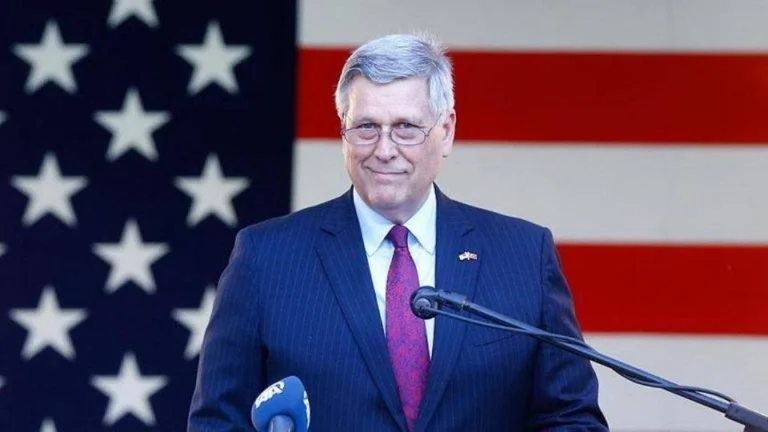
(6 years ago)US Ambassador to Kosovo Philip Costett has talked about the most important topics in the country. The Ambassador of the United States has talked about recent political developments in the country, about the former Kurti government, the Hoti Government, the Washington meeting between Kosovo and Serbia, the fight against corruption, the possible self-government in the system [...]
US Ambassador to Kosovo Philip Costett has talked about the most important topics in the country.
Ambassador to the United States, has talked about recent political developments in the country, about the former Kurti government, the Hoti Government, about the Washington meeting between Kosovo and Serbia, about fighting corruption, possible self-defense in the justice system, about American aid in the fight against COVID-19 as well as for Kosovo relations USA.
The ambassador in an interview for Telegrafi, among other things, has said the meeting, called by the White House's nominated man for dialogue between Kosovo and Serbia, Richard Green, on 27 June at the White House is very important for Kosovo, Serbia and the region.
The White House's nominated for dialogue between Kosovo and Serbia, Richard Green, has said officials of these two countries have agreed to a meeting at the end of June, what is your comment?
Costett: I don't have any more specific information or details than Ambassador Green's announcement of agenda or participation in the meeting. But let me say that I think this meeting in Washington is an important opportunity for Kosovo, Serbia and the region. Normally there's a lot of curiosity about what leaders will discuss, what the outcome may be, there will be many speculations and hypothetical questions from now until the time of the meeting, and I will be distanced from speculation and hypothetical circumstances. And I want to stress that my government has been talking about this for a long time about two years we think it's important to bring new energy into the process of discussions between Kosovo and Serbia, and in particular we are focused on issues that will affect the everyday lives of citizens. And we think that trade and economic development are important for citizens of the two countries. I think we've seen this during the pandemic, that we've all faced international, global threats. And governments can be more effective when they are willing to talk to neighbours and other international partners to solve these problems. Therefore, I would like the Washington meeting to be viewed from this point of view as an opportunity to improve the lives of citizens.
Can there be a final agreement within this year between Kosovo and Serbia, which interests all in Kosovo and the region?
Costett: I don't think we know. Ambassador Green has said there is no deadline ... but the process must continue faster and Kosovo and Serbia have lost much time over the years and is in the interest of both states and the US, but also other international partners, including the European Union, to move towards concrete actions and successes. And I can't say more than that right now. So we'll be together on this road.
How did you assess the situation created that in a short time we had two new governments voted in the Kosovo Parliament?
Costett: Kosovo has a very active, vibrant and multi-party democracy. You know the history of Kosovo politics ? politicians come and go and sometimes don't stay much longer. I think the positive aspect of this is that there are many parties that represent different views, different elements of the population and the variety of views that put it into the system. Now, one thing I want to say is that in Kosovo, as in other states, but also in the US, politicians seem more focused on politics than in government and seem more interested in attacking and insulting each other than in discussing politics, and what policy or move might be profitable for Kosovo citizens. But as I said, this is not unique to Kosovo because we have this problem in our country as well. But it is a serious problem, and I think Kosovo citizens have made it clear during October last year that they love change and that they care about economic development, that they care about fighting corruption, that they care about creating opportunities for young people. We fully support this and the US priority remain the same, regardless of which parties govern the country. Our priorities are to encourage peace between Kosovo and neighbouring states, but also peace between communities within Kosovo. Our priority is promoting economic development, and this includes not only investments but also private sector energisation. And most importantly, fighting corruption and building rule of law. These are all connected. If we want to see more foreign investments in Kosovo, it is important that investors see that the state is politically stable and that it is a justice system that can be trusted. The United States of America has invested a lot for 20 years now in building institutions in Kosovo. We have law department, lawyers, we have professionals from police and the State Department, from MCC and other agencies. And their job is not just to lay money in Kosovo, but their job is to help Kosovars build economic skills, institutions of justice, build political stability, find ways to promote relations between communities so that Kosovo citizens have a better future, because the system that has been set up over the last 20 years, which depends on much of the economic aid beyond the ocean, cannot last forever. I think the US and Kosovo will be partners for a very long time. I have no doubt about the fundamental force of this partnership. But it will only be strengthened if Kosovo becomes less dependent on the US and other international partners and is better able to develop itself for the future.
We had a no-confidence motion against the government Kurti and the citizens also went on protests about this, which one is yours?
Costett: I think it's normal and healthy for people to participate in peaceful protests. This is part of democracy. Clearly, there are many people who have supported the past government and others who have not supported the past government and who have not voted for Vetevendosje, for example. and have not been happy with the no-confidence motion. I think what is important to focus now is the responsibility of the government Hoti to meet the needs of Kosovo citizens. And I've heard that from the prime minister and others that they realize that expectations from the government are very high and I believe there are some steps that LVV and LDK have taken, which the new government has to continue. They should not immediately dismiss what the past government has done. Normally, they will develop their own policies, they only have their own programme, but I still think that Kosovo citizens want to solve problems, want action and do not want words. And that's true in the diplomatic and government field. I want to add something else about this. When people like me talk about what Kosovo needs, how to solve Kosovo's problems, I don't want to suggest that America has all the answers because America is facing its own social problems, with its economic problems, you know that the issue of racial relations in the US is much deeper. We've been fighting for centuries to try to build a society with justice, equality and equal opportunities for everyone. So I don't want to suggest that this is simple, because it's not. My experience in life is that people don't usually learn from other people's mistakes, but only from their own, but I hope that Kosovo can see US experience and see the importance of solving these problems. There are many black and white people who have never really had the opportunity to recognize one person of the other race, there are Albanians and Serbs in Kosovo who, in all sense, never met with the other community, and I think that this is the real problem for peace and stability in Kosovo, and I hope that Kosovo's leaders, including those of civil society and religious leaders, can find ways to break barriers between communities.
What are your challenges and expectations from the new government?
Costett: As I said earlier, we take priority over challenges to diplomatic ties between neighbours, challenges to economic development and rule of law as related. Therefore, I think the effort to improve relations with Serbia and other neighbouring states has direct implications for the economy. Now the urgent internal issues are fighting pandemic, finding a way to rebuild the economy, which has been a challenge even before pandemic. I think the Government of Kosovo is facing a problem with which all countries in the world are facing how to balance the public health challenge, how to keep citizens safe and develop the economy. This is a big challenge for the US and is a big challenge for Kosovo. Now I have to say, and I'm not talking as a foreign diplomat, but as a Pristina resident because I have my family, dogs, book collection and everything, that I think citizens can do more to fight pandemic. Nobody is wearing masks, nobody is paying attention to social distance and I understand the need to reopen the economy because we can't keep business closed forever, but there are steps that citizens as individuals can take to protect themselves, others, family and neighbours. And I think we should all be disciplined and vigilant in the future. Now, the US, like other international friends, is offering assistance to Kosovo we have offered money, we have offered more than $1.6m, we have provided equipment and we hope that we will offer more in the future, there have been professional consultations, etc. We want to help Kosovo, but we cannot do the work for Kosovo. Therefore, Kosovo's government and citizens must do their job to fight the pandemic. As in any other country, this is a duty for citizens.
Pandemia COVID-19 will create economic and US problems helping Kosovo, but in what areas, a little more detail?
Costett: We've been very transparent in this regard. US agencies for international developments in the State Department have provided financial assistance, provided concrete assistance in forms such as cleaning equipment, medical packages or communities, community centres, and know that American personnel have spoken to the Ministry of Health. Even the public policy staff at our embassy has exchanged ideas with those of the Ministry of Health, in order to discuss how to convey the message effectively. I think in the future we'll be able to provide additional equipment. The entire planet has been caught unawares and shocked by the pandemic and is taking time to make available the world's industrial capacities to ensure that we have enough equipment that hospitals have enough equipment, etc. I think in the coming weeks and months we will see even more international co-operation on this issue.
Fighting corruption and organised crime remains one of the challenges in Kosovo, where should Kosovo focus more specifically?
Costett: I think the public wants action and wants action soon! I believe Prime Minister Hoti takes this matter very seriously, but see what happens. When I talk about corruption, by the way, our embassy has been talking a lot about fighting corruption and rule of law, it's been one of our main problems over the past few years, not only about high-level corruption where people steal millions of dollars and place them in Swiss banks, in the Kayman Islands or elsewhere, but we're talking about nepotism. It is no secret that most young people in Kosovo think it doesn't matter what education they have because if they don't have family or political ties they won't have the chance. The government has to deal with this. And I think there's no more patience from the public. When I returned to Kosovo a year and a half ago, there have been people in the political world who have said that “po, we know we have to fight corruption, but you have to understand that it will take a few years”. I don't think the people of Kosovo have that patience anymore. Therefore, the government really needs to take over leadership and ensure that employees in government positions are qualified, to make sure that connections between officials and criminal networks are not tolerated. The US government, like other international partners, play a role and I think we can continue to work, just as in the past, working with the Kosovo government to create employment guidelines so that the government can employ only people who deserve it through a completely transparent process. But as a foreign ambassador, I don't want to tell the government by names that they should hire this man or woman. It's none of my business and I don't plan on giving them any letters with the names of the prime minister. I think the government should take responsibility for solving these problems. And it's difficult in a political system where people make lots of promises to other people. This has to change.
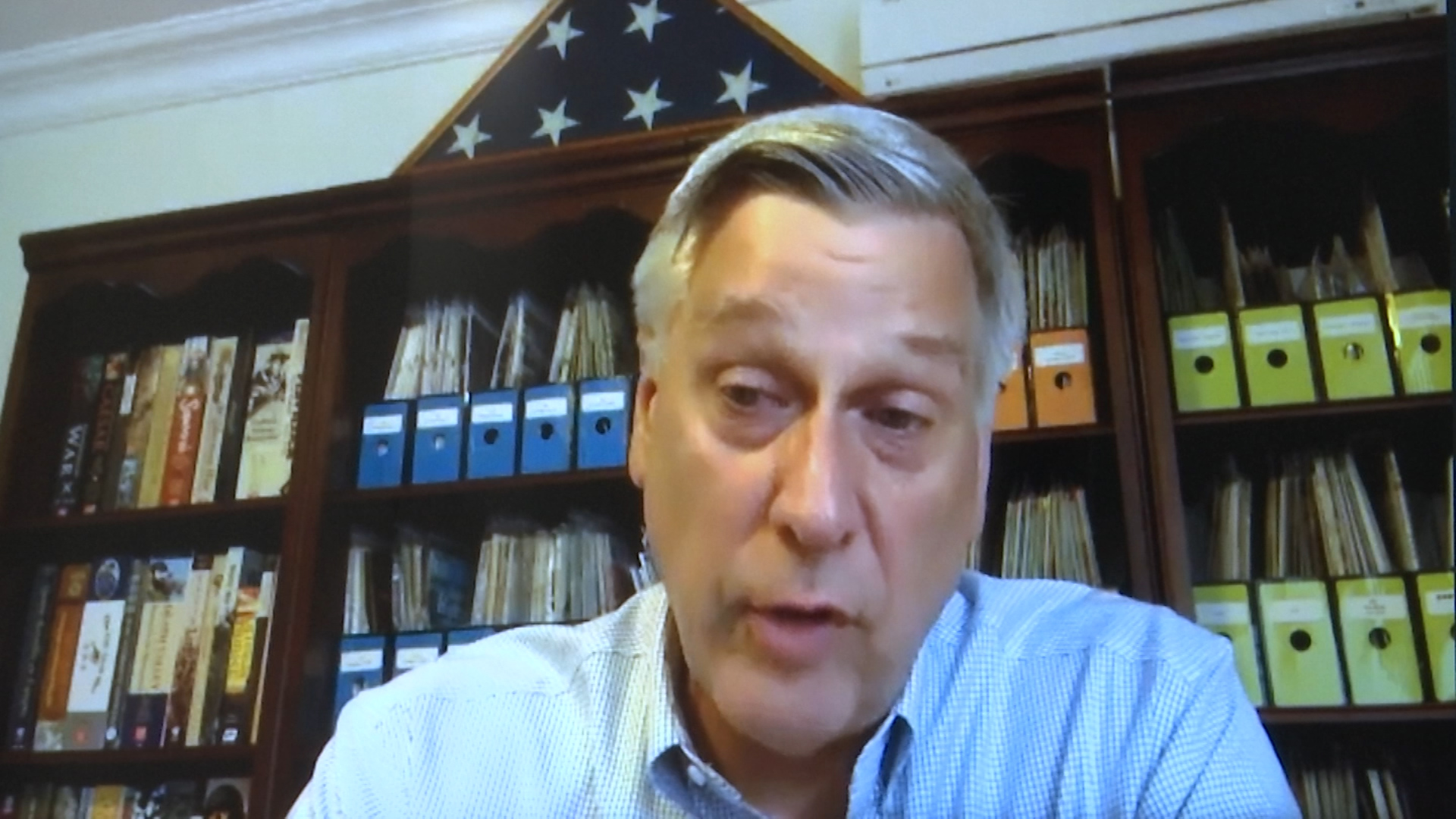
Will the US Embassy support a possible veto of the justice system?
Costett: If the government invites us to be more directly involved in the development of the Vetting system, then we will gladly participate in the process. We have experts at the embassy doing this. We can do this in partnership with the government and other international partners, such as the British. Our British friends have been involved in Vetting for several years. There are many ways about Vetting, but the key point is to make sure that people are employed because of qualifications and not because of connections, and that there is a policy of zero tolerance for misuse and corruption. I mean, Prime Minister Hoti and other government members have told me very openly that they plan to attack this problem very directly and I welcome it.
How do you assess Kosovo- Did the U.S. and the U.S. have disagreements in these relations?
Costett: I think the fundamental ties between the US and Kosovo are as strong as stone. I have no doubt that Kosovo and the US will remain close partners in the future. I have no doubt. I think the nature of the partnership will evolve and that's natural. First I lived in Kosovo in 2003, immediately after the war, when the state was in terrible economic shape. When I returned in 2018, I was impressed with all the progress I have seen and in particular with the generation of educated, expert foreign languages, people who can be successful in every country in the world and who want to build the future in Kosovo. Progress in Kosovo has been the result of the hard work of the people of Kosovo, but the US and other international partners have contributed to this. All of our co-operation efforts with Kosovo, all of our assistance, has been meant to help Kosovo stand on its own, as if an equal US partner and less dependent. This is the future we see for Kosovo.
You asked me if we had disagreements. We have disagreements sometimes, and that's clear, but that's normal in a partnership. It's normal in the family, it's normal in national relations. I think that sometimes Kosovo citizens worry too much about it and think the US will abandon Kosovo, but should not think so. It is also important that citizens are not afraid to take steps toward the future. This is our attempt to start, normalising relations with Serbia. We are asking Kosovo to take steps towards the future and we will be with you when you do.