15 minutes ago
Nutrellary: Kosovo, Albania worst in region in terms of testing for Coronavirus
Periskopi(6 years ago)
(6 years ago)Analyst Adri Nurellar has published today an analysis with comparison data for Balkan countries' fight against coronavirus. According to him, from the data it turns out that Kosovo and Albania have done at least their tests. Nurlar's complete writing: One of the main failures of the governments of Albania and Kosovo [...]
According to him, from the data it turns out that Kosovo and Albania have done at least their tests.
Nurlar's complete writing:
One of the main failures of the governments of Albania and Kosovo in the fight against the virus is undoubtedly the low level of testing.
In addition to social distance, one of the World Health Organisation's key recommendations (OBSH) to combat the coronary pandemic is to organise as many tests as possible. The director general of this organisation declared two weeks ago that “We have a simple message for all states: Test, test, ” As after that, countries have to do as many massive and frequent tests as possible because this pandemic cannot be fought with closed eyes. O The BSH has considered the test buffer to be “the backbone of the pandemic's halting” and it is alarmed that many countries are not doing enough, so it has sent 1.5 million tests to 120 countries.
Practices of countries that have been successful in preventing the spread of the coronary as well as the world's leading institutions and experts are saying it is essential that as many people do their tests. According to them, isolation can affect the ban on distribution and not infecting citizens, but to put an end to this pandemic all states have to run as many tests and then isolate and treat anyone who is found to be infected.
This strategy has been successfully used by South Korea, which has done 455 032 tests, or 840 per million. Many countries that have launched massive testing campaigns have taken this measure very seriously. So, for example, Estonia has run 1437 tests for 1 million people, Austria 11803, Norway 11410, Germany 11 127 and so on.
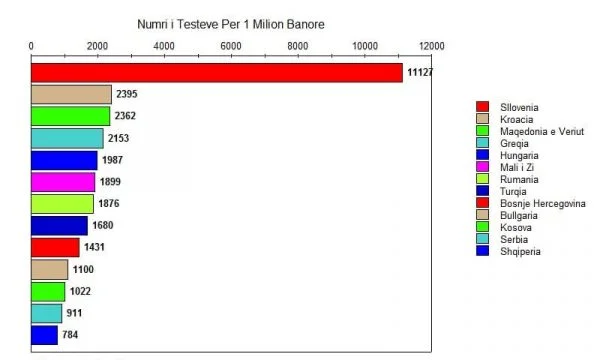
In this respect, Slovenia dominated the Balkan region with 11127 tests for residents while Albanian states, Albania and Kosovo stand at the bottom of the list. According to data yesterday from the official website of the Government of Albania, 2247 tests divided for 2.863 million people are down 784 tests per million. According to information released by the National Institute of Public Health from the 08.02.20 to 04.04.20, a total of 1,871 suspicious samples of the SARS-CoV-2 virus divided by 1,831 million people have been tested.
Fortunately, North Macedonia Albanians are in a better position because this country has done 2362 tests per million and not so bad is also Montenegro's Albanians, with 1899 testing for millions. Worse than Kosovo is Serbia, and therefore our joints in the Presevo Valley. According to data, the Torlak Institute has tested 6,401, given that Serbia's population is 7.02 million translates into 911 tests for millions. However, this number should actually be even smaller because hundreds of these tests are being done for Kosovo Serbs, since Belgrade's health structures are allowed to enter and operate massively in Kosovo as well.
Fortunately, the big investments made in the world's field of science and technology in relation to the coronary, have caused the price of test tampons to drop to as much as 20 euros. Therefore, the government of Albania and Kosovo should not waste any longer, but to undertake a massive, comprehensive campaign for testing for the choreography, initially starting with the main grounds of infection. The Albanian population is relatively new, in Kosovo it is the average age of 29.6 and Albania 36.4. It is well - known that some of the young people pass this disease without realizing it by having no serious symptoms of it and therefore do not report to the doctor or go to test. This fact is one of the commentary on the relatively low number of infection in Kosovo and Albania. But while young people may not become sick themselves, they may be carriers and colporteurs in people with fragile immunity or other health problems. So without a massive test, we'll continue to be in danger because it will never be well understood who is infected and deserves to be isolated from spreading the virus.