2 minutes ago
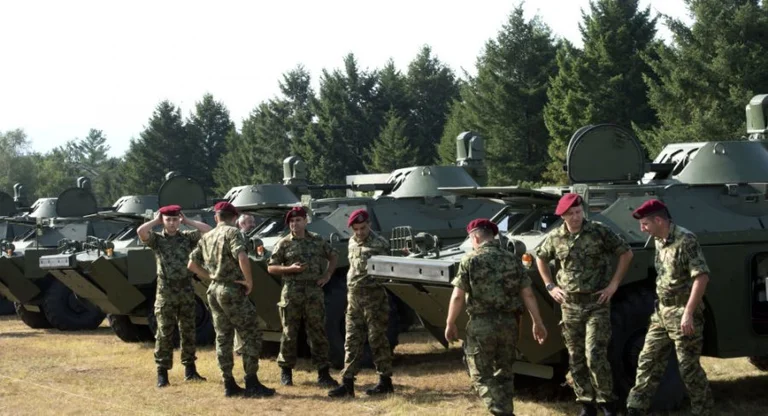
Serbia continues to arm itself
Periskopi(6 years ago)
(6 years ago)“Surpriza” warned by Serbia's president, Aleksandar Vuciq, on the eve of Russian Defence Minister Sergei Shoigu's visit to Belgrade, has been missing. Despite speculation ahead of the visit, Shoigu has been staying in Serbia this week without the missile system “Partir S1”, which Serbia has purchased from Russia, writes the REL. According to Serbian military analyst, [...]
“Surpriza” warned by Serbia's president, Aleksandar Vuciq, on the eve of Russian Defence Minister Sergei Shoigu's visit to Belgrade, has been missing.
Despite speculation before the visit, Shoigu has been staying in Serbia this week without the missile system “Pancir S1”, which Serbia has purchased from Russia, writes REL.
According to Serbian military analyst Aleksandar Radic, the reason for this should be sought in Moscow.
The “authorities in Belgrade need to show off to the public, but the Russians probably don't have the same emotion. Perhaps at the moment they do not need this marketing form”, Radic says of the Balkan Radio Free Europe Service
It's commercial. We have paid and we have to gain this system to modernise our army. It's okay, but it's paid money to the people's”, Radic says.
The Russian Defence Minister's visit to Serbia and his meetings with officials in Belgrade, in which it has been said that Serbia and Russia “will further strengthen the co-operation in the field of defence, have actualised the issue of Russian arms purchase from Serbia, but also Serbia's own arming and its defence tools.
According to the International Institute for Strategic Studies (IISS), these tools in 2019 increased by 28.7 percent, from $704 to $906m respectively.
With this increase in defence budget, Serbia has reached the top of the European continent's list of countries.
Defence investments in northern Macedonia, Bulgaria and Slovakia have also increased by more than 20 percent.
Serbia's budget for the current year, 2020, envisions reducing these expenditures.
The funds, as explained, will be spent on procurement equipment for the functioning of Serbia's Ministry of Defence and Army, as well as on repairing weapons and other military equipment.
Serbia's increased defence spending trend has been noted since 2016, says Free Europe Katarina Djokic, researcher at the Belgrade Centre for Security Policy.
This does not necessarily mean that challenges or threats have been identified, but the need for army modernisation is known. On the other hand, the entire story of the arms race is a little overrated... All the countries have their own reasons for buying specific quantities of weapons”, Djokovic says.
Radic also considers that the Serbian Army needs modernisation, but says authorities in Belgrade exploit the issue for political purposes.
The modernisation of Serbia's Army is necessary. Most weapons are an ancient legacy. Most were bought in the time of socialist Yugoslavia. Clearly, you have to invest... But, I think the current government is using weapons procurement as a means of political favour from Allies”, Radic says.
As the biggest challenges in Serbia's defence system, the IISS annual report cites human power shortages and weaknesses in existing capacities.
Vuciq, in December last year, has warned that Serbia will stop buying weapons and that it will make additional “reforms in the army”.
This move, Katarina Djokovic, sees it as positive because, she says, the biggest problem in the defence system in Serbia is the lack of human power and the position of the military in general.
“has information that it is working on resolving the problem. A few days ago, 78 NCOs have been employed permanently, who have been employed for a certain time, says Djokovic.
In the past three years, Serbia's Army has bought five Mi-17V-5 helicopters from Russia, four Mi-35M fighter helicopters, and has received six MiG-29 aircraft as donations.
Four aircraft of this kind have also received donations from Belarus.
The maintenance agreement has been reached on 14 aircraft, while the Pancir S1 missile system has been purchased under a 2019 agreement with Russia.
In 2019, ten of the 30 armoured war vehicles “have been reached by Russia to Serbia. BRDM2” With this deal for donations, the money from Russia to Serbia will reach 30 T-72 tanks.
During this time, Serbia has bought five H-145M helicopters from Europe, which, according to Vucinqi, have been paid from 11m to 13m euros per piece.
Vucinq did not specify the Russian helicopter award.
The price for piece of seven Russian helicopters is higher than 10 million and less than 20 million”, Vuciq said in December 2019, when helicopters appeared at Batajnica military airport.
Institutions have never provided concrete answers to how much Serbia pays for military equipment from Russia and how much Russian donations are worth to Serbia's Army.
Serbia's “state is currently being treated as private property. We have a very unusual situation that deviates greatly from the practice in Europe. This is a hiding of everything that happens in connection with the purchase of weapons and military equipment, except in some cases when someone seems attractive to the media”, Radic says.
Serbia's Defence Ministry has not yet answered questions on the issue, which the Balkan Radio Service Free Europe has sent to him since August 2019.
Frequent arms purchases from Russia have raised concerns in both Brussels and Washington.
In November last year, US State Department for the Western Balkans envoy Matthew Palmer, who has not ruled out the possibility of imposing sanctions on Serbia, has also reacted because of the purchase of Russian military equipment.
There is a dose of concern about placing Russian military equipment on Serbia's territory, but also about the possibility of Serbia buying specific Russian systems. That would lead to the imposing of certain sanctions. Hopefully our Serbian partners are aware of this”, Palmer world has declared it.
Serbia and Russia have signed the military co-operation agreement in 2013. The document has been signed by then Serbian Defence Minister Nebojsa Rodic, and Sergei Shoigu, who has been in the position of Russian Defence Minister since 2012. / REL