15 minutes ago
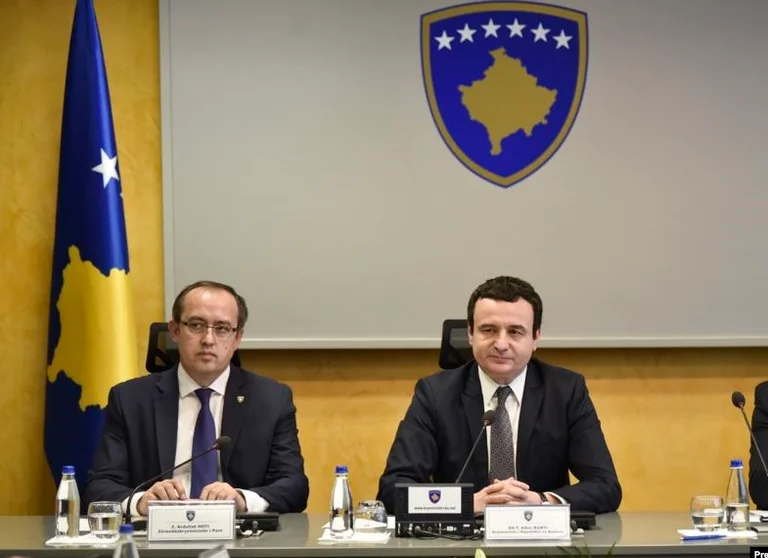
Hot goes against his boss in Government: Munich Agreements in Kosovo's Interest
Periskopi(6 years ago)
(6 years ago)Agreements signed for railways and highways between Kosovo and Serbia in Munich, Germany, are in the interest of Kosovo and the entire region, and in the function of free movement and integration path towards the European Union, Kosovo Government officials say. The Kosovo government has clarified its position in relation to these [...]
Agreements signed for railways and highways between Kosovo and Serbia in Munich, Germany, are in the interest of Kosovo and the entire region, and in the function of free movement and integration path towards the European Union, Kosovo Government officials say.
The Kosovo government has clarified its position in relation to these agreements signed in Munich on February 14th, following statements by Prime Minister Albin Kurti, that he held reservations for the fact that he was not involved in the signing talks and process.
Both these agreements, as well as those for the deployment of the Pristina airline Belgrade, are written after the White House envoy's mediation for Kosovo-Serbia dialogue, Ambassador Richard Green.
Kosovo's first Deputy Prime Minister, Avdullah Hoti, in a response to Radio Free Europe, says the <x0-letters of purpose or interest” for infrastructure ties that Kosovo must build up to the border crossing with Serbia, signed in Munich, are in Kosovo's interest and supported by the US.
“As the governing partner, we are willing to assume the responsibilities belonging to the government regarding the dialogue process”, he said.
In addition to railway and highway agreements, on January 20th in Berlin, Pristina and Belgrade, but under the mediation of Ambassador Green have signed the agreement for the Pristina-Pristina airline.
Through these letters of interest in highways and railways, the two states -- Kosovo and Serbia -- have expressed readiness for the opening of existing roads, but also for the construction of new roads connecting the two states with the region and the EU.
Civil society representatives also appreciate the signing of these letters of interest, but they have remarks on the fact that there is no transparency and that the content is still not clear nor the way they apply it.
Life Krasniqi, analyst from the Kosovo Democratic Institute (KDI), told Radio Free Europe, that this is the first step showing the parties' readiness for co-operation, but it requires that there be transparency of what the agreements actually contain.
The “Mbi all must be clear what is intended to achieve in this process, as the position of both sides remains the same. Serbia has not given up its aggressive, not constructive approach in the international arena against the state of Kosovo. On the other hand, Kosovo remains in the same position. We see Serbia trying in every way to make us a dysfunctional state, whether inside or outside Kosovo”, Krasniqi said.
These letters of interest are signed by both sides, following the White House envoy's efforts for dialogue Ambassador Richard Green, who is committed to normalising reports between Pristina and Belgrade.
Deputy Prime Minister Avdullah Hoti says the added US role in the dialogue on normalising relations and mutual recognition between Kosovo and Serbia is welcome and necessary to complete this process as soon as possible.
The “is in the interest of Kosovo and the entire region to normalise relations and move together towards the EU”, Hoti has indicated.
Kosovo's “government will be a reliable partner of the US and the EU in the process of normalising relations and mutual recognition with our northern neighbour”, Kosovo Deputy Prime Minister stressed.
Even Life Krasniqi stresses that normalisation of reports can be realised through dialogue between the two states. But, according to her, dialogue has to be taken into account since 2011, while implementation of agreements has stalled.
“We should have clear what we are aiming to achieve with this dialogue. Kosovo has been dialogue with Serbia since 2011, and we see that even in 2020 it has not been achieved to normalise reports between the two states. Normally a large part of the agreements have had positive effects, but in essence we have Serbia that still remains to oppose Kosovo as a state, whether within or in the international arena”, Krasniqi points out.
Talks between Pristina and Belgrade were interrupted at the end of 2018, when the Kosovo government imposed a 100 per cent tax on products from Serbia and Bosnia and Herzegovina.
The new Kosovo government, led by Albin Kurti, has said the tax will replace it with the measure of reciprocity. But establishing reciprocity has not found the support of the United States. The White House's envoy for the Kosovo-Serbia dialogue, Ambassador Richard Greene has asked the official Pristina to remove the tax without imposing reciprocity. Meanwhile, Belgrade has urged it to halt the campaign against recognitions of Kosovo, and especially the Kosovo state-recognition campaign.