16 minutes ago
United Arab Emirates Remember in a Special Report Days During War in Kosovo

Periskopi(7 years ago)
(7 years ago)The United Arab Emirates have remembered the days when their soldiers served during the war in Kosovo. Their mission in Kosovo was the first in Europe. The general, May Gen Obaid Al Ketby and Colonel Yousef Al Harmoud have shown experiences at the camp they had set up to help Albanians. The newspaper “The National” has [...]
The paper “The National” wrote a long reportation entitled” Special Report: The day the Amyrs troops came to help Kosovo destroyed by the war”, which below brought the newspaper Insander to them.
Twenty years ago, tens of thousands of refugees, many victims of violations and beatings, found warm accommodations and hospitality in a United Arab Emirates camp, the paper begins writing.
The “Wedland bell” had landed from the Kuwait Desert in Europe. The mission was clear, to secure peace in Kosovo after a year of fighting there.
The United Arab Emirates joined NATO's peacekeeping mission in 1999 and undertook a relief mission involving the food of thousands of refugees fleeing to the Albanian border.
Serb forces began a brutal blow on Kosovo's population in 1998, following the spordal fighting between the Kosovo Liberation Army and the Serbian special police. The people of Kosovo, ethnic Albanians and mostly Muslims, were persecuted by Slobodan Milosevic's regime in Belgrade.
Hundreds of thousands of people would flee the fighting and ethnic cleansing of villages, where men and boys were shot dead by Serb forces.
Looking on television, 5 thousand miles of wet, the first president of the United Arab Emirates, Sheik Zayed, decided that his country should help.
May Gen Obaid Al Ketby recalls patrolling abandoned villages outside Pristina, Kosovo's capital.
There was no one walking down the street”, he says, in an interview from his house Abu Dhabi after 20 years.
We waited a while and saw a man coming out of the street calling that “thanks to the West, the aid has come” Almost immediately people started leaving their homes, the general relates.
And the Imam was shot in the head before his family. People told us that the imam had always dreamed that his son, who was deaf and dumb, would receive medical treatment”.
“I have taken the phone and called Sheik Mohammed [ben Zayed], he has told me that that family should immediately be brought to the United Arab Emirates”, has confessed, Maj Gen Obaid Al Ketby.
About 1,500 Emirates troops would serve in Kosovo during two operations.
One was with the KFOR-led peacekeeping force from spring 1999 to the end of 2001. About 1,200 troops were distributed in six camps with NATO's Multinational Brigade North, with headquarters in Vushtrri where more than 100 Kosovars were massacred in May 1999.
The next operation was the mission of white aid across the border near Kukes, Albania, between March and late June 1999.
The first obstacle for the initial troops sent to establish the White Aid Camp was being reached at the planned location, a small piece of land located amid mountains near the Albanian-Kosovo border.
“NATO forces were reluctant to fly us, saying it was dangerous to allow pilots to leave on the mountains”, indicates General Al Ketby, who began his career in the UE Air Force and was trained at the Leavenorth Fort in Kansas, among other countries.
His pilots scanned the area and found a 50-year-old abandoned plane. They managed safely to land the first C-130 Hercules on an improvised track, then bring equipment to build a refugee camp.
The “was not easy to reach, but thanks to God, and with good coordination we arrived. It was an amazing” effort, says Maj Gen Al Ketby.
Aids, goods, doctors, and air traffic controllers were brought to manage the operation, once hampered by bad weather.
The type of terrain was the whole earth of mud and weather conditions were difficult. At one point it was the snow and the sun on the other side” he says.
“However, we have built a camp in collaboration with the Red Cross in a very short time, it was a unique” mission.
As refugees crossed across the border, the Egyptians had to expand the camp that was originally built to accommodate only 3,000 civilians.
The request was so high that we had to expand to 10,000 refugees and accommodate an additional 5,000 in camp”, he says. So we had to serve 15,000 people every day”.
One regular day at the soldier camp is waking up at 5: 00 a.m. Breakfast served at 7:00.
The morning was hot food like the one being served at home, we had our cooks. After breakfast, the children were going to school in camp. We opened schools where we brought people from Kosovo to teach. Camp was open. We also had journalists living with us”, the general showed.
As many as 45,000 hot foods were served every day. It was known among other forces as the five-star camp”.
We were proud of what the Emirates said about “, says General Al Ketby.
“We're lucky we have a leadership that has invested in us to help others. We served not only refugees but all Albanians. It was a humanitarian aid, part of the United Arab Emirates strategy to help wherever you need aid”.
The home of Maj Gen Al Ketby in Abu Dhabi is covered with photographs and memories of the Balkan operation.
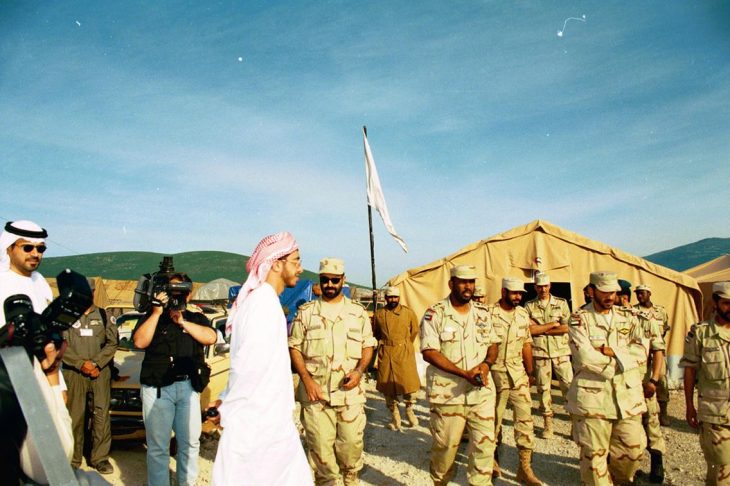
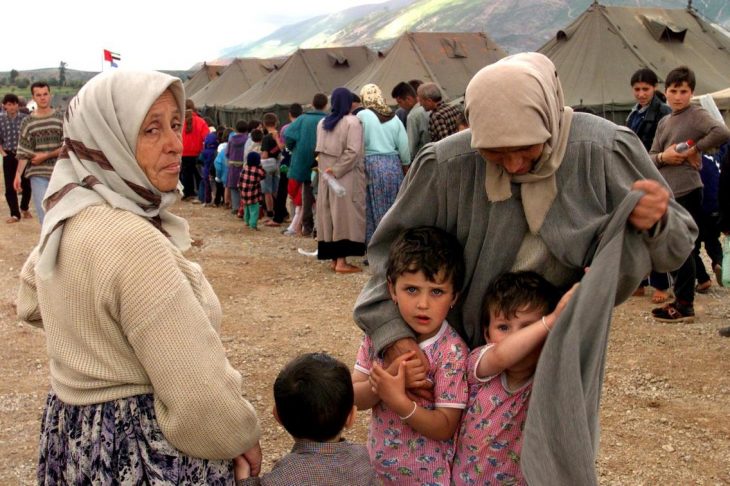
In many, Emirates ' troops blow through mud, treat civilians for wounds, and feed long refugee lines.
During the three months the camp received visits from UN personalities, including Secretary General Kofi Annan and Sheikh Mohammed bin Zayed.
These were our most important visits” the former commander says. “This had brought about the will of the entire camp, where we were instructed to expand to accommodate as many people as required”
NATO's intervention and the bombings of Serbian forces and cities led to the withdrawal of Milosevic's forces. Eventually, refugees were able to return to their homes.
When the announcement was made that refugees could return, we lost control for a few minutes, because everyone was immersed in the river,” says General Al Ketby.
We had to hold them and explain that the back road could be dangerous because of the mines and we should do it carefully.
You can see tears in their eyes. They had formed a bond with our soldiers, so it was hard to leave for everyone. ”
May Gen Al Ketby was the last to leave the White Hands camp in the summer of 1999, three months after the mission began.
Today he still remembers the situation of Albanian refugees in that club.
May Gen Al Ketby says the most difficult response was when you deal with the treatment of refugees, especially women. They were so frightened to see any men because many of them were victims of rape”.
In time, the general tells of his faith in the cossavers. He also relates the first baby born in the camp. He was called Fatima after Sheikha Fatima bint Mubarak, was Shejh Zayed's wife.
They became our children. We became a family”, he relates.
“We were happy for them, but it was hard to see that we went”.
Between April and June 1999, some 19,000 refugees received treatment at the 200-bed camp hospital and mobile clinics.
Colonel Yousef Al Harmoud, now retired, was in charge of the medical operation, supervised 22 doctors and 30 nurses, some of whom were refugees. This was not my first mission, but it was the first in the heart of Europe”, says Col Al Harmoud, whose team had only a few days to raise the object between snow and mud.
We will see the four seasons [in one day], from cold to hot to warm weather.
We met with the Albanian government and they agreed that we should open a hospital on the ground. The first team to leave [United Arab Emirates] was on April 15th, and the 17th of the entire team was there. In 20 we opened and started accepting patients, most of whom came from camps around “, he says.
He says that hot foods, infrastructure, sewers, and hot water are extracted into thousands within days.
“In other camps belonging to Italian, Greek, Scottish, refugees received three frozen meals scattered in plastic bags once a day.
Our kitchen worked 24 hours a day. We were given three hot foods and food in the middle. ”
Everyone was registered and had an identifying symbol. ”
Some refugees were hired to help conduct the camp, paying up to $200 a week, while others volunteered to translate and enroll in the hospital.
As summer arrived in southern Europe, warming brought many victims to the clinic.
We saw many diseases, most of the time it was dehydration to the elderly, women and children, because they had walked long distances. There were also chronic diseases such as diabetes and high cholesterol”, he relates.
Many needed therapy to talk about atrocities. Some of their stories he finds hard to forget.
There was an old woman who had lived in a residence [before the war]. She was screaming in agony and striking her face, because they had slaughtered her son in front of her and violated her daughter and had taken all her belongings”, relates Colonel Yousef Al Harmoudi.
Every day, the team will hold a press conference to update journalists and UN officials.
A journalist asked us why we were here. Is it because you're Muslims? she asked.
We said it wasn't because we were Muslims, but for humanity,” says Col Al Harmud.
“We showed how our first patient was a Serb tortured by Serb forces. We are the children of Zayed and this is his legacy that he has left for us to love all and support everyone and everyone in need”.
During their time in the camp, he says, some refugees were married in a small mosque by an imam.
Other objects were designed to produce a view of normal life for its inhabitants.
We had basketball, football and fields to entertain refugees and a cinema featuring Arab films translated into Albanian.
We wanted to keep them entertained and forget the atrocities they had seen. We started a school to make sure that the child education was not cut off”.
The United Arab Emirates had rented the site where the camp was located, and almost every day we would have found someone who would come to us, claiming they were landowners and demanding that they rent”, the colonel shows by laughing.
One day four different people came to us and one day six different people. It felt as if we were being hired every day by”.
The United Arab Emirates, later with a much smaller international profile than they have today, gained much attention for volunteering to serve in Kosovo.
A NATO military journalist, Captain Monica Blix, wrote of the exotic Arab “music traveling through the camp and how every month about a dozen children with special needs were sent to hospitals in the United Arab Emirates and Europe for specialised treatment. She also wrote about flights carrying $15m in food, school supplies and medical equipment paid by the United Arab Emirates
Colonel Al Harmoud said the decision to take over the mission was important.
That experience will remain in our hearts and in the hearts of our grandchildren and future generations”, the Colonel, Yousef Al Harmudi, has concluded.