25 minutes ago
The Kosovo issue: Serbia unexpectedly with US eyes

Periskopi(7 years ago)
(7 years ago)After blocking dialogue between Belgrade and Pristina, Serbian foreign policy tries to find the way out in Washington. Even the annulment of the summit in Paris has led Belgrade to turn its eyes towards the US. Politicians in Belgrade have long issued more and more statements about America's crucial impact on the process of resolving [...]
After blocking dialogue between Belgrade and Pristina, Serbian foreign policy tries to find the way out in Washington. Even the annulment of the summit in Paris has led Belgrade to turn its eyes towards the US.

Politicians in Belgrade have long issued more and more statements about America's decisive influence in the process of resolving the Kosovo issue, which conflicts with earlier statements. When Pristina insisted on America's involvement in the Kosovo process, Belgrade rejected such ideas, stressing that in this case Serbia would demand that Russia be included in the dialogue.
However, especially after the Paris summit annulment -- which in Belgrade, among other things -- is also seen as a loss of the European Union (BE) -- is evidence that more and more hopes now rest on America's political and diplomatic power.
Serbian Minister of Foreign Affairs Ivica Dačić said that the Paris summit's failure showed that without the US nothing can be accomplished, and shortly later sent a series of compensations to the address of the American administration, saying that „the Trump administration has been very correct in terms of dialogue with Pristina and that after a long time it has not been presented as a problem, but as a factor that changes before the <x1 dialogue.
But perhaps the most illustrative was the statement by the president of Serbia's parliamentary delegation to the NATO Assembly, Dragan Shormaz, who stressed that „would have been better off having the issue of Belgrade and Pristina relations completed before the US elections next year, with the help of Donald Trump and US” Sormaz further stressed that Serbia's President Aleksandar Vuci who is working to improve reports with the US and that the results are obvious.
Continued Wrong Moves
The whole series of statements shows that Serbia does not have a well-thought strategy in foreign policy, and this is just continuing the wrong moves of Serbian diplomacy, as in the case of the head of state being involved in the Hillary Clinton campaign, estimates for DW Naim Leo Beshiri, director of the European Affairs Institute.
This now looks like an attempt to stand on the side of America, which in various ways tries to settle the EU. On the other hand, America has recognised Kosovo, but it's not much against the idea of revising borders, and here maybe President Vuqiu has probably found room for talks. In Serbia it would be considered the slightest loss, if some territories were taken, even though all the tests show that this would bring short-term benefits, and many other issues would be opened in the longer term, especially when it comes to Bosnia and Herzegovina”, Beshiri warns.
Kosovo as a card for EU pressure
I doubt that America has any concrete plans for Kosovo, says the DW commentator on foreign policy issues, Bosko Jakshikh, and adds: „The EU's desire to step forward in the dialogue has opened the scope of the US role's zoom-in. Just as the US president called on the presidents of Serbia and Kosovo not to miss the historic perspective, the State Department now offers assistance to weakened Brussels, but say without the intention of pushing Europeans aside. We still don't know what the contents of this historic chance are, they probably don't even know the Americans, but it's clear that Washington can use Kosovo to continue pressure on European allies, to finally understand who is the host of the house”, says Jakshikh.
Serbia saw serious actions
On the other hand, if you look at major media sites near power, America continues to be Serbia's number one enemy, and this moment points to DW as well as Naim Leo Beshiri. This, in his words, does not serve the publicly stated will from Serbia to improve relations with America:
„At present in the American administration there is a so-called anti-estaltation garrison, which deals in a somewhat easier way with international relations, which in some way is closer to mentality here and how Serbia sees these relations, so at this point is a favourable climate, for Serbia to find co-versators in Washington. But I don't actually see any serious campaign, or Serbian activity in Washington, that could bring a better position of Serbia, when it comes to Kosovo”, Beshiri notes.
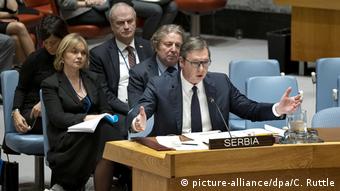 Vucic before UN KS
Belgrade and Pristina are currently in the same synton because Serbia and Kosovo think the role of America will be key to resolving the Kosovo problem. This may mean that both sides do not believe in the power of the European Union to bring this process to the end, and the impression is emerging that Washington is increasingly seen as the main negotiator or partner in these talks instead of Brussels. Bosko Jakshik thinks this is the appearance at first sight, but that Belgrade in this context passes without seeing some very important things, first of all, that Washington will naturally not give up on Kosovo's independence:
Let us not forget that Washington has long repeated the same manther, that mutual recognition is the most efficient and quick way to resolve Kosovo's problem. If Belgrade is willing to listen to Washington, then that could mean that Belgrade approaches any version of Kosovo's independence”, says Jakshikh.
Kosovo is not a priority
Belgrade's bid to speed up the process for Kosovo in co-operation with Washington, or to have it somehow completed by the end of Trump's first mandate, Naim Leo Beshiri sees as a common illusion.
We can say that this can happen if President Trump has put Kosovo up in his agenda, but this is currently absolutely not true and there are no signs that will be. If Trump wins the second term, there is a possibility that America will handle the region more.
But here I mean for the whole Balkans, because America is not particularly interested in Serbia or other countries in the region, but the Balkans they see as a whole. And that could still mean America giving up the idea of revising borders, because it's bad for the entire region”, Beshiri estimates.
The Solution in Trump's Time
The promotion, which is evident in Belgrade and emphasis on the American role for Kosovo, is interpreted as fears of the return of the democrat administration to Washington. Serbia recognises, and that is why Minister Daçi was speaking, that winning the Democrats' candidate would be very bad news for Serbia and practically turning the Clinton administration. Therefore, rhetoric in Serbia has also returned to the period following Donald Trump's victory, when there have been high expectations and a better understanding of the new US administration has been expected. So even Bosko Jakshik warns that this time again everything could end up as at the beginning of Trump's mandate, when we've seen titles "Trump, Serbian!"
„We tend to be euphoric, but the basic American policy postulates will not, however. It is clear that further pressure on Serbia will continue in order to reconcile with certain solutions, which, to this day, officially rejects”, Jakshikh concludes.