9 minutes ago
The tax is expected to turn into reciprocity

Periskopi(7 years ago)
(7 years ago)The Vetevendosje Movement and the Democratic League of Kosovo, which, based on the outcome of the 6 October parliamentary elections, are expected to form Kosovo's next government, warn of replacing the 100 per cent tax on imports from Serbia and Bosnia and Herzegovina with reciprocity to these two states. The outgoing government of Kosovo, on 21 [...]
The Vetevendosje Movement and the Democratic League of Kosovo, which, based on the outcome of the 6 October parliamentary elections, are expected to form Kosovo's next government, warn of replacing the 100 per cent tax on imports from Serbia and Bosnia and Herzegovina with reciprocity to these two states.
The outgoing government of Kosovo, November 21, 2018, had imposed a 100 per cent tax on imports from Serbia and Bosnia and Herzegovina in response to the policies of these two states against Kosovo citizenship and its membership in international mechanisms and organisations.
Since setting the 100 per cent customs fee, products from these countries are already very little present on the Kosovo market, because they have already been replaced with products similar to European Union countries, as well as Albania and Northern Macedonia.
Before the tax was imposed, Kosovo's market has been filled with products from Serbia. This country has been the biggest exporter of goods in Kosovo. According to official data, around 1.2m euros per day, or over 400m euros a year, has been the value of products that have been introduced by the state of Serbia into the Kosovo Republic market.
Meanwhile, the value of products “Made in Kosova” on Serbia's territory has been around 40m euros annually. According to official Kosovo Customs data, since the tax was imposed, the value of imports from these countries has dropped by 99 percent.
Bahri Berisha, director of Kosovo Customs, in a conversation for Radio Free Europe, says that from the beginning of this year until the end of September, the value of imports of goods from Serbia has been 3.3m euros. And in the same period in 2018, according to him, the value of products imported from Serbia has been 328m euros.
Meanwhile, from Bosnia and Herzegovina, for nine months this year in Kosovo, goods have been introduced, worth 1.9m euros from 57m euros, as it has been in the same period in 2018.
“As far as export is concerned, Kosovo in 2019 in Serbia has exported 13.6m euros, while compared to the year 2018 has been 24m euros. The amount of Kosovo products that have been exported to Serbia has dropped to 44 per cent”, Berisha says.
The same is true of Bosnia and Herzegovina, even though exports to this state has been inadequate on the part of Kosovo. This year it is 4.2m euros, and in 2018 (January-September) it was 6m euros, so there is a drop of about 30 percent of the total export”, Berisha stressed.
Meanwhile, two former opposition parties -- Vetevendosje Movement and the Democratic League of Kosovo -- are expected to come to power in Kosovo. Both of these political subjects have warned that duty or customs duties could be replaced with the measure of reciprocity against Serbia and Bosnia and Herzegovina.
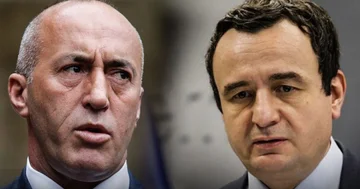
Vetevendosje Movement Chairman Albin Kurti, who is also the candidate of this political subject for Kosovo prime minister, has said in an interview for Radio Free Europe, that he is willing and interested in replacing the 100 per cent fee with full reciprocity against Serbia, as he has said, in line with the Kosovo Assembly resolution of December 7th 2011.
“Even in terms of goods documentation, merchandise production certificate, even vehicle plates, whether in the circulation of travelers or goods, spending and so on, whether in terms of investments in each other, we should use the reciprocity principle as a normal guarantor of constructive bilathealism between Kosovo and Serbia”, Kurti told Radio Free Europe.
At the time, on December 7th 2011, with the proposal of the Parliamentary Group of Vetevendosje Movement, Kosovo's Assembly had adopted a resolution, which at its very first point, said the Kosovo government “must undertake the measures of full political reciprocity, trade against Serbia”.
A reciprocity measure, the Government of Kosovo had implemented Serbia in July 2011, but the decision had only been implemented for 50 days and was later abolished.
The candidate for prime minister from the Democratic League of Kosovo, Vjosa Osmani, earlier said that the tariff should become part of mutual relations with Serbia, both political and economic reciprocity, and then, according to her, Kosovo would insist that Serbia not condition the discount at the Brussels table or the European Union with the fee.
Implementation of the 100 per cent tax on products from Serbia and Bosnia and Herzegovina, in the internal sense, according to business community representatives, has had positive effects on increasing local production capacities, while on the outside maintaining this tax has sometimes been criticised by the international factor.
Economics expert Safet Gerjaliu says that <x0rma” the most powerful new government, which will be formed after the October 6th elections, is dialogue and addressing problems, as according to him, the tax has been more populism than the economic substance.
“We as experts have also recommended in the past that much more of the way would be for Prime Minister Ramush Haradinaj, together with Trade and Industry Minister, then representatives of Customs and Tax Administration to seek a meeting with representatives of the European Union in Brussels. To address the problems facing doing business and trade with Serbia, and tosi gives a 60-90-day period for these problems to be solved based on arguments. And if there were no positive answers from the EU, then it was reasonable that Kosovo was based on reciprocity”, he said.
Compared to tax and reciprocity, Gerjaliu considers that reciprocal measures are more favourable for Kosovo.
But I want to believe that even the new government will have an international priority dialogue and partnership, that through the argumentative language these problems pass through the past. In this direction, the difference between tax and reciprocity is enormous. While the tax has been an uncontaminated political populist decision, I believe that with the support of the European Union and international factors for a dialogue and argument of challenges to try to resolve the issue and if there are no results, then it is much more likely that we have reciprocity than to have tax”, Gerjaliu told Radio Free Europe.
The United States and the European Union have consistently called for the suspension, or even the abolition of this tax, as it was seen as the cause for Serbia to withdraw from the negotiating table with Kosovo until the removal of customs duties or fees.
The candidate for prime minister by the Vetevendosje Movement, Albin Kurti, who, based on the preliminary result, is also being seen as the next mandate for forming the government, has said the tax will be replaced by reciprocity and, as he put it, international factors will have consensus on it.