8 minutes ago
Security in Kosovo over 10 years of independence (Video)

Periskopi(8 years ago)
(8 years ago)Ten years of security. Kohavision brings a review of key events that conveyed security sectors in the first decade of Kosovo state. In the first year, she said goodbye to KPC, the KSF came and is ready to become an army but lacks only political decision. 2009 ) Goodbye T MK, KSF new force, non-military [...]
Ten years of security. Kohavision brings a review of key events that conveyed security sectors in the first decade of Kosovo state.
In the first year, she said goodbye to KPC, the KSF came and is ready to become an army but lacks only political decision.
2009 ) Goodbye T MK, KSF new, non-military force
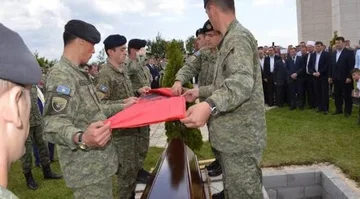
At the last hour of January 20th 2009, the Kosovo Protection Corps shut down the nine-year mission. They followed their path to a new Force, with a nearly similar mission but with an advanced structure, the Kosovo Security Force.
Of the 3 thousand active members with troops formed after the KLA demilitarisation, only 1400 managed to deploy within Kosovo's new force.
Soon after, protests began by former KPC members, who were also KLA veterans. At this point, there were moments of fighting between them...
2010 í ROSU on strike, planned state deadlock
On the evening of February 2nd 2010, all Kosovo Police Special Unit, or over 500 of its members, were shut down at the Kishnica Training Centre, in their attempt to seek 100 per cent salary growth.
A mistake, as had been named “technic”, in the Kosovo Police salary system had resulted in a several-day strike of all Kosovo special units.
While the strikers were determined in their demands, dozens of maneuvers were made by the government, sending officials every day to negotiate with them. At the time, it was found that strikers had also planned to take control of all institutions.
Former strikers' spokeswoman, Arberesh Dalipi, who, shortly after the statement was suspended, had said that the police had planned to block the introductions of state institutions, the Parliament and the Government”.
This statement led Dalipi to eventually leave the police badge after being suspended.
That same year, major developments took place in the Kosovo Police. Director Sheremet Ahmeti was dismissed from office, with a decision by Prime Minister Hashim Thaci.
The dismissal came after the strike of special policemen and the spectacular theft of over 50kg of drugs, secret evidence, weapons and other items most valuable in the testimony chamber in Pristina.
Although eight years have passed since that event, it is still unknown who were able to enter the room provided by the police and stole much and, among other things, evidence of postwar killings. The unresolved matter has already been prewritten.
2011 Hashim Thaci's attempt to take the north, police killing Enver Zymber
Three years after Kosovo had been independent, the Kosovo government made the first effort to extend its authority to the northern part of the country. On the night of July 25th 2011, special forces ROSU landed in the north, with the attempt to take control of the border points.
Kosovo police were said that that day to regain control of point 31 and attempted to take control of point 1. But the Special Police Unit didn't find it easy to pull north. Serbs were organised and blocked all roads.
The members of the Special Forces as they were returning to the south were confronted with gunfire, where police Officer Enver Zyber was shot in the face by the sniper, he didn't survive the wound and died. But despite that, Kosovo does not even today.
Besides the fact that police lost a member of it, after being automatically received on their way to Brnjak and Jarinje, police units turned around and never reached their destination.
The then Police Director Reshat Maliqi was dismissed from office, even though he said that for sending his own special forces north, he learned from the media.
There is still uncertainty about the ordinance of this action and the motives in general, which was strongly criticised by internationals. The northern event brought Kosovo blocks and barricades in all that part of the country.
2012 passport scandal
In an effort to meet the conditions for visa liberalisation, the Kosovo government had decided to equip its citizens with biometric passports.
In the open tender in February 2011 worth 14m and 127 thousand euros, the winner was Austrian company OeSD.
But in the first year, representatives of the Austrian passport-making company said the Kosovo Ministry of Internal Affairs owed 1.4m euros, money the government had paid in the account of Natali Veliaj, whose firm “Consulting. EU sh.p” was OeSD representative in Kosovo.
The scandal broke out when it was found that Natali Veliaj was not authorized at all for payment, but was only contracted for auxiliary work, such as local translation and transport, until the 1.4 million state went to her bank account.
The history of this scandal ended with condemnation by the Pristina Constitutional Court of 7 persons, with nearly 50 years in prison. For this, German national Natali Veliaj is serving 12 years in prison and 25 thousand euros in fines. She's also confiscated her apartment.
Natali Veliajt's group was accused of organised crime, money laundering, fraud, evasion of tax and misuse of confidence, all these accusations related to the contract for producing biometric passports, linked between Austrian company OeSD and MPBCE.
The biometric passports scandal did not end only by condemning 7 people to nearly 50 years in prison. In February 2013, Austria's State printery had filed indictments at the International Economic Ode Court in Paris against the Republic of Kosovo under Arbitrazhi's decision, the state of Kosovo must pay the Austrian state printery about 5m euros. The money they're putting up to pay this year.
Scandals in the internal security sector are not over. That same year, another theft occurred in the Kosovo Police. Over 50 pounds [25 kg] of gold, which had been in the witnessing room at the Peja Police Station, disappeared from there for almost five years.
The next scandal was that of March 2012, when Serbia's Gendarmerie arrested two Kosovo police officers in the Merdare region. They had wrongly entered Serbia's area.
They were released only after international pressure.
2013 The uncertain North is killed by Lithuanian customsman Audrius Senavicius
Two days after Kosovo's independence, northern citizens set fire to border points 1 and 31 in Jarinje and Kosovo's eyes turned that way.
Rebelled with the declaration of independence and its recognition by many states, a group of Serbian protesters burned the crossings at Jarinje in Leposaviqi and Bana in Zubin-Potoku.
Following this tension created to assist members of the Kosovo Police Service at the time had intervened in the north numerous KFOR forces and UNMIK police.
The burning had followed three separate explosions in the north, where no human casualties were reported in addition to material damage.
The parallel structures continued to keep the northern part of Kosovo isolated in 2013 and to challenge security in every respect.
MUP members freely exercised their activity.
On the morning of September 19th 2013, two European mission vehicles in Kosovo were ambushed in Zvecan, where one of the customs officers remained dead.
Audrius Shenavicius from Lithuania, EULEX customs officer, after the injuries, died at the health centre in northern Mitrovica.
The cars were carrying six EULEX members for their usual shift to the border checkpoint in Jarinje, these added measures since Kosovo declared its independence.
But even though five years have passed, the killers of Lithuanian customsman are still unknown. EULEX, with the aim of dawning and killing its customs officer, continues to have its 30,000-euro reward in force for anyone offering information about the perpetrators.
On the 10th anniversary of Kosovo's Independence, its customs officers continue to make the trip to their workplace -- customs points at Jarinje and Brnjak -- by armoured vehicles.
2014 Failure to Army
On January 21st 2014, the Kosovo Security Force was 5 years old and that day, respectively, completed restrictions on Ahtisaari's package, which had frozen its status on that civilian, saying only after her 5th birthday she could be evacuated into the army. But sometimes Kosovo fails to give the KSF military mandate.
On February 17th 2014, then prime minister Hashim Thaci would make the first pledge to change the mandate of the Force.
On March 31st 2015, the Parliament's legislative agenda was designed to enter the agenda of the draft law on transforming the KSF into the Armed Forces of Kosovo.
39 laws would be amended so that the force could be given the mandate to maintain the territorial integrity and sovereignty of the country and the number of its members would increase to 5 thousand.
But, the LDK coalition- The PDK, despite its rare support from the opposition, did not cast it on the vote because it lacked four votes from the Serbian List. This coalition's first attempt failed.
In August 2015, then prime minister, Isa Mustafa almost surrendered to the idea of making the KSF with constitutional changes. He suggested that it be done with changes and completions of the Law for KSF, with which the KSF would assume all the responsibilities that were ahead of the FAK.
But a few days later, he would travel to the United States, where he would change his attitude about the process
Such efforts were seen in 2016 but with weaker intensity.
I also tried in 2017, at a session called by the opposition, through a resolution drafted by the AAK, where MPs tried to make Kosovo military by law, but which Prime Minister Mustafa himself said such an idea cannot be experienced because they do not have international support.
The latest attempt was on 7 March, when President Hashim Thaci says that, as supreme commander, he has decided to make the KSF an army. But despite this proposal, for the force mission to be changed through law, this initiative failed, as the president himself withdrew after pressure from internationals, who sought the support of the Serb minority.
2015 With explosives, Gavriq stormed Pristina
On the day of the 2014 Christmass, with over 12kg of RDX-based C4 explosives, the speed of explosion 8000 meters per second, Serbian national Slobodan Gavriq targeted Kosovo. It was aimed at destroying and killing many people in Kosovo's capital.
But his attempt failed after he was captured by Kosovo Police in the vicinity of the American Embassy.
Police at the time said that the first indicators show that the blast has been planned for the holiday season, and that if this act were carried out, the consequences would be great even in people. The car, in which the explosives were found, has entered Kosovo through the official Kosovo-Serbia border crossings.
The special prosecutor, dated July 10th 2015, accused Gavriqi of criminalising terrorist acts or criminal acts against the constitutional order and security of the Republic of Kosovo.
Gavriq insisted that he was a merchant of explosives.
His judgment lasted about a year, and on June 29, 2016, the Court sentenced him to 13 years in prison.
2016 B.C.D. 56 cops in handcuffs
59 Kosovo Police members in 2016 were arrested under suspicion of involvement in criminal acts, bribery and misuse of official office.
Among those police officials were 35 Albanians, 23 Serbs and one from the Bosniak community.
They were investigated for four months for abuse of office and bribery.
The Kosovo Police Inspectorate's action, in co-operation with the State Prosecutor, was realised after the collection of a set of information of citizens who were reporting on police abuses.
The accused, during December 2016, during patrols on the <x0st highway -- Backed Rugova”, as co-chairmen acting under official authorisations, have requested and accepted gifts from violators of traffic regulations in order not to comply with their official duty, failing to impose on them counter-invasive sentences.
59 members of the Kosovo Police, mainly of the traffic and control unit of the highway, proved to have taken bribes from citizens during the move.
After the investigation, 21 of them were released.
The trial was divided into two groups, while 20 policemen were sentenced to a total of 20 years in prison.
On 29 September 2016 at the border crossing in Koncul, Serbia's police cuffed the commander at the Kosovo Police Station in Mitrovica, Nehat Thaci, on the basis of a Supreme Court arrest sheet in Nis, in doubt of the criminal work “of terrorism”.
He, the authorities of justice in Serbia, had been assigned the 30-day detention measure until he managed to be released only after the detention ended and on 1 November returned to Kosovo.
After Thaci's arrest, the Kosovo Assembly had adopted a resolution requiring immediate release, and required the European Union to intervene through its binding mechanisms in the Government of Serbia to free Thaci”.
2017 Emin Beqiri of economic crimes, police sexist
2017 started with the largest scandal in the Kosovo Police. Koha Ditore had provided evidence incriminating one of the most powerful people in this institution, chief of economic crimes Emin Beqiri, who had served as Kosovo Police sexist for closing bribery investigations.
The paper brought testimony to Beqiri's incriminating in a case where the already arrested sexist, beater Hashimi, demanded money for the closure of an investigation.
Bekiri often met the sexist. This is evidence of the recordings.
On a “type phone Ifone 6” found evidence of how a sexist in co-ordination with the Kosovo Police was demanding 100,000 euros for the closure of an investigative case for the Centre for Avoim and Diplomacy. Evidence of this incriminating the chief of economic crimes in the Kosovo Police, Emin Beqiri, as well as police sexist, beat Hashimi.
After the money had not been paid, officials from the Centre for Avokim and Diplomacy had been arrested, while several things were confiscated, including this phone. The telephone seizure had occurred on December 2nd.
On this phone they had video and audio recordings of the police sexist, Hashimi, who was asking for money and evidence for the involvement of Emin Beqiri. Among them is a meeting with the director Beqiri. ...
But, after the seizure by Kosovo Police, all evidence has been erased from this phone concerning the discussion on the bribe payment for closing an investigation case.
While there is evidence that the recordings other than have been erased from the phone, they have been handed over to physical copies, which also does not exist, have never been handed over to the Special Prosecutor, who had initiated investigations only after the paper was published in “Koha Ditore”.
However, the State Prosecutor still does not have an indictment in the case.
Meanwhile, Beqiri has moved from the position of Economic Crimes Director to the family violence department.
2018 They kill Oliver, IPK director suspended, exert influence on subordinates
Kosovo's north is the most sensitive point in the 10th anniversary of Kosovo's citizenship. On January 17th, the country would be shocked when a moving car would be hit by the leader of northern Serbs, Oliver Ivanovic.
The former Kosovo delegation had failed to survive three bullets, which were fired on by the car that would burn a few minutes later in the Bosniaks' neighbourhood of northern Mitrovica
Kosovo police say they are on a good track to uncover the case. Until the state of Serbia has demanded its involvement in investigations into the murder of the leader of northern Serbs.
But another scandal will question the credibility of the Kosovo Police Inspectorate.
Respondings made by IPK chief head Hilmi Mehmeti's dependence on him while putting pressure on the employment of a family member of the IPK.
The hearings also dawned with the fact that the case was being investigated by prosecutor Ibrahim Berisha, who in fact in the same competition he was investigating had his son as Police Inspector.
Mehmet said that the case was arranged, but his suspension came two days later from Interior Minister Flamur Sefaj, who has not yet talked about the case, nor about the media, nor has he responded to the Parliament, who had called him to report.
Anyway, The IPK will now be managed by Miradie Kelmendi, who had also exerted pressure and influence on employment in this institution and has refused to implement the Detective Police decision, for the suspension of Economic Crimes Director Nazim Sahiti, who was involved in the brutal beating of Telekom director Agron Mustafa, in downtown Pristina at last year's end.