9 minutes ago
Kosovo from 1999 to 10 years after Independence

Periskopi(8 years ago)
(8 years ago)Today's celebrations in Kosovo for the 10th anniversary of independence inevitably remind us of the great efforts that led up to this event. In these efforts, the United States and other Western allies played a crucial role. On March 24, 1999, the Western military alliance, NATO, launched a [...]
On March 24, 1999, the Western military alliance, NATO, launched an air strike campaign to stop Serbia's massive offensive against Kosovo's vulnerable population.
Serbia's president was Slobodan Milosevic, whose forces only two months earlier had massacred 45 Albanian civilians in the village of Recak, reports The Voice of America.
On the evening of March 24, 1999, President Bill Clinton appeared on American television with a speech to the country from the White House.
President Clinton and his secretary of state Madeleine Albright had been continuing for months to stop Milosevic's hand. Eventually diplomacy had failed, and the use of force had become the only solution:
We are acting to protect thousands of innocent people in Kosovo from rising military offensive”. “Acting now, we defend our values, protect our interests and advance the peace issue”, President Clinton said.
NATO bombings were met with a harsh, typical reaction to Milosevic. Countless Albanians were massacred and thrown into mass graves. Meanwhile, Kosovo Liberation Army groups attacked Serb forces on the ground and helped NATO. Volunteers from the United States had joined them.
Hundreds of thousands of Kosovo Albanians continued to leave their homes and move towards Albania and other neighbouring countries, images to remember World War II.
In the face of what was happening, America and its allies did not retreat.
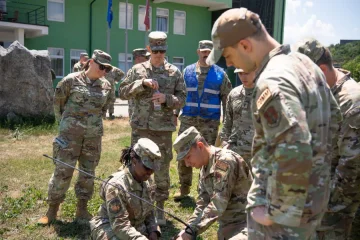
After a NATO air campaign lasting 78 days, Serbian forces surrendered. On June 12th 1999, a massive NATO force began entering Kosovo, joyfully hosted by the population.
The arrival of 50,000 peacekeepers marked a crucial turn for the fates of the people of Kosovo.
But long Serbian rule and war had left Kosovo destroyed. Tensions in some parts of the country, especially in Mitrovica, were still high.
Several hundred thousand people were homeless. Others continued lying in Serbian prisons. Many Albanians were missing.
At first, the country was administered by a United Nations mission, U n NMIC. Just a few months after the war ended, the Albanian population had returned almost all and reconstruction efforts had begun. The United States was the first to help.
Early in 2001, a new administration had arrived in Washington, and on July 24th of that year, President George W. Bush visited Kosovo.
He expressed support for the idea that Kosovars were given more responsibility to take their affairs into their own hands.
The issue of Kosovo's status, though it was the subject of discussion, still seemed distant. “Standards before status” was the formula it came up with U n NMIC in 2002, but these standards were not clearly formulated and met with negative reactions in Kosovo.
The real efforts for final status settlement were undertaken by the Bush administration in 2005.
In the spring of 2005, President Bush and the Secretary of State Condolezza Rice decided that the United States would take the lead role to finish the work done by the previous Clinton administration for the establishment of peace in the Balkans.
Through some personalities of importance, the administration undertook efforts to convince UN Secretary General Kofi Annan and Security Council members to begin the Kosovo status process.
Meanwhile, at the U.S. Congress, with the promotion of former Congressman Joe DioGuardi, efforts had previously begun to present a resolution in support of Kosovo's independence. The resolution was presented in autumn 2004 by lawmakers Tom Lantos and again appeared in January 2005.
At the American Congress, there was always consensus for Kosovo despite disagreements between the two political parties on other issues.
On May 18th, 2005, US Undersecretary of State Nicholas Burns presented to Congress a new American political initiative for Kosovo in co-ordination with the United Nations and the World Power Contact Group. He said 2005 was the year of the decision for Kosovo -- that is, the US aimed at starting a process that would define Kosovo's status.
Although it was still unclear at the time what the final status would be, the US and the Contact Group had declared to rule out a Kosovo return under Serbian control. They also ruled out any changes of borders and any division of Kosovo.
Kosovo leaders had also declared independence to them non-negotiable.
The Serbian government, in turn, insisted that Kosovo should never become independent.
The United States' main partners in efforts to determine Kosovo's status were Britain, France and Germany. The biggest challenge was the obstructional attitudes of the Russian government.
On 26 January 2007, when the UN special envoy, former Finnish President Martti Ahtisaari, submitted the proposal for Kosovo's final status, it became clear that independence was already inevitable.
Ahtisaari's recommendations allowed Kosovo to declare independence from Serbia. But they also required international supervision over Kosovo.
Ahtisaari's independence plan underwent review at the Security Council. But Russia was against it.
On June 10, 2007, President George W. Bush visited Albania, where he received a hero welcome.
And not in vain. The visit lasted only eight hours, but the statement he made in Albania would be remembered and its impact would not be delayed.
In a moment of time, rather early than late, you must say: Patience reached where it no longer holds. Kosovo is independent,” declared the American president. He said any plans to extend further negotiations must end with secure independence.
About nine months after that statement, on February 17th 2008, Kosovo declared independence from Serbia, becoming the newest state in the world.
Tens of thousands of people in Kosovo filled streets to celebrate the day they had desired for decades.
The United States and their main Western allies immediately recognised Kosovo's independence.
The declaration of independence came after a bloody conflict that left 10,000 dead and after a period of oversight by the United Nations that left Kosovo with an indefinite status without direction.
Finally, Kosovo could hope to consolidate the state and institutions with a certainty for the future.
Speaking before parliament, Prime Minister Hashim Thaci said:
“We, the leaders of our people, elected democraticly, through this statement declare Kosovo independent and democratic state”.
That day, people expressed US honour, architect of NATO's bombing campaign against Serbian forces. Pristina and other cities were full of American flags and people were calling: “Thank you USA” and God bless America”
Since February 17th 2008, when it was declared independent, Kosovo has gone through internal and external challenges. The United States has been willing to help.
In November 2009, during a visit to Kosovo, where he inaugurated a statue erected in his honour, former President Bill Clinton urged citizens to build a multiethnic society with the Serb minority and other minorities. The United States will always help Kosovo,” he said.
In the diplomatic field, Kosovo had to face Serbia's objections.
Serbia protested independence and through the Security Council demanded the opinion of the International Court of Justice in The Hague.
On July 22, 2010, the Court declared the validity of the declaration of independence, saying it did not conflict with international law.
During President Obama's administration, US support for Kosovo continued.
Despite Serbia's widespread campaign to convince different countries not to recognise the new state, Kosovo has so far secured about 115 recognitions and has been admitted to dozens of international organisations.
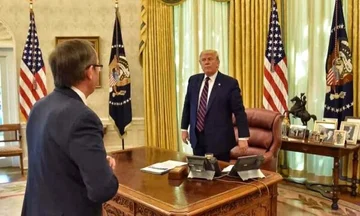
President Trump's administration has expressed strong support for Kosovo.
In the case of the 10th anniversary of independence, President Trump's principal assistant for national security, H.R. McMister, made this support clear:
The UN will stay with you as you strengthen democratic institutions, protect human rights, confront corruption and create a society responsible for rule of law. ”
Today, 10 years after independence, Kosovo has looked to a future aimed at membership in the United Nations, the European Union and NATO.
A closer goal is to normalise relations with Serbia in the dialogue that has been continuing for several years.
The functioning of the Special Court will be another challenge. Kosovo will also have to develop the economy and reduce unemployment, especially among young people.
It has been a decade of effort and achievement amid many difficulties, but Kosovo today has a perspective of development and prosperity on the horizon, and along with that has the support of important allies.