25 minutes ago
The Economist: South Korea with highest life expectancy, Macedonia and Serbia weaker

Periskopi(8 years ago)
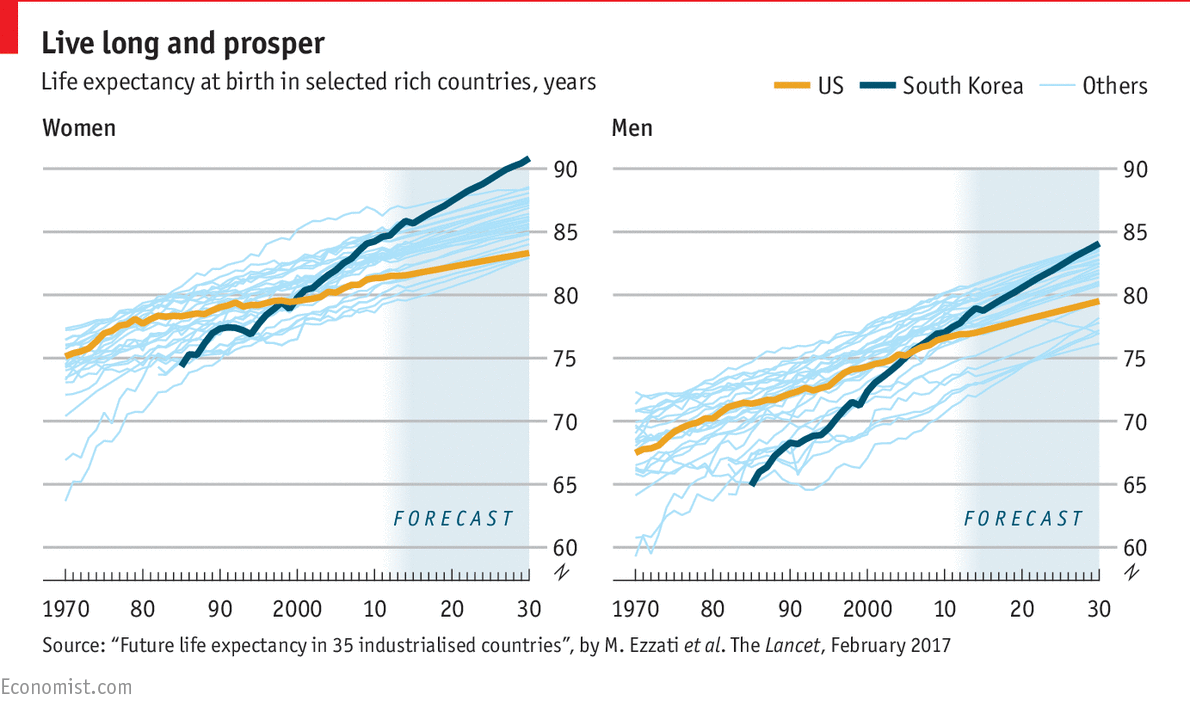
(8 years ago)The newest study suggests that South Korea will have the world's highest life expectancy by 2030. Population forecast is not simple. Demographers use information about when people die and causes them to assess the possible expectations of the lives of people still [...]
Population forecast is not simple. Demographers use information about when people die and causes them to assess the possible expectations of the lives of still alive.
The United Nations, the World Health Organization (WHO) and other organizations use periodic predictions that are quite similar.
Healthy countries such as Japan, Switzerland and Australia have the highest life expectancy according to predictions, although estimates vary slightly from the methodology used, reports The Economist”, Periscope broadcast.
But a new study involving 35 countries from “WHO” has published the results in a medical journal that used a combination of 21 statistical model.
The results, according to authors, are very reliable. They are also surprising. By 2030, South Korea will have the highest life expectancy for men and women, according to the new study.
A girl born in 2030 will likely spend her 90th birthday, seven years longer than a native in 2010. South Korean men are expected to live until 84.
South Korean trainer has been extraordinary. GDP per person is 20 times greater than in 1960.
The main reasons for this increase were the drastic decline in infant deaths, deaths from infections, deaths from high blood - pressure disorders, including heart disease and heart attacks.
Other countries are expected to have improvements for similar reasons. Many women in France and Switzerland are less obese. By 2030 Hungarian males are expected to live 7.5 years longer than in 2010, after reducing smoking.
But authors predict much less progress in other countries. In some less affluent countries, such as Macedonia and Serbia, average life expectancys are low and are projected to improve only to small extent./Periscopi/