34 minutes ago
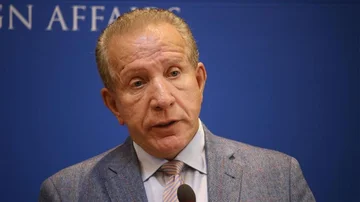
Milan Kukan, the man who sealed Yugoslavia's death: Kosovo is Balkan's main nerve point

Periskopi(9 years ago)
(9 years ago)Former Slovenian president Milan Kukan has said today that the West continues to close its eyes to the fact that the Balkans are still barotia barrels. For the daily “Pobjeda” of Montenegro, he says the insistence on capital often ignores the ethical values that form the basis of the European idea. “I have the impression that Brussels does not recognise the circumstances in the Western Balkans, [...]
Former Slovenian president Milan Kukan has said today that the West continues to close its eyes to the fact that the Balkans are still barotia barrels. For the daily “Pobjeda” of Montenegro, he says the insistence on capital often ignores the ethical values that form the basis of the European idea.
I have the impression that Brussels does not recognise the circumstances in the Western Balkans, so the impression arises that the policy it leads is not always principled. In addition to Bosnia and Herzegovina, Kosovo today is the main nerve point of the Balkans. Of course, the Balkan problem remains Macedonia. The only country that has managed to get out of this pot is Montenegro”, said former Slovenia president and former communist leader of Slovenians who separated his people from the communist line of Slobodan Milosevich, who declared the country's independence from Yugoslavia, broadcast Telegrafi.
Kucan also spoke of antifascism relativism in the spaces of the former Yugoslavia.
According to him, the reason for the denial and relativisation of antifascism can be found in the fact that no single Yugoslav nation during World War II was spared by the Quislinges and by co-operation with German, Italian and Hungarian invaders”.
“in all post-Yugoslav societies, this co-operation quosling tried to reason as anticommunism. If someone in Slovenia today asked why he affirms co-operation with the Nazis, you would get the answer that this was in the function of the fight against communism. But when Slovenia was conquered in 1941 and divided by three invaders, there was no Communism. Slovenians then faced clear choices: either to disappear as a nation or to dealt with the uncertainty of the outcome through the anti-fascist movement to fight for survival and freedom”, Kukan said.
Asked whether, in his 1990 trip to Kocevski Rog (where a major massacre was committed by partisans against the Slovenian Guard and their family, where 12,000 v.j.) suffer has contributed to the relativism of antifascism, he says the cut:
No. My gesture was, not an attempt at political rehabilitation of the victims, but a sign of respect for those who were brutally killed in the early days of the postwar. Cochevski Rog was a crime! Remember, my decision to work together with the archbishop of Ljubljana, Dr. Shushter, to pay my respects to the victims, had a political dimension: I believed Slovenian society was at a crucial moment like the expected breakup of Yugoslavia where we dare not be divided”.